

Important discovery
Scientists at the U.S. National Institute of Standards and Technology (NIST) have just announced a remarkable finding: time on Mars passes by an average of 477 microseconds per day compared to Earth.
This difference, however small, is explained by the effects of Albert Einstein's General Theory of Relativity and has key implications for future interplanetary navigation and communication systems.

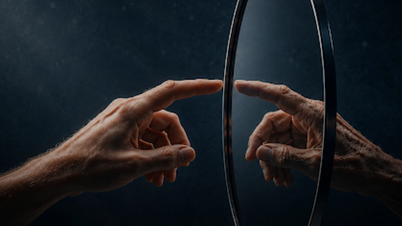
Albert Einstein's theory of general relativity makes calculating interplanetary time complicated (Image: Getty).
According to the research team, the main reason for this difference is that gravity on Mars is about five times weaker than on Earth.
Weaker gravity reduces gravitational time dilation, causing clocks on Mars to run faster. Additionally, Mars' elliptical orbit around the Sun has a greater eccentricity than Earth's.
As Mars approaches the Sun, its velocity increases, altering the rate of time dilation due to velocity. Conversely, as it moves further away, its velocity decreases, and the relative effect also changes. This constant fluctuation means that the rate of time drift on Mars is not constant but varies with its position in orbit.
The problem is further complicated by considering the combined effect of gravitational forces from the Sun, Earth, and Moon on time on Mars.
Analyzing the interactions between these four objects (the Sun, Earth, Moon, and Mars) is a major challenge, far exceeding the classical triune problem.
These factors combine to result in an average difference of 477 microseconds per day, with a range of variation that can reach up to 226 microseconds depending on Mars' position in its orbit.
Consequences for the future of interplanetary relations
For those who live on Mars in the future, a second will still pass as normal because all clocks on the planet are subject to the same gravitational pull and velocity.
However, to an observer on Earth, a second on Mars will pass a fraction of a second faster than a second measured by a clock on Earth. This is clear evidence of the time difference between the two frames of reference, which are affected by different gravitational forces and velocities.
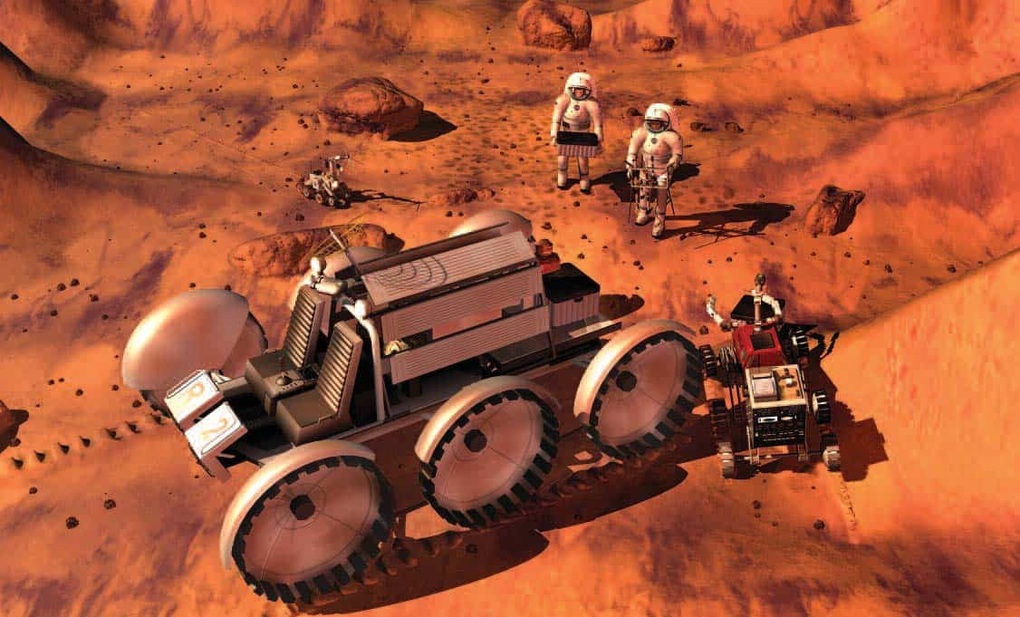
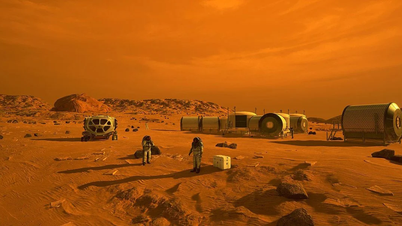
As humanity moves closer to its goal of settling beyond Earth, precise timing will become incredibly important (Image: Space).
This time discrepancy, however small, could cause significant problems for the highly accurate navigation and communication systems that humans plan to develop on Mars.
For example, GPS-like systems on Earth require time synchronization down to fractions of a microsecond. Without accounting for the time difference between the two planets, navigation signals could be misaligned, leading to significant errors in navigation or data transmission.
In addition, time synchronization also needs to consider the time it takes for light signals to travel between the two planets to ensure the system operates stably and accurately.
This research adds a crucial layer of understanding to how General Relativity works in a multi-planetary environment, essential as humanity moves closer to its goals of habitation, infrastructure development, or establishing communication networks beyond Earth.
The research team emphasized that this is an ideal time to study these issues, as lunar and Mars missions are progressing rapidly.
Accurate understanding of time will be a crucial foundation for the prospect of expanding human activity throughout the entire Solar System.
Source: https://dantri.com.vn/khoa-hoc/vi-sao-thoi-gian-tren-sao-hoa-troi-nhanh-hon-trai-dat-20251203094951824.htm

![[Image] Pleasant weather helps students enter the 10th grade entrance exam with confidence.](https://vphoto.vietnam.vn/thumb/1200x675/vietnam/resource/IMAGE/2026/05/29/1780034401612_ngay-1-thi-lop-10-minh-duy-8-5009-jpg.webp)



![[Photo] Ba Lang An Lighthouse - the "eye of the sea" amidst the "rock museum" of Quang Ngai province.](https://vphoto.vietnam.vn/thumb/1200x675/vietnam/resource/IMAGE/2026/05/29/1780038698840_anh-man-hinh-2026-05-29-luc-14-10-42.png)
































































































Comment (0)