

After the country's reunification, starting from the initiative of Doctor Luong Dinh Cua, the Mekong Delta needed a worthy rice research institute. On January 31, 1977, the Mekong Delta Rice Institute was established with the initial name of the Mekong Delta Agricultural Technology Center. In 1985, the Center officially changed its name to the Mekong Delta Rice Institute.
The Institute was assigned a 360-hectare field that had been abandoned for many years, with many bomb craters and ponds. To get to the Institute, from Highway 91, one had to cross a canal by boat and then walk 1.2km on a muddy road. The people who "opened the way" during this period included experts such as Mr. Tran Nhu Nguyen, Professor Nguyen Tho, Professor Dr. Nguyen Van Luat, etc.
Professor Luat's ideology is that research does not wait for time. That spirit has laid the foundation for the development of the Mekong Delta Rice Research Institute through the following stages.
Pioneering research on ultra-early rice varieties
Associate Professor Dr. Bui Ba Bong, former Deputy Minister of Agriculture and Rural Development, who worked at the Mekong Delta Rice Institute, and Professor Dr. Nguyen Van Luat, said: Professor Dr. Nguyen Van Luat took on the role of Director of the Mekong Delta Agricultural Technical Center in 1982, succeeding the first Director, Engineer Tran Nhu Nguyen. He temporarily lived in a thatched house, which served as a place to live, work, and receive domestic and international guests.
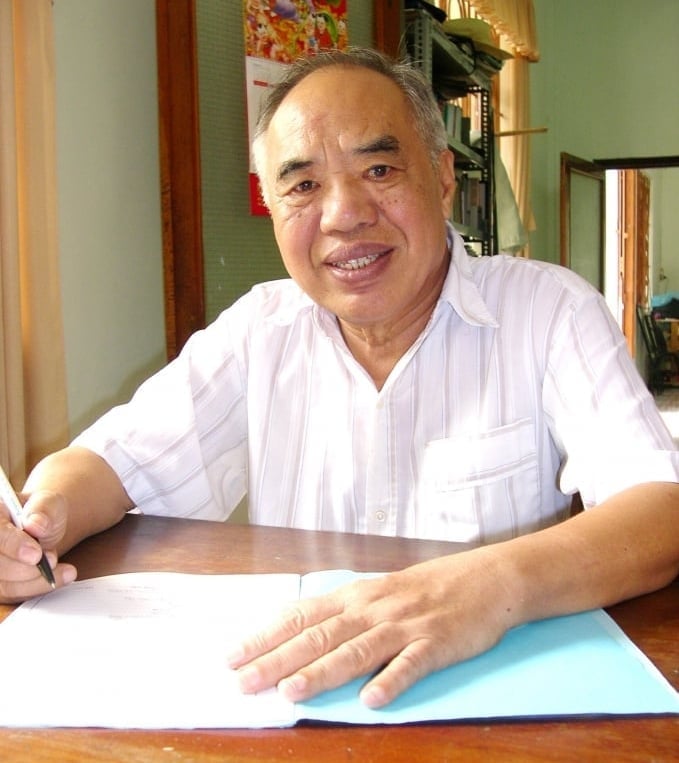
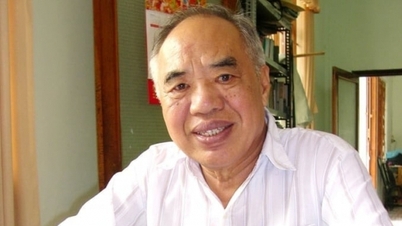
Professor Nguyen Van Luat is the pioneer who proposed the idea of an extremely early rice variety for the Mekong Delta. Photo: Le Hoang Vu.
Professor Luat retired at the end of 2000. Thus, the Professor has continuously assumed the role of Director of the Mekong Delta Rice Institute for 18 years. The Professor was awarded the title of Hero of Labor by the State.
According to Associate Professor Dr. Bui Ba Bong, in his 18 years as Director of the Mekong Delta Rice Institute, Professor Dr. Nguyen Van Luat has laid a solid foundation for the development of the Institute, making it the leading rice research institute in the country and on par with the region. The Institute has made a worthy contribution to rice production in the Mekong Delta - the region that accounts for 50% of the country's rice output and 90% of the country's rice exports. Currently, rice varieties selected by the Institute have been grown on over 50% of the rice area in the Mekong Delta every year and are among the main rice varieties for rice export.
The mark of Prof. Dr. Nguyen Van Luat is shown through maintaining the development plan of the Institute from a barren field to a research institute with high status. The early period was very arduous, both building infrastructure and doing scientific research. Prof. Luat laid the foundation for the development of the Institute's infrastructure, which has kept the overall plan intact to this day, including preserving and using the land area.
Also according to Dr. Bui Ba Bong, Professor Luat was the pioneer who proposed the idea of extremely early rice varieties for the Mekong Delta. Right from the time he first came to the Institute, he had a sensitivity about developing new rice varieties, especially he proposed the goal of selecting and creating extremely early rice varieties that he named OMCS (OM extremely early, OM is O Mon - the name of the place where the Institute was built).
The extremely early rice varieties have a growing period of about 95 - 105 days. This idea at that time was a very far-sighted vision because up to now, the rice varieties selected at the Mekong Delta Rice Institute are mostly extremely early varieties and through the research process of the Institute's scientists, other superior characteristics have been added to the extremely early rice varieties such as high yield and good quality. The superiority in production in the Mekong Delta today is largely due to the rice variety set, in which there is an important contribution from the Mekong Delta Rice Institute from the vision of the Institute's leader 40 years ago.
In addition to rice varieties, Professor Luat is very interested in the ecology of rice areas in the direction of diversifying the production structure on rice land and has directed very early research on the structure of 2 rice crops rotating with 1 color crop in the Mekong Delta; directed research on reducing costs in rice production, including the idea of reducing sowing density. Professor Luat was the first person to apply the row sowing tool more than 30 years ago in the Mekong Delta. And up to now, reducing sowing density is still a goal in the technical process of the 1 million hectare rice project.
Special attention to training
"Professor Nguyen Van Luat pays special attention to training. He always encourages, motivates and creates all conditions for staff and workers to go to school. Many workers and laborers with intermediate qualifications, when entering the Institute, have become engineers, masters, and in some cases, doctors. From a place where the Institute had no staff with masters, during the time the Professor led the Institute, it had over 20 doctors, most of whom were trained abroad. The human resources that the Professor trained are the leading factor leading to the achievements of the Mekong Delta Rice Institute", Associate Professor, Dr. Bui Ba Bong said.
Mr. Pham Van Ro moved to work at the Mekong Delta Rice Research Institute in 1986 with expertise in genetics and rice breeding. At that time in the Mekong Delta, many traditional rice varieties took 4 months, even 7 months to harvest. Shortening the growing period to about 100 days, while still giving high yields, was truly a revolution.
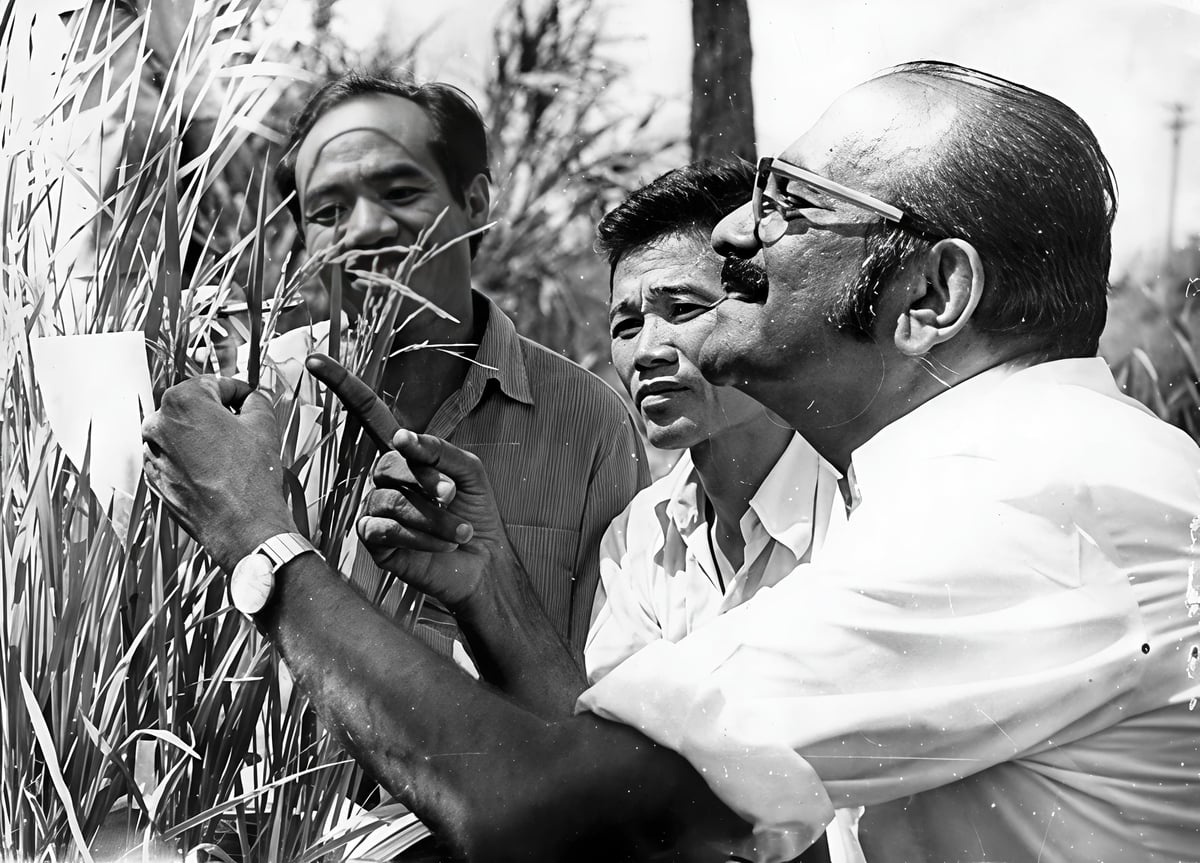
International delegation visits Mekong Delta Rice Research Institute. Photo: Mekong Delta Rice Research Institute.
Prof. Dr. Nguyen Van Luat has built a disciplined system for the staff, helping the apparatus to run stably. After many years of working with Prof. Dr. Nguyen Van Luat, Mr. Ro admires the fair and intelligent working style of the former Director. When working with international expert groups, Prof. Luat always introduces key staff in each field so that they can work directly with partners. It is this trust and respect that gives the Institute's staff the motivation and opportunity to develop and grow.
The Law Professor has built a solid team of staff, both professionally and in foreign languages. The staff are capable of communicating and debating directly with foreign experts in English. Mr. Ro jokingly said: "The Director of the Law Institute is leisurely because he has such a good team." But in fact, he is the one who created the foundation for that team to grow. The next generations of the Institute, many of whom later became leading experts in their fields, were all nurtured in the environment he laid the foundation for.
Having worked under two Institute Directors, Dr. Luong Dinh Cua and Prof. Dr. Nguyen Van Luat, Mr. Ro expressed that the two people come from two different generations and styles, but they have in common vision, impartiality and dedication. After more than 10 years of working with Prof. Luat, what Mr. Ro realized is that "the achievements belong to the Institute, not to anyone else."
"For Professor Nguyen Van Luat, his interest in science is all-encompassing. He hardly pays attention to affairs or events. Apart from science, the Professor hardly reminds the staff and employees in the Institute of anything, including the sense of discipline and organization. He lives simply, gently, close and modestly," Associate Professor Bui Ba Bong shared.
Source: https://nongnghiepmoitruong.vn/gsts-nguyen-van-luat-nguoi-dua-tam-nhin-rat-xa-cho-cay-lua-d786605.html


![[Photo] General Secretary To Lam receives the Director of the Academy of Public Administration and National Economy under the President of the Russian Federation](/_next/image?url=https%3A%2F%2Fvphoto.vietnam.vn%2Fthumb%2F1200x675%2Fvietnam%2Fresource%2FIMAGE%2F2025%2F12%2F08%2F1765200203892_a1-bnd-0933-4198-jpg.webp&w=3840&q=75)











![Varieties Revolution: [Lesson 3] Tissue-cultured bananas aim for billion-dollar trees](https://vphoto.vietnam.vn/thumb/402x226/vietnam/resource/IMAGE/2025/12/07/1765099407833_488761353918024933-114743_324-162058.jpeg)














































Comment (0)