


Construction of the new Quan Bridge.
Therefore, the most impressive image, evoking much pride and fond memories for the people of Tay Ninh, is undoubtedly the bridge built in 1924, made of reinforced concrete – a material that was still rare, even in France at that time. To this day, even though many other beautiful and modern bridges have been built, Quan Bridge still holds the top spot in the hearts of the people of Tay Ninh.
Because of this fond memory, even in 1999, when the Quan Bridge had existed for 75 years and its lifespan had expired, the people of Tay Ninh still couldn't bring themselves to demolish it ( despite a document from the AKROF agency notifying them that the bridge was no longer in use ).
There was no more room for delay! By 2012, a survey revealed that the bridge's foundations were exposed, revealing layers of dark gray gravel and pebbles. On the bridge girders, many sections of concrete had peeled off, exposing rusted steel reinforcement. Large vehicles driving over the bridge caused it to vibrate. Several options were considered. Ultimately, the chosen solution was to demolish the entire old bridge and build a new one. By then, the bridge was only 12 years away from its centenary.
For generations, the people of Tay Ninh have regarded the image of the old bridge as a symbol of the city. Therefore, the design of the new bridge—even if modern—must preserve the image of the Quan Bridge in their memories. This includes the image of three spans, with six crescent-shaped arches, curving like the Trang Tien Bridge in Hue . And of course, the bridge will be in its familiar white color, as it has reflected the Tay Ninh canal for so many years.
I still remember February 17, 2012, just three days after Valentine's Day, when the crane's first hammer blows struck the concrete surface of the bridge. For most of the onlookers, it was a joyous celebration of an important project to replace the old structure with a new one. But for a smaller number, the roar of the machinery and the harsh sound of the chisel stirred a sense of nostalgia. Those who felt the most regret were probably the residents of the old neighborhood in Ward 2, on both the left and right sides of the canal. Among them was undoubtedly Mr. Lu Thap Linh, an engineer from the Public Works Department of the old regime.
He once recounted with pride that the Quan Bridge was the first structure in Tay Ninh to use cement as a reinforced concrete material. The cement and steel had to be imported from France. After 1954, Mr. Lu Thap Linh himself was tasked with regularly inspecting and repairing the bridge as needed. It wasn't until 2012, 88 years later, during its demolition, that it was discovered the concrete used back then – made from sand, gravel, and cement – was fundamentally the same as modern concrete.
The only difference is that it's not made of 1x2 stone, but gravel. When the fragments are broken up, all that's found is a type of fresh, white or yellow gravel. And how is it that when bonded with cement, it remains so strong and solid? After many drilling operations using a modern excavator, the bridge surface remains completely intact.

New Quan Bridge, 2013
Let me also mention some basic specifications of the old bridge. It was smaller than the current bridge. The bridge deck was only 5 meters wide, with pedestrian walkways on either side, each only 1 meter wide. The most important structural element was the two bridge trusses, which were curved and had vertical and diagonal supports inside.
The two trusses, each with three spans, formed the load-bearing structure of the entire bridge. This is completely different from the new Quan Bridge structure. The new structure consists of prestressed box girders, each with a face plate 1.3m wide and 21m long. The box girders will be fitted closely together on girders and cantilevered beams extending from the bridge foundation piers.
Then, the truss beams were cast and attached to the bridge, recreating its original shape. The bridge deck is now 8 meters wide, and the two pedestrian walkways are also more than 2 meters wide. The entire bridge deck, made up of 33 box girders, is now 14.3 meters wide, while the original length of the bridge deck is 63 meters.
I remember it again! Perhaps empathizing with the longing and nostalgia of the people of Tay Ninh town, especially the residents of the old Gia Long town, the groups of workers who contributed to building the bridge all started working quickly, efficiently, and enthusiastically. Like the bridge demolition team led by Mr. Chin Nhanh, who now owns a workshop specializing in wooden houses at the Thai Hoa bridgehead.
He remembered it because he was surprised that the bridge, which he thought was dilapidated and on the verge of collapse, was still so sturdy. When requested, he sent workers to find a piece of concrete from the bridge's girder with the year engraved on it: 1924. He also remembered the company in Binh Duong that had cast all the girders and girders there and installed them in Tay Ninh.
Whether it was a bamboo bridge or an iron bridge, few people in Tay Ninh remember them anymore. Photographs of them are now rare documents found only in old books or museums. The bamboo bridge from the time of Truong Quyen's resistance against the French may not even have any photos left. Only photos of the iron bridge remain, probably built by the French to serve their rule after conquering the three eastern provinces.
On November 11, 2012, the last box girder was installed. However, it wasn't until the Lunar New Year of 2013 that residents could freely ride their motorbikes across the bridge again. Thus, in just one year , the new bridge reflected its image on the Tay Ninh canal . And , all business and trade on the old Gia Long street were restored, becoming even busier than before.
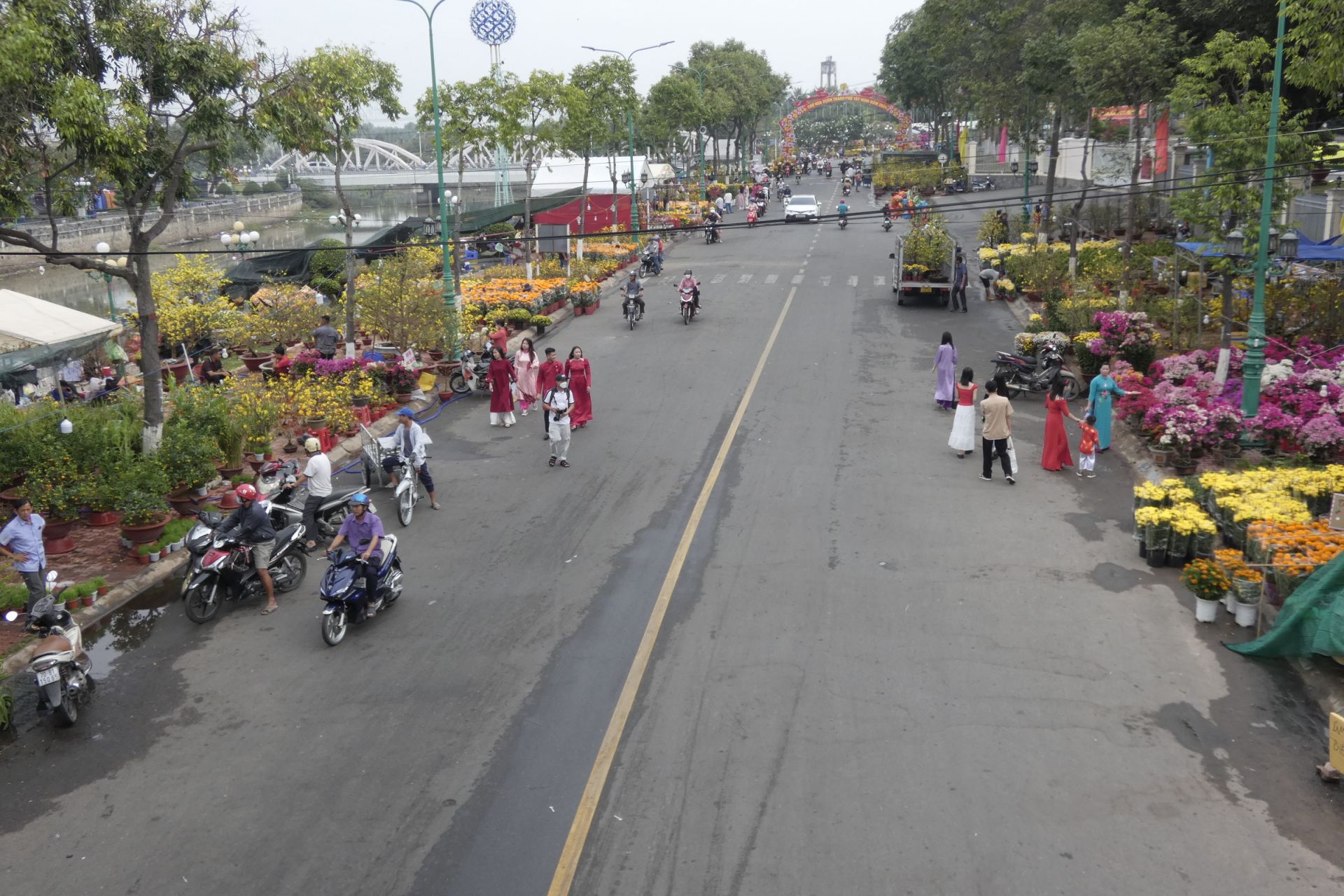
Quan Bridge and the spring flower market
2024 marks the 100th anniversary of the image of Quan Bridge being etched into the memory of the people and land of Tay Ninh. Besides the story of Truong Quyen and Po-Kum-Po's alliance against the French, achieving the first victory in Tay Ninh history on June 7, 1866, those memories also include: On August 25, 1945, the first mass march of Tay Ninh people to reclaim power for the people. The marching procession crossed Quan Bridge, demonstrating against the administrative headquarters and the Sang-da citadel occupied by the Japanese army. Then, at the end of 1946, when the French army was repelled and suffered a heavy defeat at Bau Cop and Bau Nang, they beheaded some people from Bau Cop and displayed their heads at Quan Bridge. Just when it seemed the revolutionary movement in the city had been suppressed, on May 19, 1947, a flag and portrait of President Ho Chi Minh appeared brightly on the roof of the market, only a few dozen meters from the bridge. These flags and portraits were hung and pasted on the market's facade by Mr. Vo Tri Dung (a veteran revolutionary, former Director of the Department of Culture and Information), who was not yet 20 years old at the time, along with his comrades on the night of the 18th. Then, on April 30, 1975, the Liberation Army returned from their bases in the forests to take over Tay Ninh. Flags and flowers. Tears and smiles. All remain in photographs and sketches. And every time they are seen, people's hearts are stirred with memories of Quan Bridge.
It's also impossible to forget the spring flower markets every Tet holiday. For a whole week at the end of the twelfth lunar month, countless young men and women come to stroll around. The market gate is right next to the bridge, so many people choose this place to take commemorative photos. For photographers, the bridge is also the number one choice to capture the unique features of Tay Ninh, whether with a handheld camera or, later, a drone flying high above.
I remember seeing so many photos, but the most memorable are those of the old bridge, when rows of coconut trees cast their shadows on the water. The old bridge looked very slender, not as grand and sturdy as the new bridge today. And so did the coconut trees. Slender, reaching upwards or leaning towards the water. Perhaps that's why they complemented each other so well, so vibrant that they seemed to be... conversing with each other.
Sadly, not a single coconut tree remains today.
On both sides of the bridge.
Tran Vu
Source: https://baotayninh.vn/tram-nam-mot-chiec-cau-quan-a181455.html







































































Comment (0)