

Practical, real-world vocational training.
Vocational training is not only a secondary option after university but has also become a highly practical career path. For many students, school is not just a place to learn knowledge but also an environment to shape professional skills and work ethics, especially for those who wish to enter the labor market early.
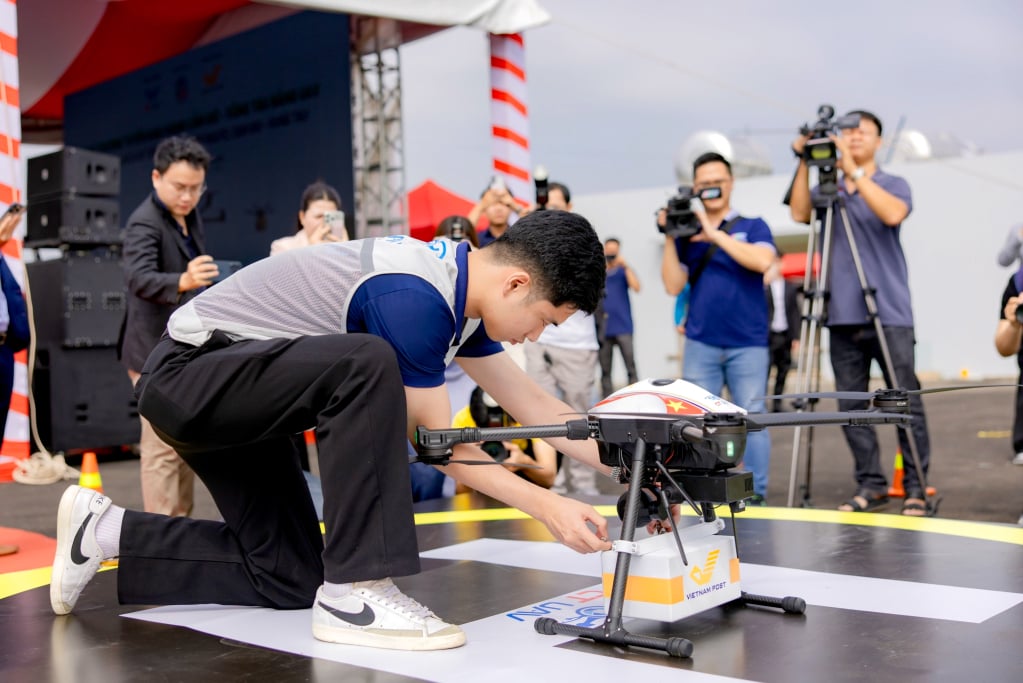
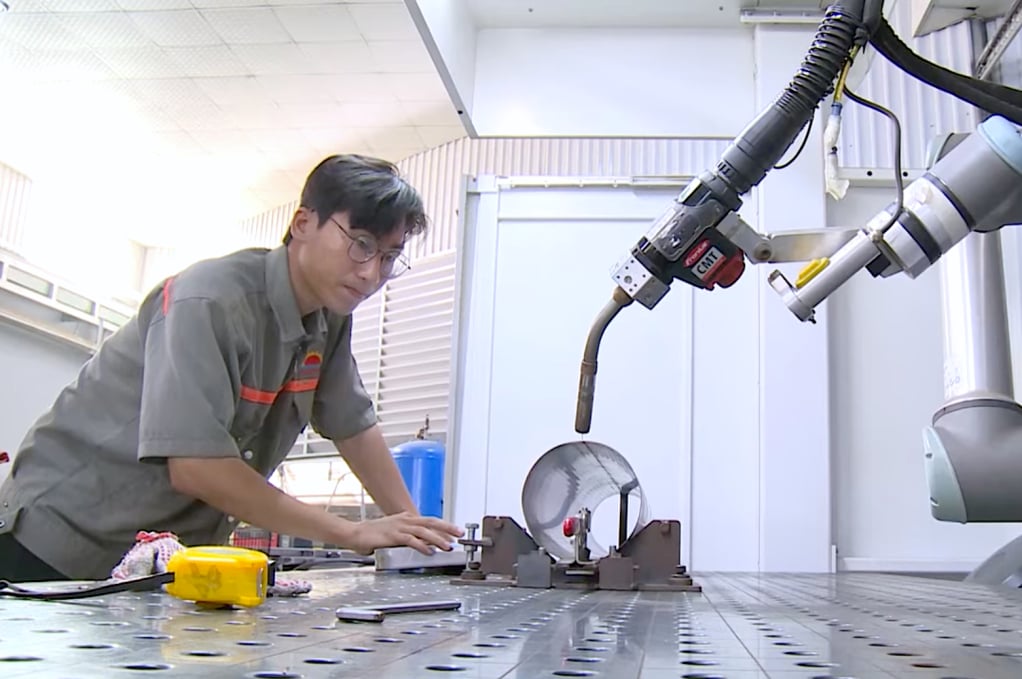
Currently undergoing an apprenticeship at Farmila One-Member Limited Company (Tan An Ward), Phan Van Dai Loi shared: “I am learning mechanical installation and painting. I decided to learn a trade because I wanted a stable income and chose to work here because the company arranged for me to learn and work at the same time to improve my skills.” Bui Le Hoai An, a robot welding machine operator at Farmila One-Member Limited Company, expressed: “At vocational school, I receive both training and more practical experience. I chose to learn a trade because I think going to vocational school is also good, and going to university isn't necessarily the best option.” Hoai An added: “I learned that Farmila Company is the first company to use robot welding technology in production. Instead of manual welding, I control the robot to weld mechanical parts. The products I make are more uniform, have stable quality, and the welds are much better than manual welding.”
In fact, from the students' perspective, "learning by doing" is a key factor. According to Le Thi Thu Thao, Vice Principal of Tay Ninh Vocational College, with the "dual training" model, students not only learn theory but also gain practical production experience in mechanical workshops, production lines, and processing plants at companies and businesses in industrial zones and clusters. Many graduates who have completed internships at businesses have been recruited and quickly adapted to their jobs. Vocational fields such as mechanics, welding, turning, industrial electricity, electronics, etc., always have insufficient training supply to meet the recruitment needs of industrial zones. After graduation, the employment rate for students in their field of study is 85-90%, and they are highly valued by businesses for their skills and professional work ethic.
The job market is expanding.
Currently, vocational training in the province is undergoing significant transformation, focusing on realizing the goal of becoming a regional industrial hub. Following the merger, Tay Ninh's network of vocational education institutions has been restructured to be more flexible and synchronized. The province has focused on developing its vocational education system with 28 vocational and continuing education institutions currently in operation. These include institutions such as Tay Ninh College, Long An College, and Tay Ninh Economic and Technical College. These institutions have clearly demonstrated this spirit of connection, with businesses increasingly involved in the training, career guidance, and recruitment of graduates.

The collaboration between schools, businesses, and management agencies will play a crucial role in solving the human resource problem. According to Tran Van Tieng, Director of the Tay Ninh Employment Service Center, with increased investment and the attraction of many large projects in the province, the labor market is expected to continue to grow, attracting workers in technical professions such as industry, construction, and trade and services. Every year, during the last six months, the trade and service sector attracts a large workforce to meet the recruitment needs of businesses at the end of the year. Currently, Tay Ninh has a workforce of over 1.7 million people, accounting for more than 51% of the working-age population. Of these, approximately 76% have received training; 31% have degrees or certificates. Mr. Tran Van Tieng added that the demand for labor recruitment by businesses continues to increase, focusing on the food processing, textile, and footwear industries. Industry sectors within the processing and manufacturing field include: electrical and electronics, mechanical engineering, machine operation, etc.
However, there is a shortage of approximately 4% of recruitment needs, including mid-level and high-level technical workers; and workers skilled in using modern machinery in production lines. In addition, IT personnel, software programmers, and technical staff with foreign language skills are being actively sought after by FDI enterprises. Not only are schools proactive, but businesses are also showing strong interest in skilled human resources. Many collaborative activities between schools and businesses are being implemented, from career counseling and trial classes to direct recruitment interviews. While academic qualifications remain important from a broader labor market perspective, soft skills and adaptability are increasingly becoming significant advantages. Meanwhile, with the strong shift towards skilled labor, businesses will prioritize recruiting workers with expertise and the ability to work in a technological, automated, and internationally integrated environment.
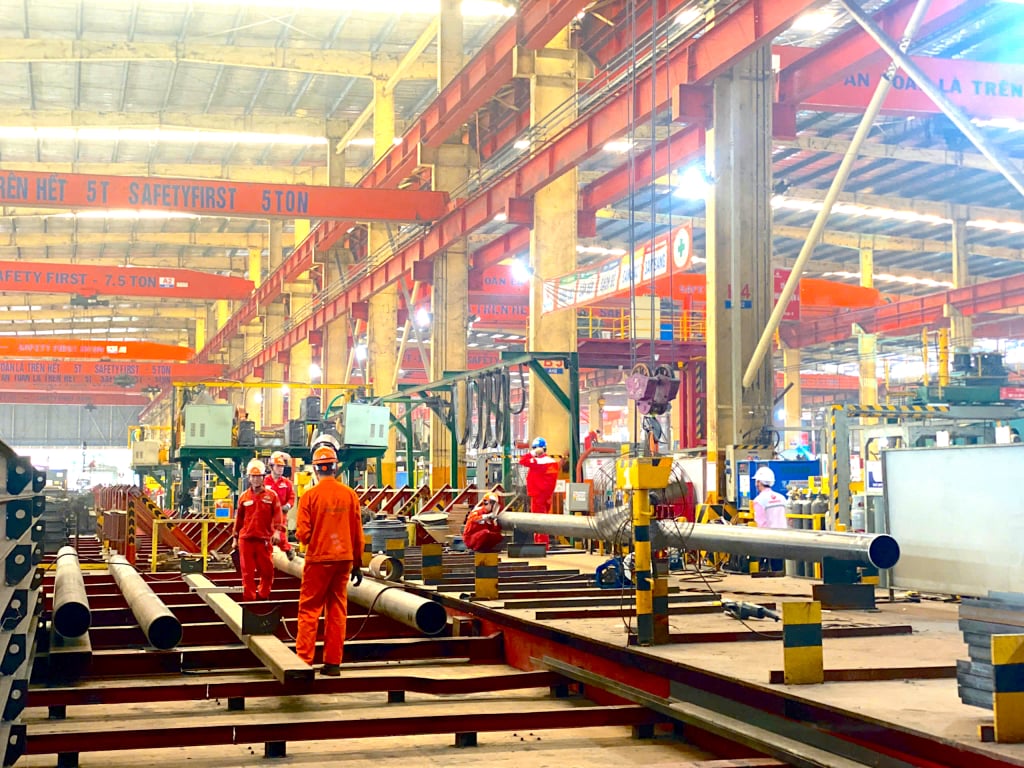
Mr. Nguyen Hop Tu, Human Resources Director of Dai Dung CNC Mechanical Joint Stock Company (Dai Dung Group), shared: “One of the important goals of the collaboration between schools and businesses is to create job opportunities for students after graduation.” Every year, the company organizes and exchanges teaching methods, and both sides cooperate in adjusting lesson plans to integrate practical applications into the curriculum. Practical experience exchange for students during internships and classroom learning helps them gain more experience in interacting with businesses and gradually develop practical thinking and working methods. The company also proposed a curriculum with 80% practical training and 20% theory. He further shared: “Our Dai Dung Group also carefully selects technical training schools with extensive teaching and training experience, as well as numerous orders from the schools to provide short-term and long-term training courses; we coordinate with the schools to send students for internships of 2-4 months to familiarize them with modern machinery and equipment, and guide them in using software applications in production such as AI, TECK LA, SPM, Pvabo, automation robots, etc., in order to select highly skilled technicians to meet international standards for our projects.”
In reality, the trend of upgrading skills is becoming increasingly clear. The workforce is still in a transitional phase, and businesses are not waiting for graduates to start approaching them, but are accompanying them right from the career orientation process. This is an important foundation that helps the local workforce gradually meet the increasingly high demands of the market.
Source: https://baotayninh.vn/dao-tao-kep-gan-ket-cung-cau-lao-dong-147252.html





![[Photo] The General Secretary, President and his wife lay flowers at the Ho Chi Minh Monument in Manila.](https://vphoto.vietnam.vn/thumb/1200x675/vietnam/resource/IMAGE/2026/05/31/1780219759477_anh-man-hinh-2026-05-31-luc-16-29-07.png)



















![[Video] Sunset at Lap An Lagoon – Where the sun sets over the fishing nets](https://vphoto.vietnam.vn/thumb/340x192/vietnam/resource/IMAGE/2026/05/31/1780192137701_beach-landscape-sea-water-nature-grass-745871-pxhere-com.jpeg)






































































Comment (0)