

The business sector is thin and weak.
The Mekong Delta currently contributes over 50% of the country's rice production, 65% of its aquaculture production, 70% of its fruit production, and over 90% of its rice exports. The region also generates approximately 58% of the national foreign exchange surplus and plays a particularly important role in Vietnam's food security and agricultural exports.
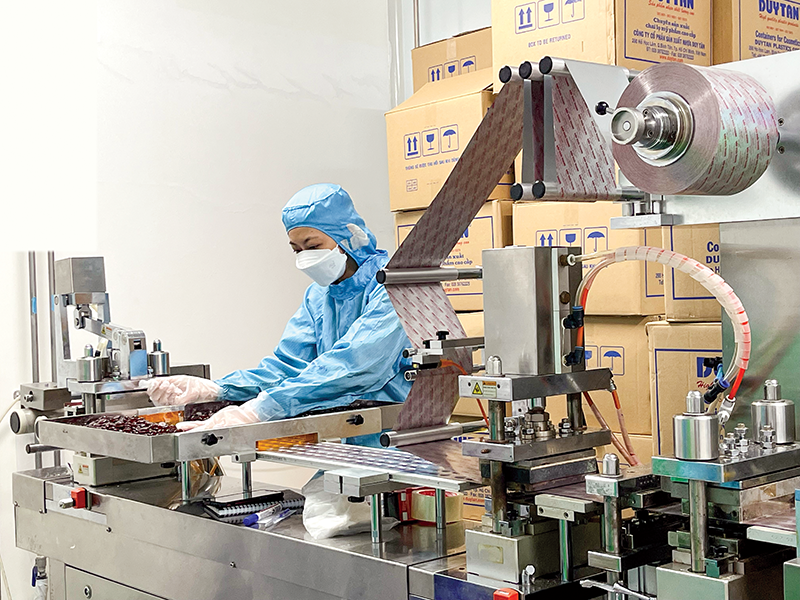
Production activities at ADC Pharmaceutical Factory (belonging to ADC Company Limited).
However, experts point out the paradox of the region: despite its significant economic role, the capacity of its businesses is quite limited. According to the Mekong Delta Annual Economic Report, by 2023, the Mekong Delta had the lowest density of businesses in the country. While in 2000, the region's businesses accounted for approximately 25% of the total number of businesses nationwide, this figure has now decreased to only about 7%.
According to Mr. Le Tan Can, Deputy Minister of Finance , by May 2026, the entire region will only have nearly 70,000 operating businesses. The majority are micro-enterprises, while medium-sized enterprises and those participating in value chains are very few. This is considered a core bottleneck in the development process.
Mr. Vu Thanh Tu Anh, Head of the research team for the 2025 Annual Economic Report of the Mekong Delta, pointed out that the Mekong Delta is bearing a huge responsibility with relatively limited input resources. Meanwhile, businesses in the region are participating in a global market with an increasingly fragmented level, and geopolitical and geoeconomic competition is becoming more complex. New instabilities and risks increase business costs and create greater pressure on businesses. In particular, green transformation is no longer an option but has become a mandatory requirement. Standards such as CBAM and ESG are gradually becoming "passports" for businesses to access large markets. This shows that the old growth model based on resource exploitation, cheap labor, and low processing content has reached its limit. If they do not transform in time, businesses in the Mekong Delta risk becoming "victims" of major fluctuations in the global economy.
Associate Professor Ho Sy Hung, Chairman of the Vietnam Chamber of Commerce and Industry (VCCI), stated that the worrying issue is not only the sharp decline in the number of businesses but also the "shortage of medium-sized enterprises." Up to 87.8% of businesses in the region are micro-enterprises, while the number of medium-sized enterprises – the "locomotives" leading the value chain – is very small. This makes it difficult for many businesses to grow, participate deeply in the international market, and create a ripple effect on the local economy.
The 2025 Annual Economic Report for the Mekong Delta region points out a series of bottlenecks hindering the development of businesses in the region, such as weak logistics infrastructure, high transportation costs, a shortage of skilled labor, difficulty accessing capital for production transformation, low FDI attraction, and limited value chain linkages. Currently, logistics costs account for 20-25% of product costs; approximately 70% of the region's export goods still have to be transshipped through Ho Chi Minh City and the Southeast region.
In 2025, the Mekong Delta will attract less than $1 billion in FDI, equivalent to about 2.45% of the total FDI of the whole country. The region currently has only 374 operating FDI enterprises, the lowest density of FDI enterprises nationwide. Meanwhile, a survey by the Vietnam Chamber of Commerce and Industry (VCCI) shows that the biggest difficulty for businesses today is no longer capital but the market. Up to 60.2% of businesses believe that finding customers is the biggest challenge, reflecting declining purchasing power and consumer demand.
The central role of the new growth model
According to Mr. Ho Sy Hung, the breakthrough for the Mekong Delta by 2030 will not lie in producing more rice, more fish, or more fruit, but in its ability to form an integrated business ecosystem encompassing agriculture, processing, logistics, finance, and technology, capable of competing in a green and digitized economic environment.
To achieve this goal, the Ministry of Finance proposes continuing strong reforms of institutions and the business environment in accordance with the spirit of Resolution 68-NQ/TW of the Politburo on the development of the private economy; shifting from a "request and grant" mindset to a "creative and service" mindset, placing businesses at the center of the reform process. At the same time, it is necessary to ensure equal access to resources such as capital, land, data, technology, and high-quality human resources.
Ms. Dang Mai Kim Ngan, Deputy General Director of Tax and Legal Affairs at Deloitte Consulting, believes that to attract investment more effectively, localities need to transparently plan, build a regularly updated "investment map," and position the Mekong Delta as the national center for agricultural processing and logistics. In addition, they need to develop high-quality human resources, promote digital transformation, support businesses in innovation, and build leading enterprises in the supply chain. In particular, it is necessary to create conditions for the formation of more medium-sized enterprises – a force capable of leading the supply chain, connecting farmers and cooperatives with the market, and enabling local products to participate more deeply in the global value chain.
Positive signs emerged in the first months of 2026, with the number of newly established businesses in the Mekong Delta increasing by over 78%, registered capital increasing by over 23%, and the number of businesses resuming operations increasing by nearly 12%. This is seen as a basis for expecting a new phase of development, in which businesses will truly become the central driving force for the region's economic growth.
Experts believe that for the Mekong Delta to achieve breakthrough development in the coming period, it needs a sufficiently strong business ecosystem to organize production, processing, logistics, trade, and innovation. When businesses are at the center of the new growth model, the region's agricultural and resource advantages can be transformed into added value and sustainable growth.
Text and photos: NAM HUONG
Source: https://baocantho.com.vn/dinh-vi-lai-dong-luc-phat-trien-kinh-te-vung-dbscl-a205961.html


![[Image] A brilliant symphony and explosive power in the skies of Da Nang.](https://vphoto.vietnam.vn/thumb/1200x675/vietnam/resource/IMAGE/2026/05/31/1780196945787_anh-man-hinh-2026-05-31-luc-10-08-51.png)














![[Video] Sunset at Lap An Lagoon – Where the sun sets over the fishing nets](https://vphoto.vietnam.vn/thumb/340x192/vietnam/resource/IMAGE/2026/05/31/1780192137701_beach-landscape-sea-water-nature-grass-745871-pxhere-com.jpeg)






























































Comment (0)