


Traffic is at a standstill.
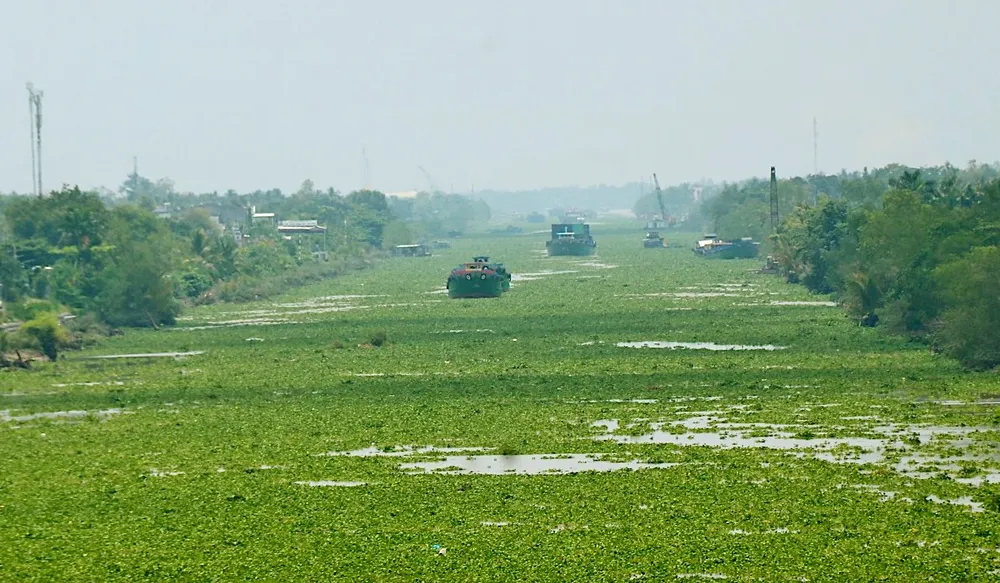
Since the end of March 2026, many sections of the Vam Co Dong River in Tay Ninh province have been covered with water hyacinths, causing frequent congestion on this national inland waterway, especially in the sections passing through Ben Cau, Thanh Duc, and Long Thuan communes. "Sometimes, while traveling, I have to unload the goods and transport them by road because the water hyacinths are so dense that the boat can't continue," said Danh Thanh, Chairman of the Board of Directors of Thap Muoi Agricultural Products Cooperative (Dong Thap province), who regularly transports agricultural products from the Dong Thap Muoi region to Ho Chi Minh City for consumption by waterway.
According to Mr. Thanh, water hyacinths on the Vam Co Dong River are increasing, especially since the Lunar New Year of 2026, significantly impacting the waterway trade of hundreds of businesses, cooperatives, and farmers. “My cooperative has five 45-ton boats, but in the past three months, we’ve only been able to make two trips; the rest of the time we’ve had to stay ashore due to… water hyacinths. To transport agricultural products to Ho Chi Minh City and the Eastern region, I have to rent trucks, which almost doubles the cost,” Mr. Thanh said.
In Dong Thap province, during the recent winter-spring rice crop, dozens of households in Phuong Thinh commune had to sell their rice at 200-300 VND/kg lower than in other areas of the province because traders deducted the cost of fuel and hiring mechanics to repair the propellers of boats navigating canals densely covered with water hyacinths to reach their fields. This situation is also common in many areas of An Giang province and Can Tho city. In Vinh Long province, a representative from the Department of Agriculture and Environment stated that in just five communes and wards – Ngu Lac, Hung Khanh Trung, Cho Lach, Phong Thanh, and Long Duc – more than 70 canals and waterways are currently covered with water hyacinths, with a total water surface area reaching hundreds of hectares.
For months, hundreds of residents living along the canal leading to the Vam Rang sluice gate (Hon Dat commune, An Giang province) have had to endure polluted air. The reason is that this section of the canal is at the end of its course before flowing into the sea. Since the middle of the 2026 dry season, the irrigation authorities have closed the sluice gate to prevent saltwater intrusion, causing water hyacinths from inland canals and ditches to accumulate here and gradually die. “The dead water hyacinths cover the river surface, emitting a strong, foul odor, attracting many mosquitoes, and easily leading to disease outbreaks,” worried Ms. Ha Thi Ngoan (whose house is near the Vam Rang sluice gate). Leaders of the agricultural sector in several Mekong Delta provinces stated that the widespread appearance of water hyacinths in rivers and canals also causes serious harm to biodiversity, freshwater ecosystems, and native species.
To fundamentally address the "water hyacinth problem," many environmental experts suggest that localities in the Mekong Delta region should consider solutions based on a circular economy, treating water hyacinth as a form of "biomass resource" instead of eradicating it completely. Water hyacinth could be collected on a large scale and transformed into organic fertilizer, a substrate for mulching plants, or a raw material in the production of handicrafts, etc.
The solution is still a distant prospect.
According to environmental experts, water hyacinths are multiplying rapidly in the Mekong Delta, with some areas seeing two plants multiply into over 1,000 in just three months. There are many reasons for this proliferation, the main one being the increasingly slow flow rate of the Mekong River system (water hyacinths reproduce quickly in still water) due to reduced water flow from upstream. In addition, rivers, canals, and streams in the Mekong Delta are becoming increasingly polluted due to industrial, agricultural, and domestic activities, creating favorable conditions for water hyacinths (an aquatic plant that absorbs impurities and heavy metals) to thrive.
Ms. Pham Thi Minh Hieu, Head of the Department of Crop Production and Plant Protection of Can Tho City, said that due to the socio-economic consequences caused by water hyacinth, the locality has regularly organized campaigns to collect and remove water hyacinth; and developed the craft of weaving from water hyacinth… However, these solutions have not been highly effective because water hyacinth reproduces too quickly. In some sections of canals, water hyacinth is collected and then covered again the following month.
In Vinh Long, many communes and wards are facing difficulties in dealing with water hyacinths because the province has not yet issued regulations and unit prices for their removal. "Without specific unit prices, communes have no basis for calculating the cost of renting large-scale mechanical equipment to collect and process water hyacinths," said a representative from the People's Committee of Ngu Lac ward.
According to the Department of Construction of Tay Ninh province, since the end of 2022, the task of removing water hyacinths from the Vam Co Dong River has been assigned to Thanh Thanh Cong Agricultural Development Joint Stock Company (now AgriS Agricultural Development Joint Stock Company). The contract between AgriS Agricultural Development Joint Stock Company and Tay Ninh province will end at the end of November 2025. Currently, Tay Ninh province is actively inviting other units to participate in signing contracts for water hyacinth removal. In addition, the Department of Construction is also coordinating with specialized units to conduct a scientific and technological research project on water hyacinth removal to advise the Provincial People's Committee on selecting a reasonable and effective long-term solution.
Source: https://www.sggp.org.vn/mien-tay-dau-dau-vi-luc-binh-post855102.html



![[Image] Nearly 125,000 Hanoi students completed the Literature exam for the 10th grade entrance exam.](https://vphoto.vietnam.vn/thumb/1200x675/vietnam/resource/IMAGE/2026/05/30/1780117233041_ndo_br_thiet-ke-chua-co-ten-2-png.webp)


![Water security in the Mekong Delta: [Part 2] 'The vicious cycle of degradation' is difficult to reverse.](https://vphoto.vietnam.vn/thumb/402x226/vietnam/resource/IMAGE/2026/05/29/1780020596526_4209-han-dbscl1-094000_891.jpeg)

![Water security in the Mekong Delta: [Part 1] When the 'rice bowl' gradually loses its ability to retain people.](https://vphoto.vietnam.vn/thumb/402x226/vietnam/resource/IMAGE/2026/05/28/1779937163427_1415-image00220230718165933-17068901867521153615427-111010_61.jpeg)








































































Comment (0)