

Many localities are at the forefront of using AI.
According to experts, as the Fourth Industrial Revolution accelerates, localities are grasping the global development trend and formulating policies and mechanisms for researching and applying AI to production and daily life.
The application of AI and data analytics in various fields, including public administration and online public services, helps reduce the workforce and shorten processing times, waiting times, and costs for citizens. Simultaneously, it promotes a creative society, enhances the efficiency of the state administrative management system in the distribution and utilization of social resources, social management, and urban management, contributing to the sustainable economic growth of the province.
Recognizing this trend, many localities are implementing AI applications in their local public administration.
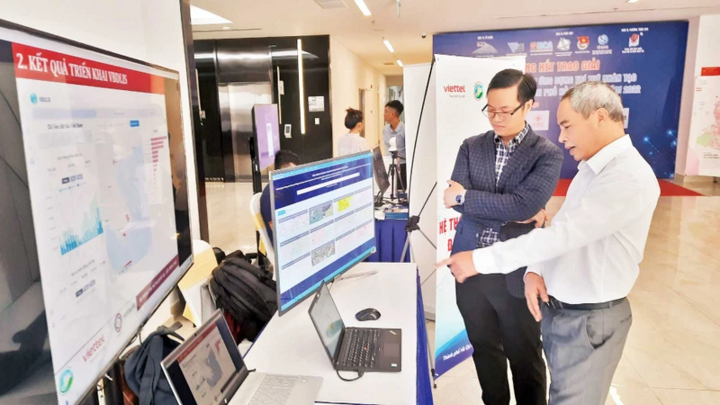
Many provinces and cities are applying AI to public administration management.
According to the 2022 Vietnam Information and Communication Technology (ICT) Readiness Index report, Da Nang city continues to lead with 0.9094/1 point; followed by the provinces and cities of Can Tho, Quang Ninh, Thua Thien Hue and Bac Giang .
This marks the 13th consecutive year that Da Nang has topped the national ICT Index. Prior to this, Da Nang held the top spot for 12 consecutive years (2009-2020). The 2021 ICT Index was not surveyed or ranked.
Da Nang is one of the first localities in Vietnam to apply artificial intelligence (AI) to public administration, and Da Nang has quickly reaped the rewards.
Since the end of 2018, the application of chatbots in providing public services in this city has been piloted. The project was launched with the goal of answering requests from citizens and businesses regarding information on public services in Da Nang; thereby reducing direct human support, minimizing costs, and improving operational efficiency, while also making information more transparent and accessible to organizations and citizens.
This decisive and systematic approach has helped Da Nang consistently lead the Ministry of Information and Communications' ranking in terms of information technology application in state agencies.
Similar to Da Nang, the smart city model was also implemented quite early in Quang Ninh.
The project began in 2016. By the second half of 2019, the locality officially put the Smart City Operations Center into operation.
The center allows the use of information and analytical technology to enable operators to make timely decisions, helping to manage a diverse range of issues, including both anticipated and unexpected problems and emergencies. It also increases interaction as citizens can submit feedback and inform provincial agencies about incidents and issues related to urban infrastructure, traffic, security, and the environment with just a few simple taps on their mobile devices.
The center's advantage also lies in its ability to monitor all issues through a system of cameras and sensors, and the application of artificial intelligence (AI)...
When incidents or alerts occur, management agencies can easily monitor each connected camera on a digital map. The information will be collected and analyzed for management activities from a single operational point. Therefore, it is possible to predict potential problems and respond to situations.
In Ho Chi Minh City, a notable application of information technology in providing online public services is the "Electronic Customer Identification" service, which facilitates paperless administrative procedures. This service is built on AI technology, utilizing "facial recognition and search" technology and anti-fraud technology.
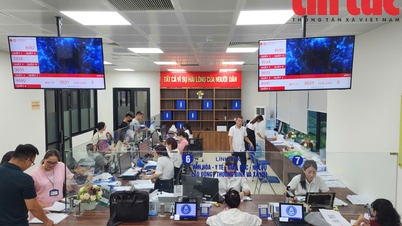
With this service, when going to the District 1 People's Committee to complete procedures, people do not need to rewrite their personal information; they only need to take photos of their identification documents and send them to the system. The system will then automatically scan the data and fill in the form. To date, District 1 has organized the registration and processing of "paperless" administrative procedures in fields such as economics, labor, justice, education, and internal affairs.
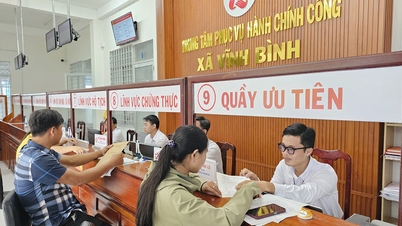
Applying AI to public administration helps Ho Chi Minh City shorten the processing time of government agencies and reduce waiting times for individuals and businesses. Providing online public services has created the most favorable conditions for citizens, reducing the time spent submitting and receiving documents; increasing transparency and avoiding inconvenience and harassment in handling administrative procedures.
What needs to be done to make AI applications more effective?
According to many experts, the difficulties in applying AI and data analysis at the local level include: issues related to the development of information technology human resources; the progress of investment and implementation of digital transformation and information technology application projects; the low rate of online public services at levels 3 and 4; and the need to improve the rate of online applications and the overall rate of online applications.

For AI applications to be more effective, the awareness of the public and businesses needs to be more proactive.
Furthermore, ensuring cybersecurity remains a significant challenge, and raising awareness about digital transformation among citizens and businesses requires a more proactive approach.
Dr. Le Kim Hung (University of Information Technology - Vietnam National University Ho Chi Minh City) stated that, in order to effectively and successfully implement digital transformation, apply information technology, AI, and data analytics, in addition to developing appropriate infrastructure, it is necessary to build a suitable roadmap and implementation methods.
In this regard, localities need to develop a detailed plan for changing work processes and improving the information technology capabilities of citizens and civil servants to align with the digital transformation trend. Furthermore, attention should be paid to risks related to security, information safety, and the reliability of the operating system.
Simultaneously, localities also need to pay attention to the importance of measuring effectiveness and evaluating the digital transformation process and technology application in public administration from the perspective of citizens and businesses. This includes considering many factors, from cost reduction and increased productivity to improved experience and satisfaction levels for citizens and businesses.
The province needs to define a clear strategy and roadmap for deploying AI applications and specific data analysis tailored to its local context. Collaboration, innovation, and creativity are crucial elements in digital transformation and the deployment of technology applications in local public administration.
Previously, at a seminar on the application of artificial intelligence (AI) in public administration held in Ho Chi Minh City, Professor Nguyen Thien Nhan, former member of the Politburo and former Secretary of the Ho Chi Minh City Party Committee, stated that for AI to be integrated into daily life and facilitate administrative procedures for the government and citizens, it needs to meet the goals of increasing state management productivity, reducing costs, and improving service quality.
" AI must be seen by managers as a useful tool to reduce work pressure, and by citizens as a more convenient and satisfying tool for completing procedures. If these goals are not achieved, officials and citizens will not be enthusiastic about applying the technology ," Mr. Nhan said.
Yen Linh
Source


![[Photo] Prime Minister Pham Minh Chinh presides over the conference announcing the establishment of the International Finance Centre in Vietnam.](/_next/image?url=https%3A%2F%2Fvphoto.vietnam.vn%2Fthumb%2F1200x675%2Fvietnam%2Fresource%2FIMAGE%2F2025%2F12%2F21%2F1766309817714_ndo_br_dsc-3400-jpg.webp&w=3840&q=75)


![[Photo] Prime Minister Pham Minh Chinh presides over a meeting on private sector economic development.](/_next/image?url=https%3A%2F%2Fvphoto.vietnam.vn%2Fthumb%2F1200x675%2Fvietnam%2Fresource%2FIMAGE%2F2025%2F12%2F20%2F1766237501876_thiet-ke-chua-co-ten-40-png.webp&w=3840&q=75)
















































































Comment (0)