Expanding cinnamon cultivation areas by thousands of hectares.
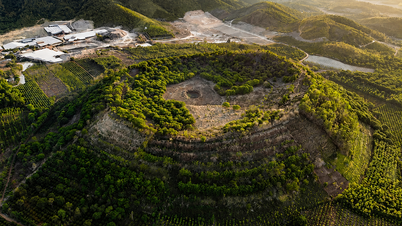
These days, visiting Dong Tam, one can easily spot the vast green expanse of cinnamon hills stretching across the mountain slopes and along the streams. From afar, the fragrant scent of cinnamon wafts in the wind, signaling a region undergoing a powerful transformation. Locals still consider cinnamon a "treasure to be kept," because every part of the tree—from the trunk and bark to the branches and leaves—can bring economic value.
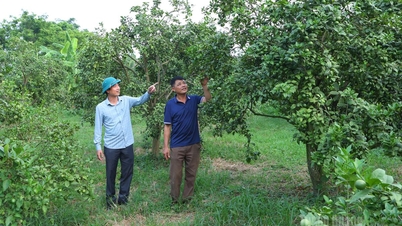
According to local people, cinnamon is very well suited to the climate and soil of Dong Tam. This tree grows well on steep hillsides, including areas along streams, where other crops previously did not yield high economic returns. This is also an important advantage, as most of the commune's forest land is hilly and mountainous.
 |
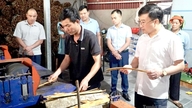
| Representatives from Trang Long - Dong Tam Cooperative instruct residents of Cong Da on the technique of peeling cinnamon bark. |
Previously, people mainly planted acacia and pine trees, which provided unstable income. Now, many households have boldly switched to planting cinnamon. With a density of about 4,400 trees per hectare, the trees begin to yield fruit after 8-10 years. During the growth process, people can also harvest branches and leaves to sell to essential oil processing facilities to increase their income.
Currently, the price of fresh cinnamon bark ranges from 15,000 to 17,000 VND/kg; cinnamon branches and leaves range from 1,200 to 1,500 VND/kg. After the harvesting cycle, the cinnamon trunk continues to be used as timber, contributing to increased economic value. Thanks to this, many households have a stable source of income, gradually escaping poverty and developing economically.
Having been involved with cinnamon cultivation for many years, Mr. Dang Van Ben, Secretary of the Party Branch of Cong Da village, said: Although cinnamon trees take longer to harvest than some other forestry trees, the economic value they bring is much higher. Thanks to the development of cinnamon cultivation, many households in the village have gradually improved their lives, had the conditions to invest in production, build houses, and take care of their children's education. The area of cinnamon cultivation in Cong Da village is expanding, becoming a direction of economic development chosen by many households. "People now consider cinnamon trees as a long-term asset. The better they take care of them, the higher the value they bring," Mr. Ben shared.


Enhancing the value of cinnamon trees.
According to Comrade Luc Hai Xuyen, Chairman of the People's Committee of Dong Tam commune, in implementing the province's policy of restructuring crop patterns, the commune has identified cinnamon as a suitable crop for the local conditions. With a large area of forest land and favorable climate and soil, Dong Tam has great potential for developing concentrated cinnamon growing areas, especially in the villages of Cuong, Pu Don, Phien, Tram, Buot, and Cong Da. To date, the entire commune has converted approximately 2,150 hectares to cinnamon cultivation, initially yielding clear economic benefits. The commune aims to develop approximately 3,000 hectares of cinnamon by 2030.
However, for cinnamon to truly become a key crop, the locality still faces many challenges that need to be overcome. The rugged mountainous terrain and limited transportation make harvesting and transporting cinnamon difficult. Many areas are located on steep hillsides, and transportation is mainly done by hand, resulting in high costs.
During the harvest season, a shortage of labor for peeling cinnamon bark is a frequent occurrence. Furthermore, cinnamon products are currently mainly sold through traders, and a stable supply chain has not yet been established, so prices remain dependent on market fluctuations. Deep processing of cinnamon products is still limited, resulting in low added value.
“In the coming time, the commune hopes that the province and relevant agencies will pay attention to supporting the granting of planting area codes, building OCOP product brands, and connecting with businesses for consumption. We expect that cinnamon trees will not only be a suitable crop for local conditions but will truly become a key crop, bringing sustainable livelihoods, helping people feel secure in their long-term commitment to the forest, gradually increasing their income and stabilizing their lives,” emphasized the Chairman of the People's Committee of Dong Tam commune.
Not only do the people and local authorities have high expectations for cinnamon cultivation, but processing facilities in the area also hope that this industry will continue to receive attention and investment for development.
At Trang Long - Dong Tam Cooperative, a unit specializing in purchasing and processing cinnamon essential oil and producing cinnamon products, Mr. Vuong Manh Hung, Director of the Cooperative, said that the Cooperative hopes to soon receive support from relevant authorities in granting planting area codes and building OCOP product brands for cinnamon essential oil and processed cinnamon products.
In addition, the cooperative is also facing difficulties in the process of trading and purchasing raw materials from local people, especially regulations related to taxes on transactions exceeding 5 million VND. "We hope that the authorities will have appropriate mechanisms to resolve these issues and create favorable conditions for cooperatives and businesses to operate stably, thereby contributing to increasing the value of cinnamon and raising the income of local people," Mr. Hung shared.


In the context of Tuyen Quang's efforts to restructure its agricultural sector towards increasing added value and sustainable development, the story of Dong Tam's transition to cinnamon cultivation demonstrates a direction well-suited to the local conditions. From previously barren hills, lush cinnamon forests are now opening up prospects for a more prosperous life for the local people.
Text and photos: Van Nghi
Source: https://baotuyenquang.com.vn/kinh-te/202605/trien-vong-tu-cay-que-76171ac/