

In Nghe An province , the persimmon tree, a shade tree, has helped people in Nam Anh commune, Nam Dan district, earn a decent income, with each harvest bringing in 30-70 million VND if they plant 50-100 trees.
On a morning in mid-October, Mrs. Bui Thi Thanh, residing in Nam Anh commune, put on protective clothing, carried an iron ladder, and took a bamboo basket to the hillside garden behind her house to pick persimmons. Her family grows 60 persimmon trees, and this season all of them are bearing fruit. Each kilogram sells for 20,000-30,000 VND at the garden, and they have sold nearly 500 kg so far. They estimate the total yield at the end of the season will reach one ton, with a total income of approximately 30 million VND.
Ms. Thanh said that for hundreds of years, various persimmon varieties such as egg-shaped, slender, bamboo-shaped, fairy, and long-round... have been grown in Nam Anh, with the egg-shaped persimmon being the most popular. The red soil around the Dai Hue mountain range is suitable for the trees to grow, giving them a distinctive sweet taste. Some places grow egg-shaped persimmons, but the fruit is not as delicious as the persimmons from Nam Anh.
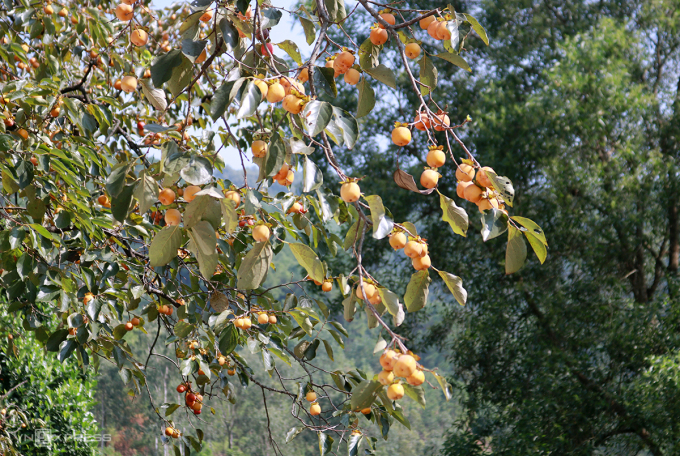
Persimmon trees in Nam Anh commune are ripening. Photo: Duc Hung
This plant can be grown using two methods: seed propagation or grafting. Seed-grown plants take 5 years to bear fruit, so people usually choose grafting. They take branches from high-yielding persimmon trees, graft them onto the mother plant, and after 6-7 months separate the grafted branches. They dig a 50 cm deep hole, add manure, and plant the grafted branch.
Trees grown from grafting begin bearing fruit after two years, and can be harvested on a large scale from the fourth year onwards. Egg-shaped persimmons require little care, needing only one fertilization per year. Each tree reaches a height of 5-7 meters, with a canopy diameter of 8-10 meters, yielding 3-4 quintals of fruit under favorable weather conditions and without insect damage. The trees can live for hundreds of years, and the older they get, the sweeter and more abundant the fruit becomes.
Joining visitors in picking fruit in the orchard, orchard owner Nguyen Dinh Que shared that frost appeared at the beginning of the year, causing the flowers to fall off, and a prolonged drought from April to August resulted in a decrease in persimmon production. Fortunately, the price of persimmons is 3,000-5,000 VND higher per kilogram than last year, which is a consolation for the growers.
Two months ago, traders bought up all of Mr. Que's family's egg-shaped persimmon orchard, which has over 50 trees. To date, they have harvested more than 500 kg, and the family expects to earn a profit of about 40 million VND by the end of the season.
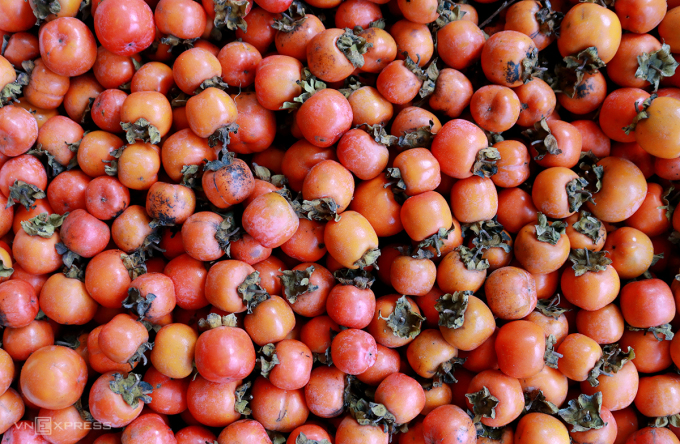
Persimmons turn red after ripening. Photo: Duc Hung
Typically, people harvest the persimmons when they are still unripe, then put them in styrofoam containers with a little soil at the bottom, and layer straw on top. After 3-4 days, the fruit turns a deep red. Ripe persimmons are soft, have red flesh, and a sweet, refreshing taste.
Mr. Ho Viet Hoa, Chairman of the Farmers' Association of Nam Anh commune, said that more than 400 families in the commune grow persimmons, with some families having at least 5 trees and others having more than 100. The entire commune has nearly 200 hectares of egg-shaped persimmons, of which 150 hectares are currently in the harvesting period. Due to unfavorable weather conditions, the commune's persimmon production reached about 100 tons, a decrease of one-third compared to last year.
Eggplant has provided a decent income for the people of Nam Anh. On average, each family earns 30-50 million VND per harvest, with many households owning large areas earning 70-80 million VND.
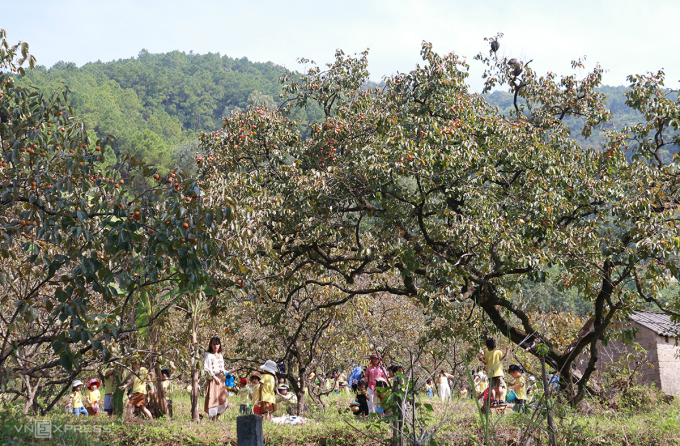
Several ancient rose gardens in the area attracted visitors who came to experience and take photos in mid-October. Photo: Duc Hung
For about three years now, in addition to selling the fruit, many people in Nam Anh commune have also designated areas in their rose gardens for tourists from within and outside the district to come and take photos, charging 30,000 VND per visit. There are three such photo spots in the entire commune. Furthermore, the commune is also developing a rose garden check-in model in Hamlet 6, featuring 20 ancient rose bushes.
Mr. Nguyen Quy Hieu, Head of the Science Management Department of the Nghe An Provincial Department of Science and Technology, said that the egg-shaped persimmon in Nam Anh commune is a valuable tree species, and since 2018 the Department has had a project to restore and develop its genetic resources. To date, the specialized agency has selected 20 superior trees to use as grafting material for seed production.
The authorities are also planning to develop persimmons as an OCOP product (One Commune One Product program), and open a dried persimmon processing factory to improve quality and brand recognition.
Source link


![[Photo] Prime Minister Pham Minh Chinh presides over a meeting on private sector economic development.](/_next/image?url=https%3A%2F%2Fvphoto.vietnam.vn%2Fthumb%2F1200x675%2Fvietnam%2Fresource%2FIMAGE%2F2025%2F12%2F20%2F1766237501876_thiet-ke-chua-co-ten-40-png.webp&w=3840&q=75)




























































































Comment (0)