

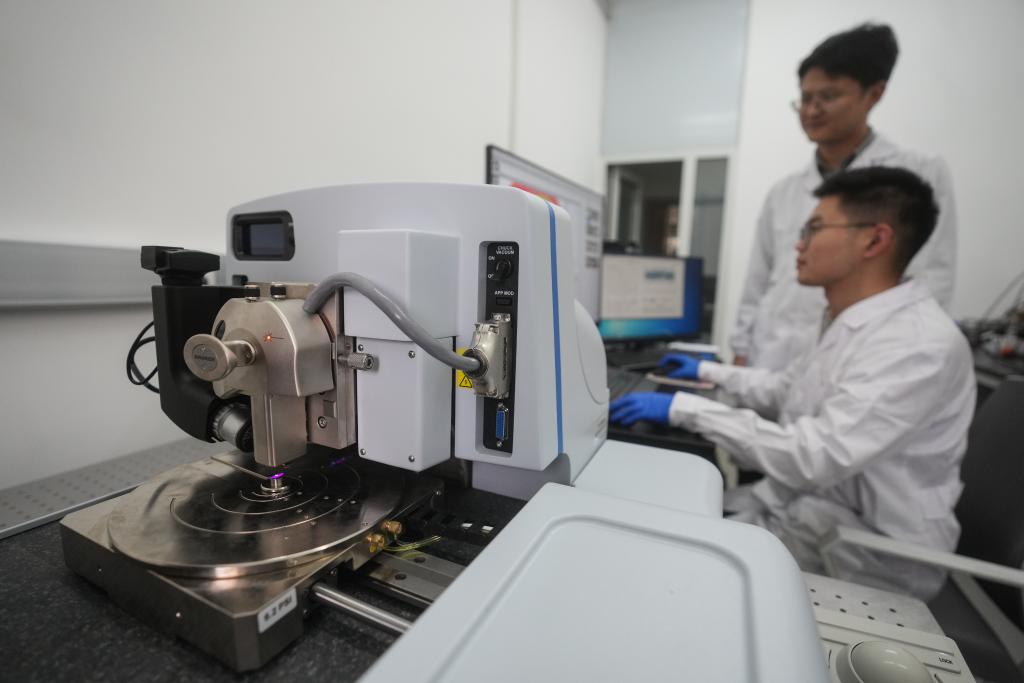
Scientists are examining a modified titanium dioxide (TiO₂) semiconductor photocatalytic material sample at the Shenyang Materials Research Center – Institute of Metals Research, Chinese Academy of Sciences, on April 7. Photo: Xinhua News Agency
Fifteen hundred years ago, science fiction writer Jules Verne predicted that water would become the ultimate fuel of the future. Today, scientists are working to make that prediction a reality.
Liu Gang, director of the Institute of Metals Research under the Chinese Academy of Sciences and head of the research team, said that the Chinese scientific research group has recently achieved a breakthrough in the field of "photocatalytic water splitting to produce hydrogen".
Through “restructuring” and “element replacement” in the photocatalytic semiconductor material titanium dioxide (TiO₂), the team significantly improved the efficiency of generating hydrogen gas directly from sunlight.
The relevant research findings were published in the Journal of the American Chemical Society on April 8th.
Currently, there are two main methods for producing hydrogen from solar energy.
One method is to use solar panels to generate electricity, then electrolyze the water – although highly efficient, the equipment is complex and expensive.
The second method is direct photolysis using sunlight – employing semiconductor materials such as titanium dioxide to “split water” under sunlight.
Liu Gang's team focused their research on the second method.
According to the explanation, the traditional method of using titanium dioxide to split water faces a major obstacle: when light shines on titanium dioxide, charged particles (electrons and holes) are generated inside, which are the "tools" for splitting water. However, these electrons and holes are unstable.
Liu Gang explained: “Electrons and holes are like race cars that have lost their way, crashing haphazardly in a maze of material structures; most will recombine and disappear within a millionth of a second. Furthermore, high-temperature fabrication often causes oxygen atoms to 'leave their homes,' creating oxygen vacancies and trapping electrons, all of which reduce the efficiency of the photocatalytic reaction.”
To overcome this, the research team creatively introduced a "neighboring" element of titanium in the periodic table – Scandium (Sc) – to improve titanium dioxide. The results showed that Scandium has three major advantages:
Firstly, the ionic radius of Sc is comparable to that of Ti, so it can be embedded in the crystal lattice without distorting the structure.
Secondly, the stable valence state of Sc helps neutralize the charge imbalance caused by the oxygen gap.
Thirdly, Sc ions can restructure the crystal surface, creating a special surface structure, much like building "highways and intersections for electrons and electron holes," helping them escape the labyrinth more easily.
Thanks to sophisticated adjustments, the team successfully fabricated titanium dioxide with outstanding performance: its ultraviolet absorption capacity exceeded 30%, and its hydrogen production efficiency under simulated sunlight increased 15 times compared to similar materials, setting a new record in this material system.
Mr. Liu Gang stated: "If this material is used to make a 1-square-meter photocatalytic panel, under sunlight, it can produce about 10 liters of hydrogen gas per day."
Researchers added that titanium dioxide is a widely used inorganic material in industry, with China accounting for over 50% of global production, forming a complete industrial chain. Meanwhile, China also has the world's largest reserves of the rare earth element scandium. This creates a potential industrial advantage for the development and application of photocatalytic materials in the future.
As the efficiency of photovoltaic water splitting continues to improve, this technology has the potential for application in industrial-scale production, driving the transformation of the global energy structure.
Source: https://baotintuc.vn/khoa-hoc-cong-nghe/trung-quoc-dat-dot-pha-moi-trong-tien-trinh-nghien-cuu-bien-nuoc-thanh-nhien-lieu-20250409112539937.htm


![[Photo] Prime Minister Pham Minh Chinh presides over a meeting on private sector economic development.](/_next/image?url=https%3A%2F%2Fvphoto.vietnam.vn%2Fthumb%2F1200x675%2Fvietnam%2Fresource%2FIMAGE%2F2025%2F12%2F20%2F1766237501876_thiet-ke-chua-co-ten-40-png.webp&w=3840&q=75)








































































Comment (0)