

At the 79th World Health Assembly (WHA) meeting in Geneva, Switzerland, the World Health Organization (WHO) warned that the Ebola outbreak in the Democratic Republic of Congo and the Hanta virus on the MV Hondius cruise ship are just the latest crises in a world already in a dangerous and divided period by conflict, economic crises, and climate change.
Bringing together delegations from WHO member states, the WHA79 session aimed to establish global health policy and advance the organization's strategic priorities amid global concerns over the Hanta virus outbreak and the Ebola virus outbreak.
This conference builds on the momentum of WHA78 in 2025, which adopted the Global Plan of Action on Climate Change and Health – an updated roadmap for strengthening the global response to adverse health impacts from air pollution and elevating climate change to a top strategic priority in the WHO's 14th General Agenda (2025-2028).
Furthermore, looking ahead to the 31st Conference of Parties to the United Nations Framework Convention on Climate Change (COP31), WHA79 offers an opportunity for global solutions to climate and health issues, maintaining the political momentum achieved at WHA78.
The WHA79 session took place after a particularly difficult year for the WHO, marked by the US announcement of its withdrawal from the organization and deep budget cuts of approximately 21%, equivalent to nearly $1 billion; many programs were scaled back and hundreds of jobs were cut, forcing the organization to undertake extensive reforms in an emergency.
During the meeting, the WHO was forced to declare a global health emergency due to the surge in highly contagious Ebola virus infections in the Democratic Republic of Congo and Uganda, which has killed 131 people so far. The latest crises, Ebola and Hanta, clearly demonstrate why the world needs an effective, credible, neutral, and well-funded WHO.
The world is not yet truly safe from pandemics. As outbreaks become more frequent, their consequences grow larger, with widespread impacts on health, the economy, politics, and society, while diminishing resilience. A decade of investment has yet to keep pace with the increasing risk of pandemics.
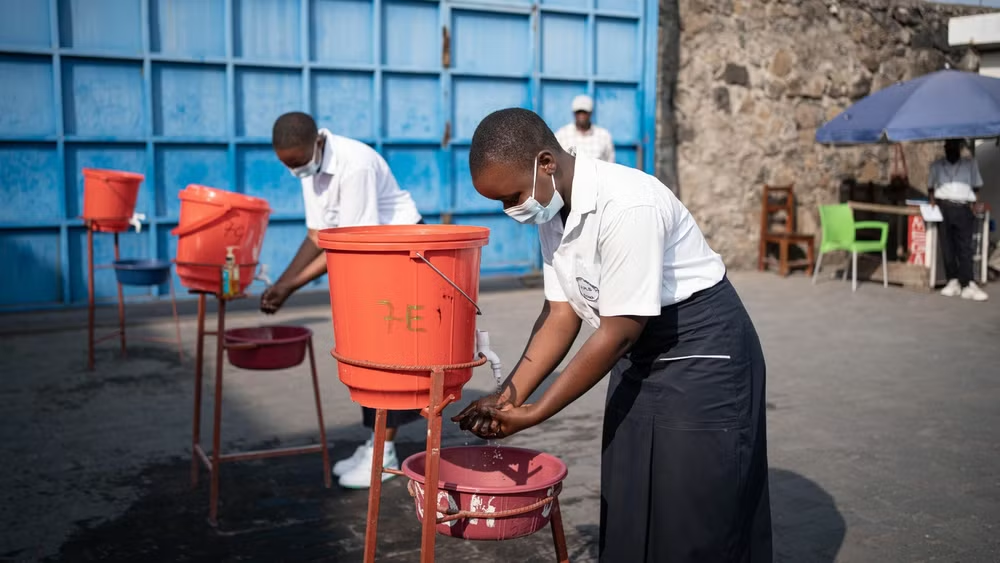
After reaching a historical peak of approximately $80 billion during the Covid-19 pandemic, development financing for health is now experiencing a sharp decline, directly threatening essential healthcare programs in low-income countries.
Total global development aid for health is projected to fall to around $39 billion in 2025-2026, its lowest level in over 15 years. This decline is primarily due to major donor countries shifting their budget priorities to internal issues, geopolitical conflicts, and post-pandemic economic recovery. The US cut funding by approximately 67%, the UK by 40%, France by 33%, and Germany by 12%.
The Global Epidemic Preparedness Monitoring Council was established by the WHO and the World Bank (WB) following the Ebola outbreak in West Africa between 2013 and 2016. The Council warned that outbreaks of infectious diseases globally are becoming more frequent and more devastating.
Health experts are calling for the establishment of an independent, permanent monitoring body to track the risk of pandemics, while also ensuring equitable access to vaccines, testing, and treatment through a global pandemic agreement.
Source: https://nhandan.vn/ung-pho-thach-thuc-y-te-toan-cau-post963615.html















































































Comment (0)