

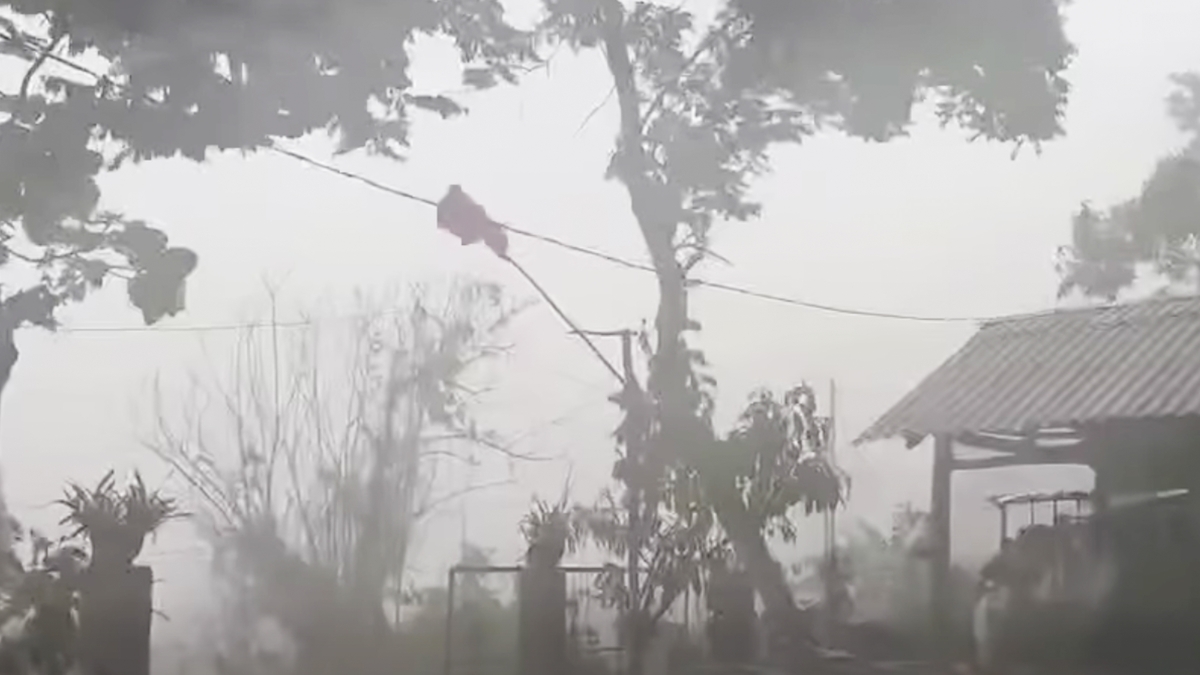
Due to the impact of Typhoon No. 3 and its remnants, the province experienced heavy rainfall and historic flooding, causing loss of life and property. Notably, the floods caused landslides in many riverbanks and along numerous transportation routes throughout the province. Currently, local authorities are focusing on mitigating the damage caused by the natural disaster.

Authorities have erected warning signs and strung ropes to indicate danger at the landslide site on the right bank of the Thao River in Bac Son commune, Tam Nong district.
According to preliminary statistics as of September 15th, due to the impact of Typhoon No. 3 and its remnants, landslides in Phu Tho province have resulted in one death and 30 locations along riverbanks with a total length of nearly 20km. Throughout the province, 200 locations along roads have also been affected by landslides, with a total length of over 50km (approximately 26,500m3 of soil and rocks have been displaced).
In Ha Hoa district, landslides have claimed the life of one person in Tu Hiep commune. Many roads in the district have been damaged or affected by landslides, including National Highway 32C, National Highway 2D, National Highway 70; and district, inter-village, and inter-commune roads, with many sections affected by landslides, impacting 11 communes and towns and causing significant difficulties for residents' travel.
According to Mr. Nguyen Ngoc Hong, Vice Chairman of the People's Committee of Ha Hoa District, to quickly overcome the damage after Typhoon No. 3, the District People's Committee has focused on directing and requiring the People's Committees of communes and towns, as well as departments, agencies, and units of the district to proactively inspect and review slopes and hillsides at risk of landslides and riverbank subsidence due to the impact of rain, floods, or changes in water flow... and relocate households from dangerous areas. At the same time, they are inspecting and reviewing residential areas adjacent to rivers and streams, and low-lying areas that have recently experienced floods and landslides, to proactively implement response and handling measures. They are also organizing control and support forces, erecting warning signs and barriers, and guiding traffic to ensure the safety of people and vehicles in areas affected by landslides, mudslides, and riverbank subsidence caused by rain and floods, in order to quickly address the incidents and ensure smooth traffic flow on transportation routes and arteries during heavy rains. Report any incidents that occur after floods and heavy rains promptly to the District People's Committee to ensure the safety of lives and minimize property damage to the people.
Currently, many areas in the province are at high risk of landslides, flash floods, and mudslides, posing significant risks to people and property. According to forecasts from specialized agencies, storms and floods are likely to occur in the coming days, affecting localities throughout the province. Given the increasingly complex nature of natural disasters, identifying and implementing warning and forecasting solutions, and constructing risk mitigation infrastructure, is an urgent task.
To achieve this, solutions to mitigate damage from natural disasters are needed, such as: investing in infrastructure, improving early warning capabilities, enhancing self-response capabilities, especially within communities, and investing in information systems for the public.
According to Comrade Nguyen Hung Son, Head of the Irrigation Sub-Department, responding to landslides requires a proactive approach based on the principle of "prevention is better than cure." Authorities at all levels need to review and effectively address landslide-prone areas, applying temporary reinforcement methods to avoid unnecessary damage. Emphasis should be placed on forecasting and prediction, strengthening the capacity of officials and disaster prevention and control centers at all levels; and disseminating knowledge and information on disaster prevention and control to the public.
Local authorities must urgently evacuate people from high-risk areas, review residential planning and infrastructure, and ensure the minimization of impacts caused by natural disasters. They should leverage the role of rapid response teams and search and rescue forces to respond promptly and minimize losses of life and property caused by natural disasters. In particular, local authorities need to actively plant and protect forests to combat soil erosion.
Trinh Ha
Source: https://baophutho.vn/ung-pho-voi-sat-lo-dat-phong-hon-chong-219275.htm


![[Photo] The courage of new recruits of Brigade 144 on the training ground.](https://vphoto.vietnam.vn/thumb/1200x675/vietnam/resource/IMAGE/2026/05/27/1779881651341_anh-man-hinh-2026-05-27-luc-18-32-52.png)
![[Photo] The heat at the fireworks display site on the opening night of the Da Nang International Fireworks Festival 2026](https://vphoto.vietnam.vn/thumb/1200x675/vietnam/resource/IMAGE/2026/05/27/1779889741485_ndo_br_z7872039145157-fecaba5112f39e8352544099d7ef4738-5140-jpg.webp)






















































![[Photo] The courage of new recruits of Brigade 144 on the training ground.](https://vphoto.vietnam.vn/thumb/402x226/vietnam/resource/IMAGE/2026/05/27/1779881651341_anh-man-hinh-2026-05-27-luc-18-32-52.png)




























Comment (0)