

Welcoming us into the ancient, always-cleaned temple, Mr. Do Don Thin, Head of the Bui Temple's Celebration Committee, slowly said: "Bui Temple worships two deities: Duc Vuong Thien Thong Dai Vuong and Ha Ba Thuy Hai Dai Vuong. Legend has it that during a year of natural disasters and epidemics, the people suffered greatly. Hoping for favorable weather, relief from disease, and averting disaster, the villagers discussed and unanimously agreed to set up an altar to pray to heaven and earth. During the ceremony, a person in the crowd stood up and said: 'I am a god from heaven, named Duc Vuong Thien Thong Dai Vuong, along with Ha Ba Thuy Hai Dai Vuong, currently patrolling the land. Seeing the people's sincere prayers, if you wish to escape the epidemic and calamities, you must build a temple to worship us, our deities Duc Vuong Thien Thong Dai Vuong and Ha Ba Thuy Hai Dai Vuong.' Hearing this, the people unanimously joined forces to build the temple in the 8th year of Duong Hoa (1642) during the reign of King Le Than Tong."
After the temple was built, the villagers and people from neighboring areas who came to pray all found it miraculous. During the reign of King Le Dai Hanh, the country suffered from drought and epidemics. Hearing about the sacredness of Bui Temple, the king sent someone to request the title of the deity to be worshipped in Ninh Thai commune, Thanh Liem district, to perform rituals praying for rain, favorable weather, and abundant harvests. After the prayers were completed, heavy rain indeed fell, the fields were flooded, and the epidemic was eradicated. In the first year of Thuan Thien (1428) of King Le Thai To (Le Loi), many soldiers contracted an epidemic. When passing by the temple, the king ordered the construction of an altar and a ritual praying for rain, and the soldiers naturally recovered and became healthy again. In the first year of Thuan Binh (1549), King Le Trung Tong came to the temple to pray for rain and to avert disaster. Knowing that the two deities were high-ranking gods sharing the same divine decree, the king granted a "National Sacrifice" ceremony. From then on, every year in the spring, officials from the prefecture and district would come to offer sacrifices.
Over time, witnessing the sacredness of the deities worshipped in the temple, the village elders and officials unanimously agreed to repair and renovate the temple into a communal house, considering the two deities as the village's guardian spirits, always respectfully worshipped. In 1763, Mr. Doan Van Tai, a native son who served as an official during the Le-Mac dynasty, donated all the wood granted by the king to repair and rebuild the communal house…
Not only a place of cultural and religious activity, during the resistance against the French, Bui communal house was a gathering place for guerrillas; a place to bid farewell to young people from the village who were going to join the army to fight the enemy; a place to welcome and serve as a starting point for main units, local troops, and guerrillas attacking outposts in the surrounding area such as Dam, Sui, Ngo Khe... Today, Bui Nguyen village still preserves the folk song: "Bui communal house has a banyan tree/ Its trunk twists like a flying dragon/ Since the revolution came here/ People gather at the base of the banyan tree/ The banyan tree's top flutters with red flags/ People flock from all over the region to listen/ The Viet Minh brought the revolution...". During the resistance against the Americans, Bui communal house served as a liaison station for troops going south to fight...
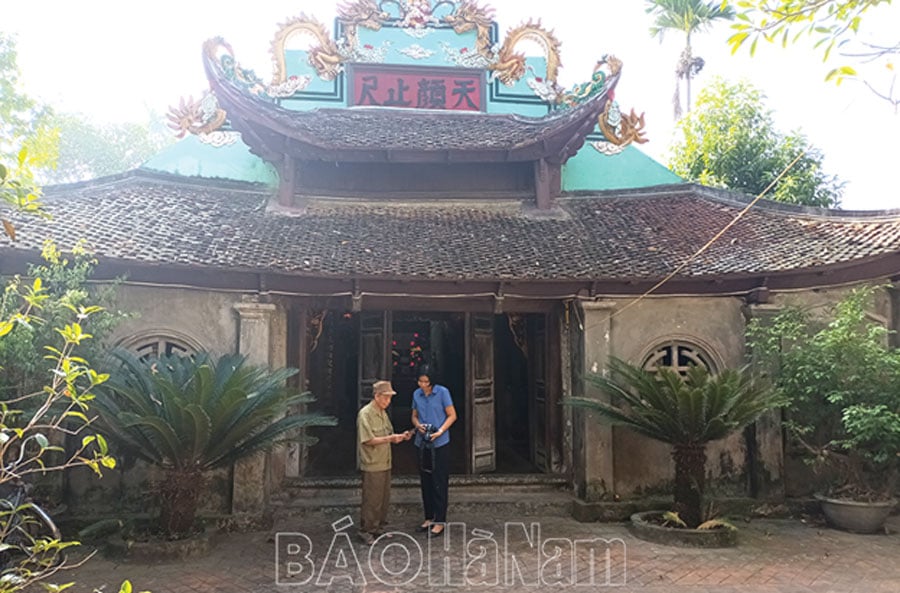
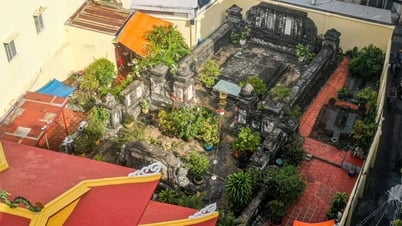
Through the vicissitudes of history and time, the once bustling Bui Wharf, teeming with boats trading goods, is no more. The old Ngo Xa River is now just a large lake beside the temple. Only Bui Market still meets on a regular basis, remaining a large and lively marketplace for the local people. As we leisurely toured Bui Temple with Mr. Thin, we felt the beauty and tranquility of this ancient and sacred temple. Bui Temple faces north, with an ancient banyan tree spreading its branches to shade a large courtyard in front of the gate. To the west of the temple, a high mound rises above the lake; it is said to be the tomb of Thuy Hai Dai Vuong (the second Saint), covered by an ancient banyan tree with lush, vibrant branches reflecting in the clear blue water. About 500 meters northeast of the temple is the tomb of Thien Thong Dai Vuong, with a banyan tree used for worshipping the Saint.
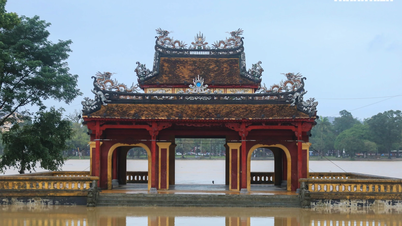
Besides its beautiful natural scenery and traditional architecture rich in national identity, Bui communal house also preserves diverse, rich, and unique decorative carvings on its structural elements. The decorative themes focus on the four mythical creatures and the four seasons… In particular, the images of the “dragon-horse” and “dragon-serpent” are repeated on many carvings with distinct nuances. It is very likely that the ancient artisans wanted to emphasize the origins of the two guardian deities worshipped at the communal house: Thong Thien Dai Vuong descending from heaven (dragon-horse) and Thuy Hai Dai Vuong rising from the water (dragon-serpent). In addition, the famous skilled carpenters of the village of the past depicted boat races with oarsmen at the stern, the half-body figures of four strong young men rowing, a drummer cheering on the race, birds perched on lotus flowers, and scenes of turbulent water causing turtles and carp to surface…
Bui Temple was classified as an architectural and artistic relic by the Ministry of Culture and Information in 2001. The Bui Temple festival is held annually on the 10th day of the 8th lunar month – the anniversary of the death of the two village guardian deities. Proud of this famous and sacred ancient temple, over the years, the people of Bui Nguyen village have always upheld their responsibility in protecting, preserving, and promoting the values of Bui Temple, contributing to building a healthy cultural and religious life, and strengthening community solidarity and cohesion in the residential area.
Pham Hien
Source




![[Image] Close-up view of the interchange connecting the two expressways and Long Thanh Airport.](https://vphoto.vietnam.vn/thumb/1200x675/vietnam/resource/IMAGE/2026/05/25/1779703378210_ndo_br_z7863716673926-224453a31600126cce10622af6290afd-4549-jpg.webp)




































































Comment (0)