

After hundreds of years of existence, the woodblocks of Te Xuyen Pagoda in Duc Ly commune, Ly Nhan district, have attracted the attention of local researchers and cultural administrators. With over 1,550 woodblock prints preserved in the pagoda's library, these prints are not only evidence recording a period of existence and the role of disseminating Buddhist teachings, but also an invaluable heritage for future generations to preserve and safeguard, due to the cultural essence embodied in each print.
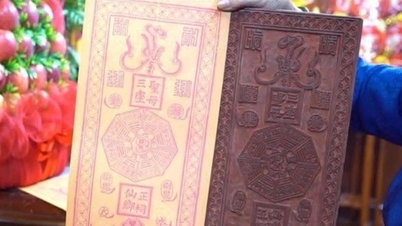
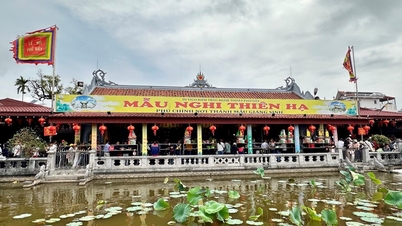
Te Xuyen Pagoda, located in Duc Ly commune, Ly Nhan district (also known as Te Xuyen Bao Kham Mountain Gate), was built during the Ly Dynasty and was classified as a National Historical and Cultural Monument in 1996. Besides its beautiful scenery and architecture, Te Xuyen Pagoda preserves many valuable and rare artifacts, including wooden printing blocks of Chinese characters carved on persimmon wood, used for printing Buddhist scriptures with content mainly related to Buddhism in Vietnam, encompassing various types of sutras, treatises, and petitions.
According to Venerable Thich Thanh Bang, the abbot of the pagoda, the temple was built as a spiritual center and a place of cultivation for many renowned monks from Northern Vietnam, such as: Venerable Thich Pho Tu, Venerable Thich Doan Hai, Venerable Thich Thong Tien, the Great Venerable Thich Tam Tich (former Second Dharma Chief of the Council of the Vietnam Buddhist Sangha, secular name Nguyen Dinh Khue, Dharma name Nhu Son), Venerable Thich Tri Hai (who made great contributions to the revival of Buddhism in Northern Vietnam in the early 20th century), and the Elder Venerable Thich Thanh Bich (former Vice Dharma Chief and Chief of Discipline of the Council of the Vietnam Buddhist Sangha, Head of the Te Xuyen Bao Kham lineage)...
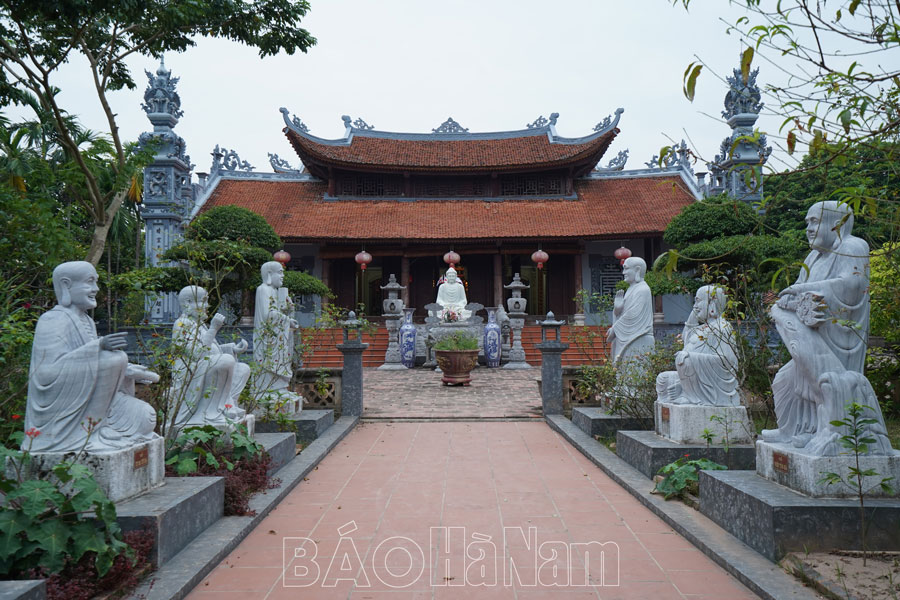
The Buddhist revivalist ideals of Venerable Thích Trí Hải spanned many years, during a time when the nation and its people faced numerous challenges and turbulent times (from 1924 to the early 1930s), and Buddhism was increasingly at risk of decline and superstition. At that time, he mobilized monks in the Lý Nhân region to establish a Buddhist association to rectify the Dharma. The Tế Xuyên ancestral temple became a center for spreading the Dharma, and the woodblock prints of Buddhist scriptures were put to use and gained significance, even though these woodblocks had already served their original function. Many prestigious monks who ordained there said that the ancestral temple was one of the largest centers for spreading Buddhism in the Hà Nam region in the past. Although small at the time, the temple was where poor families sent their children to learn literacy and Buddhist teachings from profound Zen masters.
According to the village temple's historical records, the pagoda was built during the Ly Dynasty, donated by Mr. Tran Nham. Over time, the pagoda has undergone several renovations. During the Le Dynasty and the Trinh Lords' reign, a young woman from this district was favored by the Lord and recruited into his household. In her old age, she spent money to renovate the pagoda and bought land to cultivate for the two villages of Te Xuyen and Te Cat, using the proceeds to maintain the pagoda. During the reign of the ninth abbot, Venerable Thich Thanh Bang, the pagoda was once again renovated, becoming grand and beautiful, befitting its status as the ancestral home of renowned Buddhist monks.
With meticulous care and attention to detail in surveying and cataloging the entire collection of woodblocks currently preserved at the temple, officials from the Department of Culture, Sports and Tourism stated that they have fully documented the types of woodblocks. Among dozens of sets of scriptures, laws, treatises, and literary works, there are also many Buddhist prayer texts, repentance texts, seals hung on banners, protective amulets, and texts on Buddhist precepts… Each type carries different values, but all contain the unique cultural identity of Vietnamese religion.
For example, among the 13 surviving Buddhist scriptures, the Great Sutra of the Buddha's Gratitude (3 volumes, 16 woodblock prints) reflects the Buddha's teachings in response to Ananda's request regarding filial piety towards parents, and the importance of honoring one's teachers to prevent the slander of the Six Masters. Examples of filial piety from ancient times include: a Brahmin carrying his mother to beg for food, Subhuti cutting off his own flesh to offer to his parents to prevent starvation, and Prince Shanti burning incense to save his parents from blindness. The four volumes of the Amitabha Sutra reflect the Pure Land, a world without suffering, birth, aging, sickness, and death… a world of boundless bliss. Then, the 78 woodblock prints of the Diamond Sutra reflect Buddhist teachings, admonishing people to practice truth and goodness: In life, one must cultivate virtue and accumulate merit, perform many good deeds, and diligently recite scriptures to attain liberation. Hundreds of other woodblock prints belonging to the scripture genre also contain quite profound content addressing medical science, religious law, etc. The value of these scriptures is to guide people's spirits towards certain moral standards, self-cultivation and self-improvement, and the building of an equal, crime-free society.
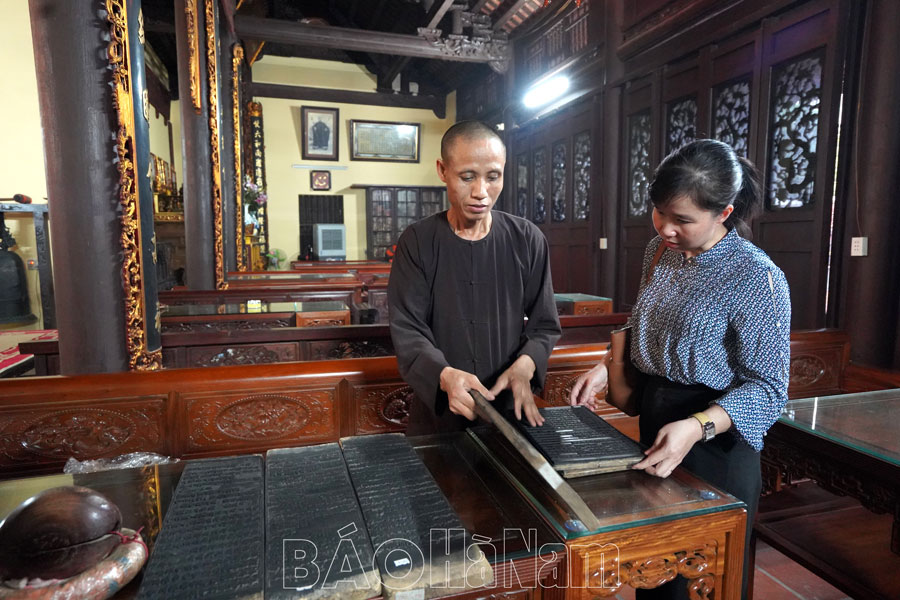
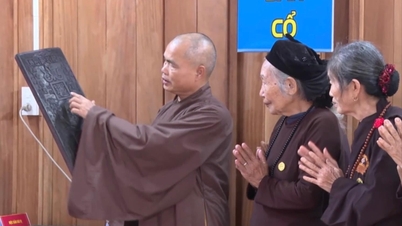
Besides the scriptures, the four sets of precepts also hold special value for those practicing Zen meditation: Do not kill, do not steal, do not engage in sexual misconduct, do not be insolent, do not drink alcohol, do not wear makeup, do not sing, do not sit on high chairs, do not sleep on wide beds, do not eat beyond noon, do not handle money, gold, or silver... All the woodblocks are in ancient Chinese characters, carved in reverse with quite sophisticated and skillful craftsmanship.
Consulting with experts in Buddhist culture, sculpture, and painting regarding woodblock printing techniques, many believe that the creation and existence of these woodblock prints have their reasons. Firstly, by examining the meticulously crafted woodblocks, one can deduce much about the skill and background of the craftsmen. Secondly, the location of Te Xuyen Pagoda is situated in the heart of the region's most developed woodblock printing area, home to many talented artisans and once comprised groups of craftsmen specializing in building temples and pagodas in the North. Therefore, the question of who made these woodblocks can be definitively answered by identifying local people. The level of woodblock printing in Te Xuyen truly reached a high degree of sophistication and precision. The woodblocks are carved in a simple, elegant style, with two pages on each side of the board. Many pages are interwoven with special images and shapes, particularly the depiction of Shakyamuni Buddha and Avalokiteshvara Bodhisattva seated on lotus thrones, which possess high aesthetic value. The choice of persimmon wood for carving was also very refined, as it is a flexible wood that is less prone to warping and is resistant to termites. According to the stone stele at Te Xuyen Pagoda and the inscriptions on the woodblocks, these woodblocks date back to the Nguyen Dynasty.
Mr. Ngo Thanh Tuan, Deputy Director of the Department of Culture, Sports and Tourism, said: "The existence of these wooden printing blocks contributes to increasing the cultural value of Te Xuyen Pagoda. The cultural sector has conducted surveys and inventories and found that many Buddhist scriptures have lost a significant number of wooden printing blocks, and the possibility of collecting them again is very low. Therefore, the task of surveying, supplementing, and selecting for translation is difficult. Of the more than 1,000 wooden printing blocks, many are warped, cracked, rotten, or broken; some have been damaged by mold and have lost their characters. The Department of Culture, Sports and Tourism has developed a plan for preservation and will propose that the province consider recognizing these wooden printing blocks as heritage of memory." (Venerable Thich Thanh Bang, abbot of the pagoda.)
Jiangnan
Source
![[Photo] General Secretary and President To Lam visits and delivers a policy speech at Tsinghua University.](https://vphoto.vietnam.vn/thumb/1200x675/vietnam/resource/IMAGE/2026/04/14/1776164592318_vna-potal-tong-bi-thu-chu-tich-nuoc-tham-va-phat-bieu-chinh-sach-tai-dai-hoc-thanh-hoa-trung-quoc-8700658-5437-jpg.webp)
















































Comment (0)