

On the morning of September 4, within the framework of the High-end Tourism Forum at the Ho Chi Minh City International Tourism Fair (ITE HCMC) 2025, the small woodblock group's exhibition booth became bustling. Mr. Pham Minh Hai (43 years old, cultural researcher; working at the University of Arts - Hue University) diligently introduced to visitors about famous folk paintings: Dong Ho, Sinh village, Kim Hoang, Hang Trong...
Experience Vietnamese culture at an international fair
Not only displaying, the group also brings unique experiences. With prepared sheets of Do paper, visitors can use the woodblocks to print black outlines using the common technique of Vietnamese folk paintings and then print them on paper. From familiar paintings such as roosters, babies holding ducks, stylized Sino-Vietnamese characters, to dragon and phoenix motifs of Hue royal court, each work completed in just a few minutes has made many foreign visitors admire.
"I didn't expect Vietnam to have such a vibrant tradition of handcrafted paintings. When I personally printed a Dong Ho painting, I clearly felt the subtlety and cultural significance hidden within it," a foreign visitor shared.
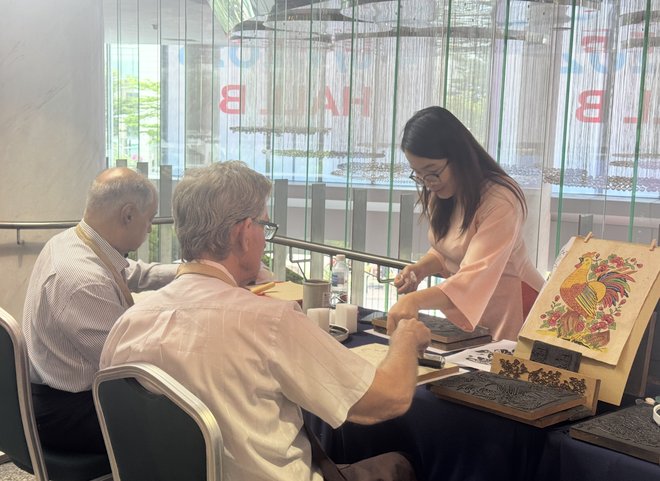
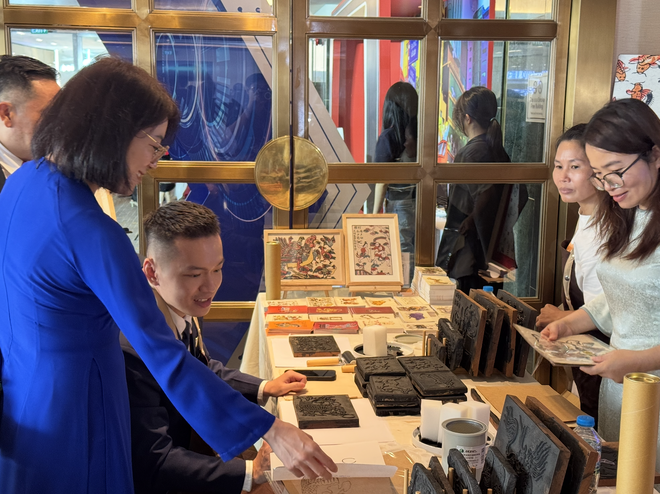
Tourists enjoy making woodblock paintings at the international tourism fair.
PHOTO: LE NAM
Mr. Pham Minh Hai shared that his journey began with the research of folk paintings from Sinh village (Hue) and royal court patterns of the Nguyen Dynasty. Sinh village paintings were originally for decoration purposes, used in rituals and then burned, so they are almost absent in contemporary life. "Although they are called paintings, most of them are not for decoration, but only for rituals. Therefore, many young people do not even know about them, or if they do know, they find them strange and difficult to approach," Mr. Hai said.
He had organized many free experiential activities for years to promote the art form, but without much success. "Sinh village paintings have almost lost their place; the last remaining artisan, Mr. Ky Huu Phuoc, has yet to find a successor. I also know that simply introducing one style of painting is very difficult. To get people interested, you have to put the story into a larger, overall picture," he explained.
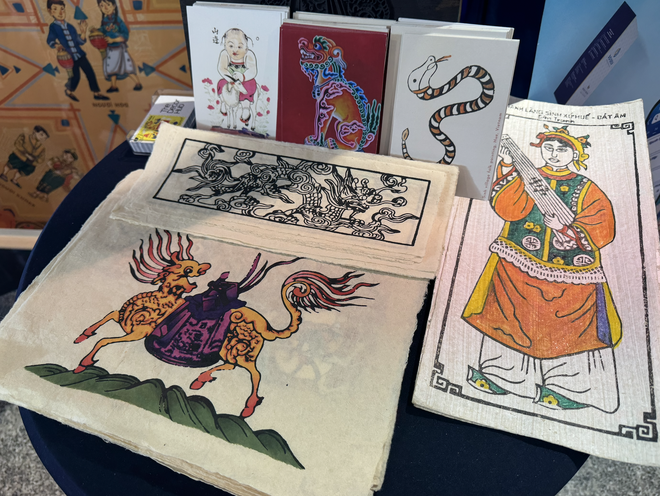
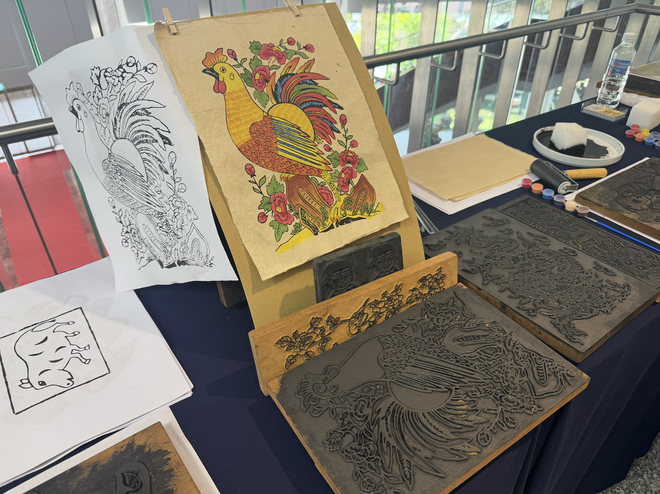
From Sinh Village paintings to woodblock prints: a common home for many styles of Vietnamese folk art.
PHOTO: LE NAM
Since then, he founded Moc Ban not only to introduce Sinh village paintings, but also as a "common home" for many genres of Vietnamese folk paintings, all using the same woodblock printing technique. Through familiar images such as Dong Ho rooster paintings or children holding chickens, he skillfully leads viewers to little-known stories about Sinh village paintings.
"My journey has been quite lonely, receiving little attention from the community. Fortunately, I met some individuals, experts, and foreign customers who truly loved my work. And the biggest turning point was when The Decor Hub, a business in Ho Chi Minh City, offered to partner with me," he shared.
It was this cooperation that helped the woodblocks appear for the first time in the international arena. After learning about the project, the representative of the unit, Ms. Ha Nguyen, flew to Hue to meet Mr. Hai directly and promote cooperation. "Enterprises are the wings for traditional handicraft cultural models. Without that support, we would hardly have had the opportunity to debut at an international event like ITE HCMC," Mr. Hai emphasized.
Vietnamese folk paintings have healing properties.
Surprisingly, the people who spent the most time at the workshop were middle-aged and young men. They patiently printed each picture, enthusiastically observing each carving. Mr. Hai realized: "Perhaps folk paintings touch deep emotions, helping them find tranquility in the hustle and bustle of life. This could be a form of healing."
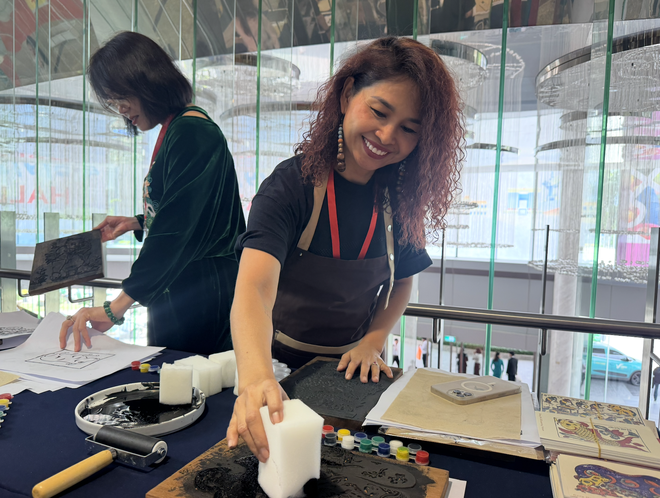
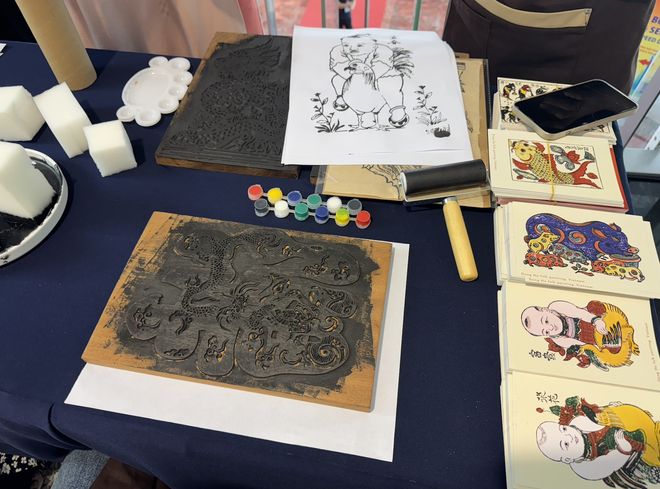
Ms. Ha Nguyen (who dreams of bringing woodblock printing culture closer to the public) is demonstrating how to apply ink to the printing stencil.
PHOTO: LE NAM
He hopes that woodblock printing will not only be limited to short-term events, but will also create a permanent space for the public to come and admire and experience. Furthermore, the group wants to create an outlet for artisans by placing orders and bringing their products to art lovers, thereby nurturing the traditional craft.
Each folk painting carries a cultural and spiritual message. For example, the painting "Ông Đốc's Boat" from Sình village, associated with the legend of Saint Trần and Phạm Nhan, symbolizes the interplay between the earthly and spiritual realms. Or the image of the "sacred horse," which is not only for decoration but also signifies guiding souls.
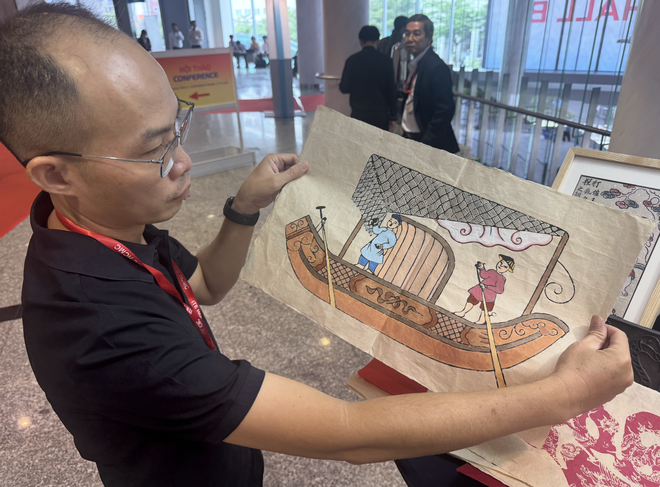
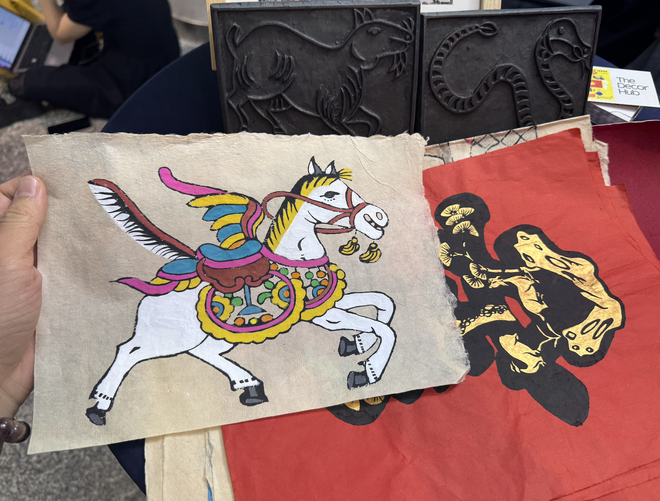
The painting 'The Boat of the Governor' (left) and the painting 'Sacred Horse' (right) both carry a cultural and spiritual message.
PHOTO: LE NAM
Hue's imperial motifs, such as flowers and birds (peony and a pair of mandarin ducks), symbolize wealth and complete happiness. Meanwhile, paintings of roosters evoke the yang trigram - the sun, the five virtues of men (benevolence, propriety, wisdom, trustworthiness, and righteousness), and the crowing that dispels darkness.
"Viewers of the paintings are not just admiring a work of art, but are also touching upon the deep layers of Vietnamese culture and beliefs," Hai said.
Following its debut at ITE HCMC, woodblock printing has become well-known to many international visitors, opening up broad development potential. Hai and his colleagues hope to continue bringing this experience to other major cities, organizing regular workshops, and especially inspiring the younger generation.
"The ultimate goal is not only to preserve, but also to breathe new life into folk art, so that it can accompany modern life. We hope that, through tourism, Vietnam's traditional cultural heritage will be spread more widely to friends around the world," Hai affirmed.
Source: https://thanhnien.vn/tranh-dan-gian-moc-ban-viet-thu-hut-khach-nuoc-ngoai-185250904175702049.htm


![[Photo] Prime Minister Pham Minh Chinh holds a phone call with the CEO of Russia's Rosatom Corporation.](/_next/image?url=https%3A%2F%2Fvphoto.vietnam.vn%2Fthumb%2F1200x675%2Fvietnam%2Fresource%2FIMAGE%2F2025%2F12%2F11%2F1765464552365_dsc-5295-jpg.webp&w=3840&q=75)
![[Photo] Closing Ceremony of the 10th Session of the 15th National Assembly](/_next/image?url=https%3A%2F%2Fvphoto.vietnam.vn%2Fthumb%2F1200x675%2Fvietnam%2Fresource%2FIMAGE%2F2025%2F12%2F11%2F1765448959967_image-1437-jpg.webp&w=3840&q=75)










































![[OFFICIAL] MISA GROUP ANNOUNCES ITS PIONEERING BRAND POSITIONING IN BUILDING AGENTIC AI FOR BUSINESSES, HOUSEHOLDS, AND THE GOVERNMENT](https://vphoto.vietnam.vn/thumb/402x226/vietnam/resource/IMAGE/2025/12/11/1765444754256_agentic-ai_postfb-scaled.png)













































Comment (0)