

VND deposits are approximately 2 trillion VND lower than loans.
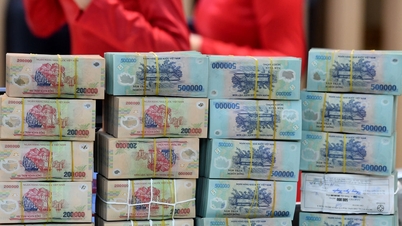
According to the State Bank of Vietnam, as of the end of April, the rate of capital mobilization by banks increased by approximately 0.6%, while outstanding loans increased by 4.4%. The growth rate of capital mobilization is consistently lower than the growth rate of credit, resulting in the scale of VND-denominated capital mobilization being approximately 2 trillion VND lower than the scale of credit. This indicates that credit growth is exceeding the capital mobilization capacity of banks. This is also the reason why banks are facing difficulties in generating capital to meet the needs of economic growth in the coming period.
Notably, the slow pace of deposit mobilization is occurring even as savings interest rates remain high. Specifically, for terms under 6 months, savings interest rates at most banks have hit the ceiling of 4.75%/year, while for terms of 6 months or more, rates of 7-8% and 9%/year are seen. Despite this, newly released data from the State Bank of Vietnam shows that household deposits at credit institutions increased slowly in January, while deposits from economic organizations decreased sharply. Household deposits totaled over 10,381 trillion VND, an increase of 46,000 billion VND in January (equivalent to 0.45%). However, this increase did not offset the sharp decline in deposits from economic organizations, which decreased by 100,000 billion VND (equivalent to 1.62%), to 6.08 trillion VND. Total money supply (excluding securities issued by credit institutions) increased by 0.69%, to VND 19,578 trillion. This marks the fourth consecutive month of increase in total money supply, but it has yet to reach the high of VND 19,980 trillion achieved in September 2025.

Banks are slower to raise capital than to lend.
PHOTO: NGOC THANG
The decline in deposits is occurring across many banks, rather than being scattered as in previous years. Despite being the leading bank in terms of deposits, BIDV saw a decrease of over 82,000 billion VND in the first three months of the year, falling to 2.141 trillion VND. To increase lending capital (reaching nearly 2.43 trillion VND, an increase of nearly 57,000 billion VND compared to the end of 2025, equivalent to approximately 2.4%), the bank issued securities worth 78,000 billion VND compared to the end of the year, reaching 303,000 billion VND. Similarly, MB saw a decrease of 15,000 billion VND in deposits, down to 905,918 billion VND. Meanwhile, outstanding loans to customers continued to expand, reaching over 1.12 trillion VND. Therefore, MB issued securities worth an additional VND 21,580 billion in the first three months of the year, bringing the total to VND 208,816 billion.
In addition, other banks also experienced a decrease in customer deposits, such asACB , which decreased by VND 17,607 billion to VND 570,267 billion; Techcombank, which decreased from VND 665,550 billion at the end of 2025 to VND 650,921 billion, a decrease of 2.2%; VietBank, whose customer deposits decreased from VND 101,645 billion to VND 96,713 billion, a decrease of approximately 4.3%; Sacombank, which decreased by 2.8% to VND 600,789 billion; TPBank, which decreased by 4.3% to VND 267,038 billion; and SeABank, which decreased by 3.1% to VND 185,876 billion…
Why is mobilization slow?
Mr. Nguyen The Minh, Director of Investment Banking at An Binh Securities Company, analyzed that savings interest rates will increase from Q4 2025 and continue through Q1 2026. The interest rate market will be strongly stimulated by the participation of large banks, especially the Big 4 (BIDV, VietinBank, Vietcombank, Agribank). The reason is that the amount of deposits from the State Treasury at these banks is not counted as deposits, which results in a significant shortfall. To compensate, state-owned banks must attract capital back into the market by increasing interest rates, impacting the amount of deposits at other banks.
"Recently, the State Bank of Vietnam amended this regulation, allowing 20% of the State Treasury's time deposits to be included back into the loan-to-deposit ratio (LDR) denominator, instead of being 100% excluded as stipulated from the beginning of 2026. With total treasury deposits at the three state-owned banks (Vietcombank, VietinBank, BIDV) reaching VND 563,036 billion as of Q1/2026, including 20% of time deposits into the LDR denominator creates an additional approximately VND 37,000 billion for each bank (Vietcombank and BIDV), equivalent to a theoretical credit space of about VND 31,500 billion for each bank if the LDR ceiling of 85% is applied," Mr. Nguyen The Minh explained.
However, according to Mr. Nguyen The Minh, the slow increase in bank deposits is due to money previously flowing into gold and real estate, and remaining stuck there until now. "Many real estate projects have restarted, and customers are paying according to the schedule, so the amount of deposits has decreased. Gold was bought at a high price, so now that the price has fallen, it's difficult to sell. Another factor is that inflation is currently higher than in previous years, with oil prices above $100 per barrel. Therefore, the increase in interest rates only partially compensates, and cooling down to the levels seen in previous years is very difficult," Mr. Minh said.
Despite the decline in deposits, Mr. Nguyen The Minh believes that banks have shifted to issuing securities with higher interest rates to secure funding. Therefore, the cost of capital for banks remains high and will continue for some time. The outlook for bank capital mobilization is expected to brighten when gold prices are no longer soaring, inflation is controlled and slows down, banks issue securities to increase their capital buffers, and borrow USD… to improve liquidity.
Similarly, SSI Investment Analysis Center believes that bank capital will be a hot spot in Q1 2026. By the end of Q4 2025, the Loan-to-Deposit Ratio (LDR) of banks was approaching 100%, while liquidity increasingly depended on deposits from the State Treasury, open market operations (OMO), and some foreign capital sources, rather than growth in core deposits. This has led to increasingly fierce competition for deposits, resulting in a divergence in deposit amounts, shifting from banks with low interest rates to banks with high interest rates.
In the coming period, deposit growth may recover thanks to deposit interest rates remaining relatively high, the return to normal seasonal factors related to corporate customer deposits, and recent adjustments to tax policies for household businesses. In addition, credit demand may slow down amidst double-digit lending interest rates.
"However, funding conditions remain highly sensitive to upcoming regulatory changes. In particular, the application of new liquidity measures (such as CDRs) – if implemented immediately without a transition period or a phased implementation roadmap – could lead to renewed pressure to raise capital," SSI Investment Analysis Center stated.
Banks' capital mobilization rate has been slower than their lending rate, leading to a loan-to-deposit ratio (LDR) close to the maximum limit of 85%. For example, the LDR at VietinBank, BIDV, Vietcombank, and Agribank increased in the first months of 2026, and as of March 31st, these ratios were 83.48%, 82.94%, 84.54%, and 83.28%, respectively.
Source: https://thanhnien.vn/vi-sao-huy-dong-von-cham-185260518200555401.htm
![[Photo] General Secretary and President To Lam presides over a working session with the Central Policy and Strategy Committee on the development of the materials industry.](https://vphoto.vietnam.vn/thumb/1200x675/vietnam/resource/IMAGE/2026/05/21/1779359935432_a3-bnd-3129-1412-jpg.webp)




![[Photo] National Assembly Chairman Tran Thanh Man working with the Standing Committee of the Law and Justice Committee](https://vphoto.vietnam.vn/thumb/1200x675/vietnam/resource/IMAGE/2026/05/21/1779378929214_ndo_br_1-4610-jpg.webp)














![[Infographic] Stock market on May 21st: VN-Index falls 16.34 points, market liquidity decreases.](https://vphoto.vietnam.vn/thumb/402x226/vietnam/resource/IMAGE/2026/05/21/1779379204295_screenshot-2026-05-21-220948-jpg.webp)
















































































Comment (0)