

Natural sand resources in the Mekong Delta are scarce, and using artificial sand as a substitute is also ineffective due to high costs and a lack of raw material sources.
According to the Ministry of Natural Resources and Environment , the current reserves of natural sand for land leveling in the Mekong Delta are approximately 37 million cubic meters. Meanwhile, for transportation infrastructure alone, the six expressways to be implemented in the region between 2022 and 2025 require nearly 50 million cubic meters of sand. In addition, provincial-level transportation projects will need approximately 36 million cubic meters of sand in 2023-2024.
In many transportation projects in the North and Central regions, the price of natural sand is being driven up due to scarcity compared to three years ago. In the future, natural sand will become increasingly scarce as less sand flows from upstream, insufficient to compensate for the amount of sand extracted. Indiscriminate sand mining will cause the riverbed to deepen, increasing the risk of landslides.
The solution of using artificial sand or sea sand to replace natural sand in transportation projects has been considered by management agencies and contractors. However, both solutions face certain difficulties.
Artificial sand costs 3-4 times more than natural sand.
Mr. Nguyen Van Nguyen, Deputy Director of the Geology Department (Ministry of Natural Resources and Environment), said that artificial sand, or crushed sand, is produced using high-speed impact technology that breaks down rocks. The production process creates round particles with low friction and a size almost identical to natural sand.
Currently, the world commonly uses artificial sand made from sandstone, granite, basalt, and pebbles whose main component is quartz. In addition, some natural sandstone layers have a weak level of cohesion and do not require crushing; instead, they use water jets to separate the particles, then screen and select particles of a size similar to natural sand.
This type of artificial sand has the advantage of having more uniform grains than natural sand, and its grain size and material composition can be easily adjusted to meet construction requirements.
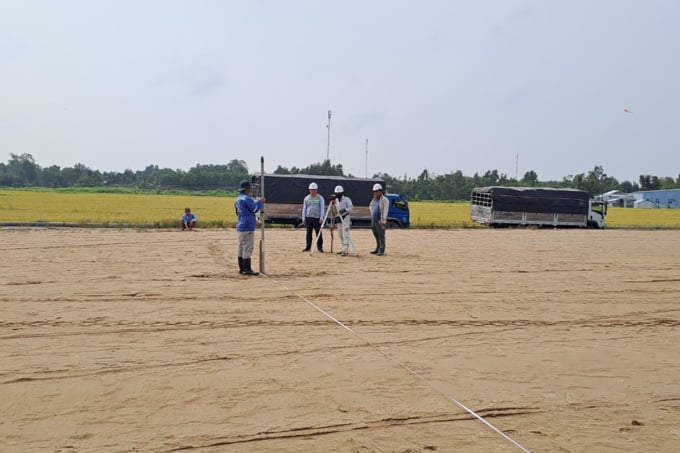
Inspecting the quality of the embankment for the North-South Expressway section through Long My district, Hau Giang province, in March 2024. Photo: Phuong Linh
According to Mr. Le Viet Hung, Deputy Director of the Cement and Concrete Center (Institute of Building Materials), crushed sand is currently produced by 73 enterprises in 25 provinces with a total capacity of 8.6 million cubic meters per year. Provinces with many crushed sand factories include Lang Son, Ha Nam, Thanh Hoa, Hoa Binh, Ba Ria-Vung Tau, Dong Nai, and Binh Duong... due to their availability of stone and proximity to large consumer markets such as Hanoi and Ho Chi Minh City. In 2020, these localities consumed 4.1 million cubic meters of crushed sand.
Crushed sand is of sufficient quality for road embankment construction, but its cost is 250,000-300,000 VND/m3, while the government's unit price for leveling sand is around 80,000 VND/m3. Due to the high price, crushed sand is mainly used for concrete and mortar, and is not suitable for leveling and embankment construction in transportation projects.
Furthermore, the Mekong Delta does not have many quarries for crushing sand. "Using artificial sand to replace leveling sand for transportation projects would be inefficient, construction costs would be high, and contractors would incur losses," Mr. Hung said.
In response to National Assembly representative Nguyen Huy Thai (from the Bac Lieu Provincial National Assembly Delegation) in early March, the Prime Minister stated that the demand for sand for leveling in key transportation projects in the Mekong Delta region is approximately 50 million cubic meters. If artificial sand were to completely replace natural sand, it would require the exploitation of large quarries, the deployment of numerous production lines to meet the demand, and a much higher cost compared to natural sand. Therefore, using artificial sand to replace natural sand for road embankment is not feasible.
New sea sand samples are being tested on a small scale.
To replace the shortage of natural sand resources, experts believe that sea sand is the most effective alternative to leveling sand. Mr. Le Viet Hung stated that Vietnam's seas have great potential for mineral resources used in construction. The Ministry of Natural Resources and Environment has identified 30 promising areas with a total estimated resource of nearly 150 billion cubic meters, including the sea areas of Binh Thuan, Ba Ria - Vung Tau, Soc Trang, Phu Quoc - Ha Tien, Hai Phong - Quang Ninh provinces, etc., which could be planned for exploration and exploitation.
Soc Trang's sea sand meets the 2006 Vietnamese standards for construction and leveling materials. Currently, Tra Vinh and Kien Giang provinces have licensed the exploitation of sea sand for leveling the foundations of large coastal projects such as thermal power plants or residential areas built on reclaimed land. Kien Giang has licensed the exploitation of sea sand with a reserve of 15 million m3 and an exploitation capacity of nearly 5 million m3/year.
To ensure a sufficient supply of sand for embankment in transportation projects in the Mekong Delta, following the Prime Minister's directive, in 2023 the Ministry of Transport implemented a pilot project in Tra Vinh province to use sea sand as a substitute for river sand. Monitoring and evaluation were conducted, and a ministerial-level council was established to assess the pilot project's results. The pilot section using sea sand is 320 meters long on Provincial Road 978.
According to representatives from the Ministry of Transport, the sea sand used for the pilot section meets the physical and mechanical properties requirements for road embankment materials as specified in TCVN 9436:2012. The summary report on construction and inspection shows sufficient grounds to use sea sand for road embankment construction under saline environmental conditions similar to the pilot project's test area. Sea sand is considered for use in the subgrade, embankment, and roadbed areas under live load.
However, because the pilot project was only implemented on a small scale, with a lower design level than a highway, and the quality of sea sand was only studied for one area (a sea sand mine in Tra Vinh province), the technical regulations and standards regarding salinity for crops and livestock are incomplete. Therefore, the widespread use of sea sand for road construction needs to be further piloted and expanded to a larger-scale project with a higher design level.
Dr. Thai Duy Sam, Vice President of the Vietnam Association of Building Materials, believes that the Ministry of Transport needs to conduct an environmental impact assessment when using sea sand on a large scale, as there are concerns about the potential for sea sand to cause salinization, affecting crops and plants. In addition, localities need to quickly survey and plan areas where sea sand can be used to avoid environmental impact and prevent coastal erosion risks similar to those associated with river sand mining.
Source link


























































































Comment (0)