

Elevating the national financial system
One of the specific tasks outlined in the Politburo 's Resolution 79 on the development of the state-owned economy is the comprehensive restructuring of the State Capital Investment and Business Corporation (SCIC) towards professional capital business, aiming to establish a national investment fund; focusing resources from capital restructuring in enterprises and other state-allocated resources to invest in the development of large-scale enterprises and highly efficient enterprises; investing in projects in technology, innovation, and digital transformation sectors that are crucial to the economy. Simultaneously, it aims to implement direct investment and provide support resources for state-owned enterprises (SOEs) to invest abroad; and to carry out mergers and acquisitions to access new technologies, core technologies, strategic technologies and industries, or for high-profit objectives. There is an independent monitoring mechanism for the transfer and management of SCIC's capital in enterprises, ensuring that enterprise restructuring and capital investment are carried out effectively, at market value, and in full compliance with legal regulations.

A rendering of Vietnam's first semiconductor chip factory, invested in by Viettel . The national investment fund will expand its operations, signaling a push to promote the development of priority industries.
PHOTO: VIETTEL
Supporting this goal, many economic experts believe that the formation of a National Investment Fund is entirely correct and necessary. This shift in mindset represents a leap forward in the professional management of state capital, contributing to the upgrading of the national financial system and attracting more domestic and foreign resources to the economy. Economist Dinh Tuan Minh commented that the comprehensive restructuring of SCIC and the formation of a National Investment Fund expands the functions, tasks, and powers of this company. The role of the National Investment Fund is primarily to ensure the safety and growth of state assets. This is similar to the national investment funds that have developed in the Middle East, Norway, Sweden, Singapore, etc. Investment funds in many countries are growing stronger, corresponding to an increase in national assets, becoming a pillar of the national economy. SCIC itself will no longer be a purely state-owned enterprise but will expand into many activities, potentially becoming "seed capital" or creating a directional signal for development in many business sectors that the state wants to promote…
According to economist Tran Anh Tung (Head of Business Administration Department, Faculty of Business Administration, Ho Chi Minh City University of Economics and Finance), after the model transformation, SCIC's new role is no longer limited to simply "holding" or "divesting" capital, but is being repositioned as the state's strategic investment arm. The core change lies in Resolution 79's requirement for a comprehensive restructuring of SCIC towards professional capital business, moving towards the formation of a national investment fund with very clear tasks. This means that SCIC is being pulled away from a passive capital management mindset to a role of allocating national capital according to market logic but serving long-term development priorities. "For the whole year of 2025, SCIC's revenue is estimated to reach over 12,000 billion VND and after-tax profit of approximately 11,000 billion VND, an increase of about 15% compared to the same period. These figures show that SCIC is not starting from scratch, but already has the capacity to move into the role of 'the Government's investor'," Mr. Tung assessed.
Expand investment and create new channels for capital flow into the market.
According to economist Dinh Tuan Minh, SCIC previously operated as a national investment fund, but its activities were quite limited; mainly focusing on divesting, retaining, or increasing investment capital in state-owned enterprises, and rarely proactively investing in other entities. Meanwhile, national investment funds in many countries can invest in any enterprise. For example, Temasek Holdings, wholly owned by the Singaporean government, invests in various sectors, including finance, telecommunications, transportation, real estate, technology, and renewable energy… not only in Singapore but also in many countries, including Vietnam. This group has become a leading global investor, significantly increasing Singapore's national assets. Therefore, after comprehensive restructuring, SCIC can invest in any company if it sees strong growth opportunities. He cited examples, saying that SCIC could continue to hold investments in Vietnam Airlines, the oil and gas corporation, and the electricity sector, but could also allocate investment capital to Vietjet Airlines or corporations like Vingroup and Sun Group… Or, if it assesses that certain sectors do not need investment encouragement, SCIC could withdraw all its capital, thereby increasing national assets and promoting stronger business development. This investment policy also truly shows that the state treats all businesses equally. Notably, the flow of state capital through the National Investment Fund will create a new signal in the market, contributing to attracting more domestic and foreign capital.

The national investment fund will inject capital into any domestic or foreign business. Pictured is a rendering of the Can Gio reclaimed land urban area project by Vingroup.
PHOTO: VG
"The primary goal of the National Investment Fund is to preserve national capital, then increase capital to bring about general welfare for the people. In addition, based on the fund's investment decisions, the Government can signal the promotion of development in priority economic sectors, such as investing heavily in railway infrastructure development or chip and semiconductor development, while divesting from cement, consumer goods, or even telecommunications companies… This also contributes to attracting more investment capital into important, prioritized sectors of the nation," shared expert Dinh Tuan Minh.
Analyzing the significance of the strategic model transformation in more detail, Mr. Tran Anh Tung argued that if the goal of establishing a National Investment Fund based on SCIC is fully implemented, this will be the first time Vietnam has a state-owned investment institution with a logic close to a "Sovereign Wealth Fund" (SWF), meaning it not only holds assets but also proactively invests, restructures, and creates value. In terms of the macroeconomy, a truly national investment fund can help Vietnam solve the problem of capital shortage for strategic sectors such as high technology, new infrastructure, innovation, digital transformation, and overseas investment to access technology. In the context of Vietnam setting higher growth targets for the 2026-2030 period, the question is not just "how much capital is available" but "where the capital goes and with what efficiency." The National Investment Fund will help create a satisfactory solution to this problem. The second impact is on Vietnamese businesses.
A well-functioning national investment fund can play a leading role in providing capital, especially for businesses with the potential to become top players but lacking long-term capital or access to technology. This is crucial given that many Vietnamese private companies have reached a point where bank loans alone are insufficient to achieve regional scale. If the new SCIC can co-invest, share long-term risks, and support technology mergers and acquisitions, Vietnamese businesses will have the opportunity to scale up faster and improve their quality more deeply. The third impact concerns the structure of the capital market. An economy aiming to overcome the middle-income trap cannot rely solely on short-term bank credit. A national investment fund, if properly developed, will contribute to the formation of long-term capital, patient capital, and strategic capital. This is the greatest value, as it supplements both the budget and credit, creating a new capital channel for quality growth.
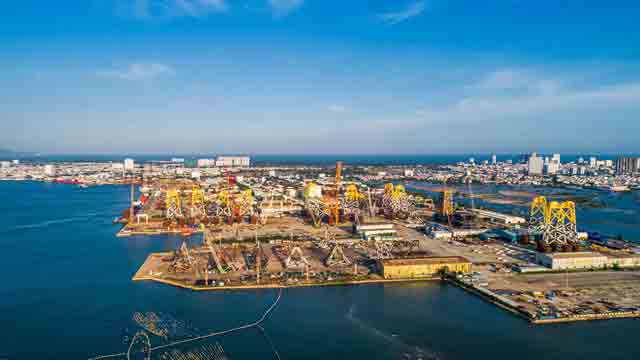
The offshore wind farm construction site of the Vietnam Oil and Gas Group. The national investment fund will contribute to promoting stronger business development.
PHOTO: PVN
Completely separate the roles of corporate governance.
Economist Dinh Tuan Minh believes that for the National Investment Fund to operate effectively, Vietnam should first learn from the operational models of some successful government investment funds around the world. Most importantly, the role of the investment fund must be completely separated from the management of the invested enterprises. For example, SCIC should not participate in appointing or proposing enterprise leaders, but only hold shares with the right to veto leadership appointments if it deems them unsuitable for national goals and interests. Similarly, SCIC should not participate in the operation of enterprises, even if it owns a majority stake. This means that the management of enterprises needs to be completely independent, like any other company in the market. He emphasized: When the state clearly demonstrates its non-involvement in the operations of companies and corporations, foreign investors will be more confident in investing in these entities than before, when there was still some "shadow" of state management. The way a company is managed is crucial because it can influence its ability to attract foreign investment into many sectors in Vietnam in the future.
Meanwhile, while praising SCIC's transformation, economist Tran Anh Tung also noted that SCIC's biggest challenge lies not in the idea itself, but in its operational mechanism. A truly effective state-owned investment institution must possess three crucial conditions: sufficiently large and stable capital, strong investment autonomy, and a sufficiently professional governance and supervision system. Currently, SCIC has achieved good business results and investment experience, but it still operates within a rather cumbersome legal and administrative framework. This means that the speed of decision-making, the ability to accept risks, the mechanism for rewarding investment personnel, and the ability to execute complex transactions may still be limited. Compared to Temasek of Singapore, the biggest gap is not in the name but in the level of marketization, as Temasek operates as a commercial investor with very flexible portfolio decision-making power. Meanwhile, SCIC is currently in a transitional phase, much smaller in scale, and more importantly, must reconcile profit objectives, policy objectives, and the administrative and legal framework. Therefore, simply saying "learn from Temasek" without deeply reforming the mechanism will make it very difficult to achieve the essence of Temasek.
Comparing it to Malaysia's Khazanah sovereign wealth fund, we see a model closer to Vietnam in terms of state structure. Khazanah is expected to have net assets of approximately 105 billion ringgit at the beginning of 2026, up from 103.6 billion ringgit the previous year, while still paying dividends to the government. This demonstrates that a sovereign wealth fund can both pursue profits and serve national goals, provided there is a clear governance framework and transparent key performance indicators (KPIs). Similarly, the UAE's Mubadala fund is even larger, with assets under management of approximately 1,200 billion dirhams in 2024, heavily focused on AI, technology, clean energy, and future infrastructure.
"The lesson learned is that every fund is linked to national priorities, but it is only effective when it has investment autonomy coupled with public discipline and accountability. For SCIC, the existing challenge is that many laws regulate it, and the boundary between administrative management and market investment is not yet clearly separated. Resolution 79 actually correctly identified this when it required an independent monitoring mechanism for the transfer and management of SCIC's capital, ensuring efficient investment at market prices. This is a very important point, but the journey from identification to implementation is a long one," Mr. Tran Anh Tung commented.
Creating a strong development message for Vietnam.
The restructuring of SCIC, the formation of a national investment fund, and even the change in its name, conveys a message of abandoning the mindset of managing state capital. This signals to domestic and foreign investors that the Vietnamese government will no longer directly participate in the operations of state-owned enterprises (SOEs). Alongside the tasks outlined in Resolution 79, the governance of SOEs is also undergoing significant changes towards modernization, aligning with international practices. When foreign investors see the changed governance model of SOEs, they will be more confident in investing and injecting capital into these entities if the state needs to divest. This will contribute to attracting more foreign investment into Vietnam, boosting economic development.
Economist Dinh Tuan Minh
Resolution 79 is a landmark resolution.
This is a landmark resolution because it addresses the issue of state-owned economic development in a fairly comprehensive way for the first time, not only from the perspective of state-owned enterprises but also encompassing all state resources. The biggest new aspect is that the resolution does not view the state-owned economy in the narrow sense of "100% state-owned enterprises," but rather takes a broader view encompassing state capital in enterprises, the budget, reserves, infrastructure, resources, and state financial funds. Resolution 79 shifts the thinking from "maintaining a leading role through ownership" to "maintaining a leading role through efficient resource allocation." The resolution clearly states: State economic resources must be fully reviewed and accounted for according to market principles, assessing social benefits and costs in accordance with international practices, and the state-owned economy must be a pioneer in creating development, with science and technology, innovation, and digital transformation as the main driving forces. This is a pivotal institutional "impetus" to redefine the role of the state economy in a new context: becoming the leading material force, the "conductor" regulating the macroeconomy, and the shield guaranteeing economic independence and autonomy.
Economist Tran Anh Tung , University of Economics and Finance, Ho Chi Minh City.
Source: https://thanhnien.vn/viet-nam-se-co-quy-dau-tu-quoc-gia-185260307213504605.htm


![[Image] Close-up view of the interchange connecting the two expressways and Long Thanh Airport.](https://vphoto.vietnam.vn/thumb/1200x675/vietnam/resource/IMAGE/2026/05/25/1779703378210_ndo_br_z7863716673926-224453a31600126cce10622af6290afd-4549-jpg.webp)


![[Image] Hanoi's urban life under the challenge of a "scorching hot" environment](https://vphoto.vietnam.vn/thumb/1200x675/vietnam/resource/IMAGE/2026/05/25/1779706979265_nang-nong-t5-2026-minh-duy-7-4636-jpg.webp)






























































































Comment (0)