

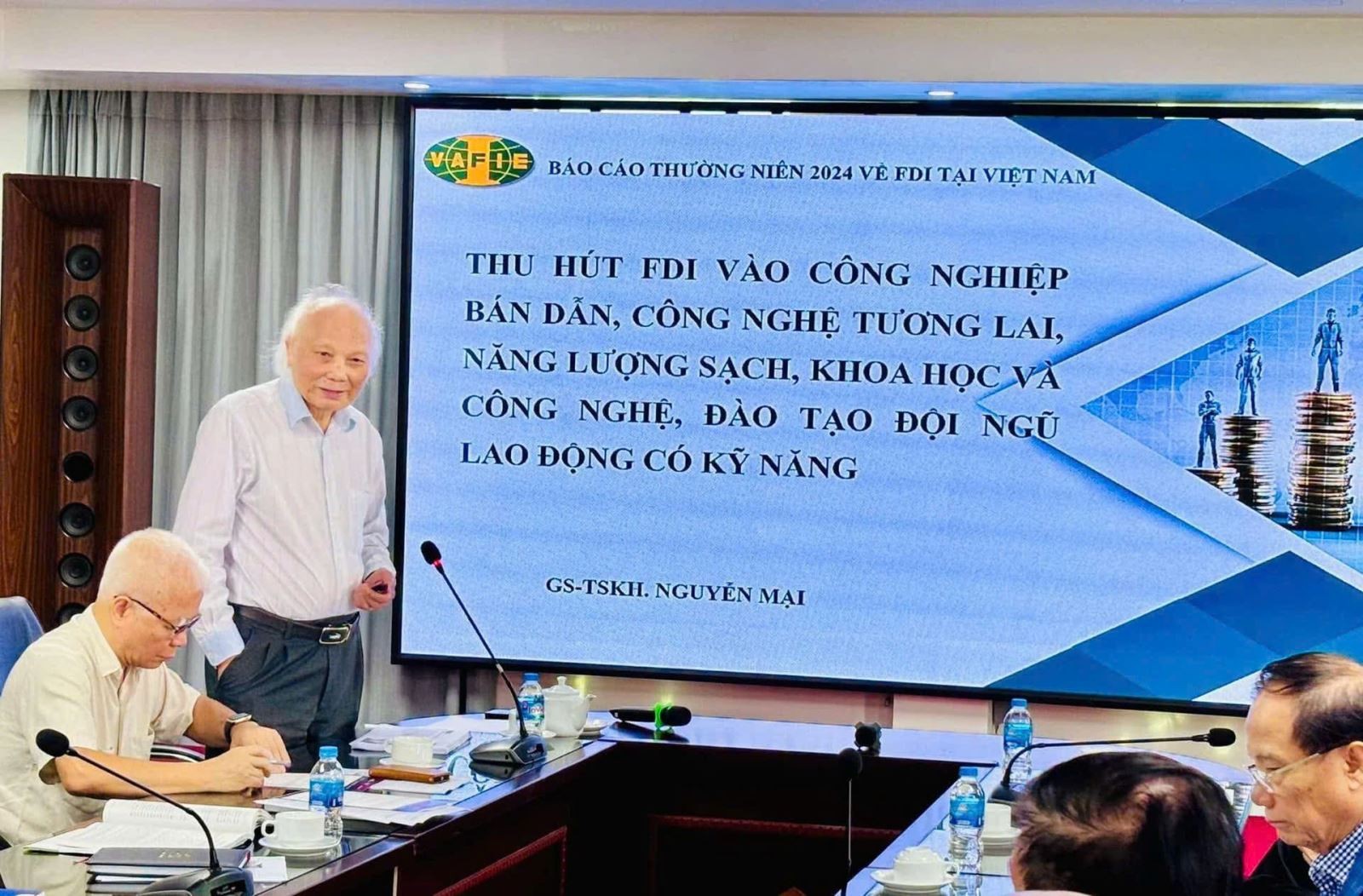
Forecasting opportunities for attracting FDI in 2025, Professor Nguyen Mai believes that the global political , economic, trade, and investment situation remains volatile and unpredictable, creating challenges for Vietnam's economic growth and FDI attraction.
However, Vietnam is still considered a successful model in attracting FDI thanks to its increasingly完善 institutional and business environment, stable political foundation, and high economic growth potential. Among these, sectors in Vietnam that are particularly attractive to foreign investors include the semiconductor industry, future technologies, clean energy, science and technology, etc.

To "improve the quality" of foreign investment, aiming to achieve the goal of the digital economy accounting for approximately 30% of GDP by 2030, according to Professor Nguyen Mai, Vietnam needs to increase the proportion of state budget investment in research and development (R&D), innovation, and encourage businesses to establish R&D centers and transfer technology through tax incentives and financial support policies.
"In addition, it is necessary to attract domestic and international resources to invest in the development of new industries such as artificial intelligence, information technology, and high value-added industries; focus on investing in training digital-generation citizens, reforming education and training so that the new generation of citizens has the knowledge, skills, and adaptability to the circular economy and digital economy growth model," Professor Nguyen Mai proposed.
Vietnam needs to transform its growth model to rely on modern technology and high-quality human resources, increasing national competitiveness; minimizing licensing procedures and investment project implementation; and strengthening support for investors and businesses facing difficulties.
Highly appreciating VAFIE's annual FDI report, experts emphasized that the report was meticulously and scientifically prepared, with carefully selected data and practical surveys, leading to many good recommendations and solutions for management agencies. However, in reality, the global socio-economic situation has been fluctuating rapidly since the beginning of the year, with many unknowns that are difficult to fully anticipate. Therefore, in order to make forecasts and recommendations for attracting FDI in 2025, the drafting committee needs to continue research to provide useful information for businesses and policymakers.
Presenting the report, Professor Dr. Nguyen Mai, the report's editor, assessed that Vietnam continues to be a positive exception in attracting foreign direct investment (FDI) amidst a volatile global and regional context. Specifically, FDI implemented in Vietnam reached US$22 billion in 2023 and is projected to reach US$25 billion in 2024 – impressive figures showing that international capital continues to trust and choose Vietnam as a long-term investment destination.
This year's annual report highlighted new investment trends that foreign businesses are increasingly interested in: strategic industries such as semiconductors, renewable energy, high technology, and high-quality human resource training. Specifically, businesses from Denmark, France, Belgium, South Korea, and Taiwan highly value the potential of offshore wind power in Vietnam; Japan shows particular interest in the clean energy sector; while South Korea plans to boost investment in key sectors such as semiconductors, artificial intelligence (AI), big data, and renewable energy.
Source: https://baolaocai.vn/viet-nam-van-thu-hut-nhieu-nha-dau-tu-ngoai-post400318.html


![[Photo] General Secretary and President To Lam and the President of the Philippines hold talks.](https://vphoto.vietnam.vn/thumb/1200x675/vietnam/resource/IMAGE/2026/06/01/1780283481955_vna-potal-tong-bi-thu-chu-tich-nuoc-to-lam-va-tong-thong-philippines-hoi-dam-8797519-1429-jpg.webp)














































































Comment (0)