

Meat exports decreased in volume but increased in value.
According to data from the Customs Department, in the first four months of 2026, Vietnam exported approximately 5,700 tons of meat and meat products, earning $40.8 million. Compared to the same period in 2025, export volume decreased by 20.8%, but value increased by 2.9%. This is noteworthy, indicating that the average export price tends to increase, partially offsetting the decrease in volume.
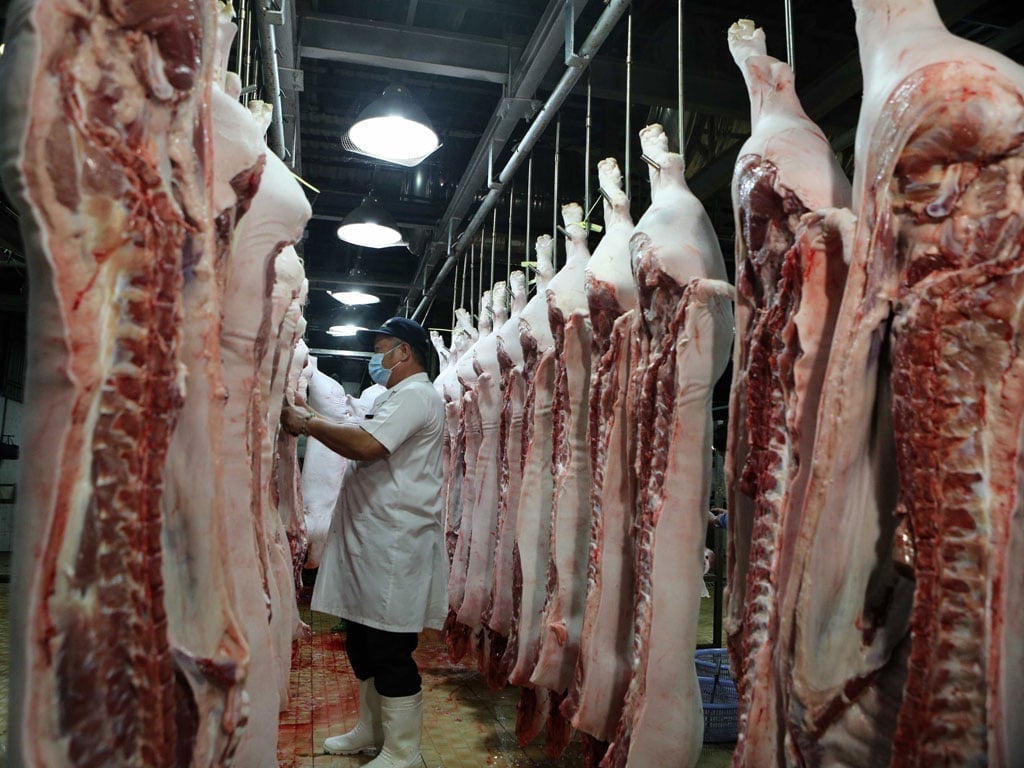
Vietnamese meat products have expanded to 25 international markets. Photo: NNMT.
Vietnam's export market continues to be maintained with 25 countries and territories. Of these, Hong Kong (China) remains the largest market, accounting for 37.25% of total volume and 46.4% of total export value. However, exports to this market decreased sharply, reaching only 2.1 thousand tons, equivalent to 18.93 million USD, a decrease of 41.6% in volume and 24.7% in value compared to the same period last year.
This decline reflects a number of factors, from changing market demand to increasingly fierce competition from other suppliers. Nevertheless, Hong Kong remains the "locomotive" of Vietnam's meat exports, especially for traditional products such as frozen whole suckling pigs and frozen whole pork carcasses.
Exports to Hong Kong, not just Hong Kong, but also to other markets such as Canada, Malaysia, South Korea, Spain, and Lebanon have recorded a downward trend. Conversely, some markets have seen positive growth, notably China, France, Singapore, the United States, and Cambodia. This indicates an ongoing market shift, opening up opportunities for diversifying outlets for Vietnam's livestock and meat processing industry.
In terms of product structure, pork continues to play a leading role in exports. In the first four months of the year, fresh, chilled, or frozen pork accounted for 40.29% in volume and 50.24% in value. However, exports of this product group also decreased significantly, reaching only 2.3 thousand tons, worth 20.5 million USD, a decrease of 24.6% in volume and 12.7% in value compared to the same period in 2025.
Imports increased sharply, putting competitive pressure on the domestic market.
In contrast to exports, imports of meat and meat products in the first four months of 2026 increased sharply. Total imports reached 313.07 thousand tons, with a value of up to 928.83 million USD, an increase of 11.2% in volume and, notably, a significant increase of 37.6% in value compared to the same period in 2025.
India continues to be Vietnam's largest supplier market, accounting for nearly 24% of total imports, with 74.4 thousand tons, worth $310.11 million. Growth from this market is impressive, reaching 31.6% in volume and 59.4% in value, respectively.
In addition, imports from many other markets such as the United States, Canada, Spain, Germany, Türkiye, and Italy also increased sharply. Conversely, some markets such as Russia, South Korea, Poland, and Argentina recorded decreases.

Imports of meat and meat products increased sharply in the first four months of 2016. Photo : NNMT.
In terms of structure, poultry meat and poultry by-products accounted for the largest share in terms of volume (37.27%), while frozen buffalo meat accounted for 31.9% in terms of value. Imported pork accounted for 13.77% in volume and about 10% in value, indicating that domestic pork supply is still able to meet most of the demand.
A notable point is the downward trend in the price of imported pork. In the first four months of the year, the average price of imported pork was only $2,143 per ton, a decrease of 19.3% compared to the same period last year. This contributes to increasing the competitiveness of imported meat in the domestic market.
However, in the domestic market, live pig prices are showing signs of recovery. In May 2026, live pig prices in all three regions increased compared to the previous month. Specifically, in the North, prices ranged from 66,000–70,000 VND/kg, in the Central and Central Highlands regions from 68,000–69,000 VND/kg, while in the South, prices reached the highest level, from 69,000–71,000 VND/kg.
This price increase reflects a potential contraction in domestic supply, while consumer demand remains stable. At the same time, input costs and international market developments also significantly impact domestic prices.
Vietnam's meat import and export figures for the first four months of 2026 show a clear divergence: exports faced difficulties in terms of volume but still maintained value, while imports increased sharply to meet domestic demand.
In the coming period, the livestock and meat processing industry needs to continue promoting diversification of export markets, reducing dependence on a few traditional markets. At the same time, it is necessary to improve quality and develop deeply processed products to increase export value.
Conversely, controlling imports, ensuring a balance between supply and demand, and protecting domestic production are also issues that need careful consideration. Only by harmoniously addressing both import and export aspects can Vietnam's meat industry achieve sustainable development in the context of increasingly deep integration.
Source: https://nongnghiepmoitruong.vn/viet-nam-xuat-khau-thit-sang-25-thi-truong-d814058.html
![[Image] A brilliant symphony and explosive power in the skies of Da Nang.](https://vphoto.vietnam.vn/thumb/1200x675/vietnam/resource/IMAGE/2026/05/31/1780196945787_anh-man-hinh-2026-05-31-luc-10-08-51.png)






















![[Video] Sunset at Lap An Lagoon – Where the sun sets over the fishing nets](https://vphoto.vietnam.vn/thumb/340x192/vietnam/resource/IMAGE/2026/05/31/1780192137701_beach-landscape-sea-water-nature-grass-745871-pxhere-com.jpeg)








































































Comment (0)