

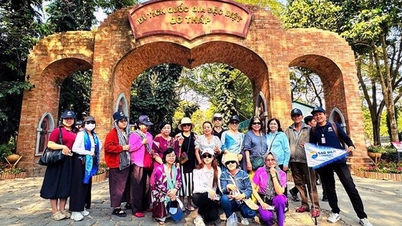
The Cai Ngang Revolutionary Historical Site was started on October 23, 2002, and inaugurated on August 9, 2003. The site housed the headquarters of the Vinh Long Provincial Party Committee from 1966 to 1975. It was here that the Provincial Party Committee led the people and military of the province to victory in the Tet Offensive of 1968; and the Ho Chi Minh Campaign of April 30, 1975, which resulted in a general offensive and uprising.
The site almost completely recreates the daily life, work, and battles of the Provincial Party Committee and specialized departments within the base, under the care and protection of the people. Seeing firsthand the images, artifacts, and functional buildings; hearing stories about the living, working, and fighting conditions, we further appreciate and admire the sacrifices, resourcefulness, and courage of our ancestors in protecting peace and independence for today's generation.
With just a simple thorny bridge, built in the style of a makeshift monkey bridge in the waterways of the Mekong Delta, the soldiers cleverly cut the bridge in half at the bottom and strategically placed sharp iron spikes beneath the stream. When the enemy crossed, the bridge would break, and the spikes would pierce them, causing injury and terror among their comrades.
Inside the base, various types of bunkers were constructed and arranged. Each type of bunker was built using methods suited to the natural conditions, intended use, and combat requirements of the base. There were secret bunkers for shelter; for observing combat and providing cover, there were fortifications and trenches; and for inflicting casualties or limiting the enemy's offensive power, there were spiked bunkers and booby traps.
In particular, the functional buildings within the base—the guardhouse, meeting hall, mess hall, information center, and security guard house—were all constructed using wood and leaves, designed to be compact and hidden within the gardens to avoid detection by the enemy and to facilitate mobility during combat. Exploring these buildings, we realize the difficulties, shortages, and dangers faced, and we admire even more the clever and flexible inventions of the comrades in the specialized departments of the base at that time. There were versatile and practical sets of tables and chairs that could be set up as writing desks during meetings and reassembled into beds at night. Simple bamboo mats could be used to display food and for resting after hours of work and combat. The cooking stoves were incredibly simple, just a small hole dug and three small bricks placed on top to serve as cooking vessels. To avoid detection by the enemy, the comrades had to cook very early in the morning or after sunset. In the morning, smoke still clung to the treetops, so the comrades in the mess hall had to climb up and shake them to disperse the smoke.
The Cai Ngang revolutionary historical site nurtures love for the homeland, the will to overcome difficulties, and sacrifices, enabling generations to confidently continue the tradition and firmly protect the achievements of the revolution. Contributing to this is the monument of Heroic Vietnamese Mother Nguyen Thi Ngọt – a representative Heroic Vietnamese Mother of Vinh Long province – respectfully placed within the site's grounds. Her husband and six children bravely sacrificed their lives in the two wars of resistance to defend the nation. The monument aims to honor and express gratitude to Heroic Vietnamese Mother Nguyen Thi Ngọt in particular, and to Heroic Vietnamese Mothers of Vinh Long province in general.
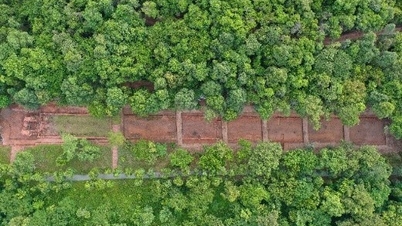
The Cai Ngang Revolutionary Historical Site attracts visitors not only for its historical value and traditional educational significance but also for its fresh, cool air, spacious grounds, and well-arranged greenery and ornamental plants that complement the site's atmosphere. Perhaps the most impressive aspect is the richness and diversity of the pristine garden, featuring familiar and characteristic plant species closely associated with the historical and cultural life of the Mekong Delta's riverside orchards. Inside the site are towering rows of crape myrtle trees, firmly rooted in the village and protecting the homeland; water chestnut trees with their vibrant blossoms; lush green bushes of bougainvillea laden with fruit; and climbing plants like the Chinese evergreen, the longan, and the rambutan, intertwining and spreading across the trunks of cassava, Terminalia catappa, and other trees, providing ample shade for the entire garden. Nestled beneath the cool, green canopy, visitors can enjoy the sounds of birds singing, the calls of wild animals like frogs, toads, and reptiles. Adding to this are the pristine, naturally growing plants, thriving like floating vegetable gardens along the canals, such as water spinach, water hyacinth, elephant ear plants, and duckweed. Occasionally, looking down at the pond, one can spot schools of fish swimming playfully, a delightful sight.
The Cai Ngang Revolutionary Historical Site is a representative historical landmark, a significant site for educating about revolutionary traditions, and also a suitable place for recreation and experiences for most visitors. Therefore, since its inauguration, the site has attracted hundreds of thousands of visitors. In 2016, the site was honored to be recognized as a National Historical Site by the Ministry of Culture, Sports and Tourism, becoming one of eleven nationally ranked historical sites in the province.
















































![[Photo Collection] Beautiful Ao Dai (traditional Vietnamese dress) for Tet (Lunar New Year) photos](https://vphoto.vietnam.vn/thumb/402x226/vietnam/resource/IMAGE/2026/01/10/1767997205400_5j_20260109142705.jpeg)








Comment (0)