

The VNVC vaccination system plans to distribute the dengue fever vaccine from Takeda Corporation if it is licensed for use in Vietnam.
On September 28th, VNVC Vaccination System held a signing ceremony for a memorandum of understanding on strategic cooperation with Takeda Pharmaceuticals (Asia Pacific) Co., Ltd., abbreviated as Takeda, a subsidiary of Takeda Group (Japan).
At the signing ceremony, VNVC and Takeda agreed to implement various activities to promote awareness and enhance professional knowledge among healthcare staff regarding dengue fever prevention measures, including dengue fever vaccination.
Specifically, the two sides will cooperate in organizing scientific conferences, workshops, and training courses on dengue fever and dengue fever vaccines for VNVC's medical staff, and will also coordinate communication activities to raise community awareness about vaccination and dengue fever prevention.
Furthermore, the collaboration also aims to develop a model for predicting dengue vaccine demand, helping people access the new dengue vaccine from Takeda if it is licensed for use in Vietnam.
Present at the signing ceremony, Dr. Nguyen Ngo Quang, Deputy Director of the Department of Science, Technology and Training ( Ministry of Health ), expressed his hope that the cooperation between Takeda and VNVC would bring benefits to the people in the near future. "We hope that Vietnamese people will have access to dengue fever vaccines as soon as possible," said Dr. Quang.
Speaking at the ceremony, Associate Professor Tran Dac Phu, former Director of the Department of Preventive Medicine and Senior Advisor to the Vietnam Center for Emergency Response to Public Health Events, expressed his hope that the signing ceremony between VNVC and Takeda would be successful and that dengue fever vaccines could soon be brought to Vietnam. "Of course, the vaccine must meet the standards and requirements for effectiveness and safety to be brought into Vietnam," added Professor Phu.
Takeda's dengue vaccine, TAK-003 (registered trade name QDENGA), has been licensed for use in over 30 countries, including the European Union (EU), the United Kingdom, Argentina, and countries experiencing recent dengue outbreaks such as Indonesia, Brazil, and Thailand. Currently, the vaccine is not licensed for distribution in Vietnam.
Test results show that QDENGA can generate varying levels of immune response to all four circulating strains of Dengue virus, helping to prevent the disease and reduce the likelihood of hospitalization in infected individuals.
According to the European Medicines Agency (EMA), the body that licensed the QDENGA vaccine in the EU, this vaccine has been approved for use in children from the age of 4, regardless of whether they have previously been infected.
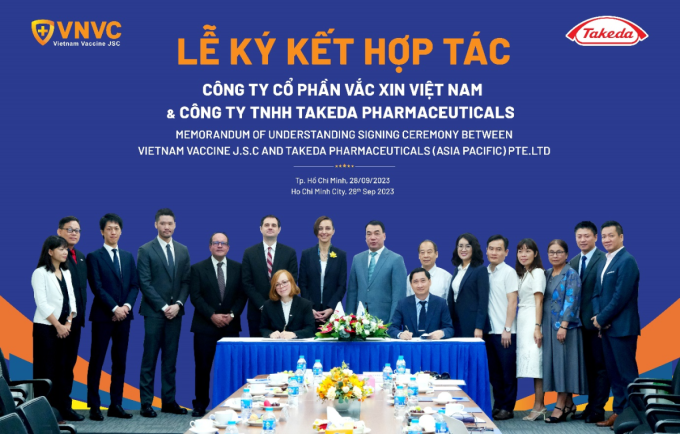
Representatives from Takeda Vietnam and VNVC vaccination system signed a memorandum of understanding for strategic cooperation on September 28 in Ho Chi Minh City. Photo: Thanh Tung
At the signing ceremony, Mr. Ngo Chi Dung, Chairman of the Board of Directors and General Director of VNVC Vaccination Center System, shared that with its comprehensive capabilities, experience in vaccine preservation, and strategic partnership with many major vaccine manufacturers worldwide, VNVC is always seeking and ready to cooperate with manufacturers to promptly bring new generation vaccines such as dengue fever, shingles, hand, foot and mouth disease, and hepatitis B to serve the Vietnamese people.
"One of VNVC's commitments is to bring the most comprehensive range of high-quality vaccines, equivalent to those in developed countries, to the Vietnamese people. This collaboration opens up prospects for applying advanced measures to prevent dengue fever, especially through dengue fever vaccines, in the future in Vietnam," Mr. Dung expressed his expectations.
Ms. Katharina Geppert, Chief Representative of Takeda Vietnam, shared that the cooperation between the two sides will help bring Takeda's high-quality preventive and healthcare solutions closer to the Vietnamese people. "We highly appreciate the strength of cooperation between healthcare partners in each country to jointly address public health challenges, including solutions in dengue fever prevention," Ms. Katharina Geppert said.
On the same day, Takeda also continued its collaboration with the Pasteur Institute of Ho Chi Minh City to organize a scientific workshop on dengue fever prevention and control. This is an important event within the framework of activities commemorating the 50th anniversary of the establishment of diplomatic relations between Vietnam and Japan.
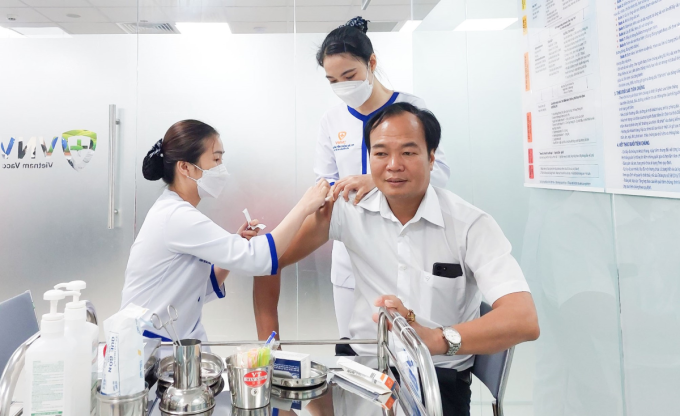
VNVC is a vaccination center capable of storing over 300 million doses of internationally standardized vaccines at any given time. Photo: Tuyet Huynh
According to the World Health Organization (WHO), dengue fever is ranked among the top 10 global health challenges, with up to 40% of the world's population living in areas at risk of dengue infection. Vietnam is one of the leading countries in terms of the number of cases, with an estimated more than 200,000 cases per year.
Dengue fever presents with unpredictable and complex symptoms, commonly affecting both children and adults. It is estimated that approximately 10%-30% of people with severe dengue fever require hospitalization each year.
According to the Ministry of Health, from the beginning of the year to August 25th, the whole country recorded 66,386 cases of dengue fever, including 14 deaths. Many localities recorded a high increase in the number of cases. For example, Hanoi recorded 10,372 cases of dengue fever, including 3 deaths. Compared to the same period in 2022, the number of cases increased nearly fourfold, while the number of deaths remained similar.
The Department of Preventive Medicine, Ministry of Health, forecasts that climate change, with the prolonged El Nino phenomenon in 2023-2024, will create favorable conditions for mosquito breeding. This presents an opportunity for mosquito-borne infectious diseases, especially dengue fever, to spread.
Yen Chi
Source link
![[Photo] General Secretary and President To Lam and the President of the Philippines hold talks.](https://vphoto.vietnam.vn/thumb/1200x675/vietnam/resource/IMAGE/2026/06/01/1780286997787_anh-man-hinh-2026-06-01-luc-11-09-43.png)
![[Photo] Reception to welcome General Secretary and President To Lam and his wife on their State visit to the Philippines](https://vphoto.vietnam.vn/thumb/1200x675/vietnam/resource/IMAGE/2026/06/01/1780295488620_vna-potal-chieu-dai-chao-mung-tong-bi-thu-chu-tich-nuoc-to-lam-va-phu-nhan-tham-cap-nha-nuoc-toi-philippines-8798060-7855-jpg.webp)































































Comment (0)