

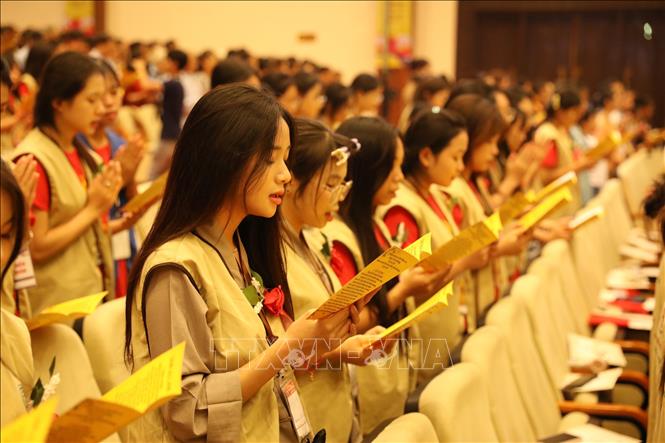
Performing Buddhist rituals during the Vu Lan Festival. Photo: Duc Phuong/VNA
The Vu Lan Festival of Buddhism has long been intertwined with the philosophy and cultural tradition of filial piety and gratitude, the "drinking water, remembering the source" principle of the Vietnamese people. This is a time for each person to practice and deeply engrave the vow of filial piety towards their parents, grandparents, and loved ones, and also a time to remember and express gratitude to ancestors, national heroes, martyrs, and the forefathers of the Vietnamese people.
Spreading the values of filial piety in society.
The origin of the Vu Lan festival comes from the Vu Lan Bon Sutra in Buddhism. The story tells that Venerable Maudgalyayana, the Buddha's most powerful disciple, saw his mother after her death suffering as a hungry ghost, tormented by hunger and thirst. Out of compassion, he used his supernatural powers to offer her food, but the food turned into red flames, and she could not eat it. Distressed, Maudgalyayana sought out the Buddha to ask for his help. The Buddha taught that to save one's parents from suffering, one must rely on the power of the Sangha – those who practice pure and virtuous conduct. On the fifteenth day of the seventh lunar month, after the rainy season retreat, he should prepare offerings to the Three Jewels. Through the divine power of the Sangha gathered on the day of the self-confession ceremony, his mother would be liberated. The Vu Lan festival was born from this.
Today, Vu Lan is not just a ritual but has become deeply ingrained in the consciousness and human emotions, becoming a way of life, a rhythm of breathing, a source of inspiration for countless Vietnamese hearts. In 2025, the Vu Lan season, coinciding with the 80th anniversary of National Day on September 2nd, has become a sacred time for every Buddhist to practice filial piety and honor the tradition of "drinking water and remembering the source."
Throughout the country, temples and places of worship organized the Vu Lan Festival, a celebration of filial piety, with rituals such as pinning roses, chanting scriptures, offering incense, and lighting candles to express gratitude. These ceremonies were held to show appreciation to parents and to remind people of their responsibility to be grateful to the country and the nation.
At Tam Chuc Pagoda (Ninh Binh), the "Vu Lan - Gratitude to Parents and the Nation" program, featuring a lantern lighting ceremony forming the shape of the map of Vietnam, was held with the participation of nearly 500 students and over 2,000 Buddhists; at Bang Pagoda - Linh Tien Temple ( Hanoi ), the Vu Lan - Rose Pinning Ceremony attracted thousands of Buddhists; Truc Lam Hung Quoc Pagoda (Son La) organized the Vu Lan ceremony with rituals of chanting scriptures, reciting Buddha's name, offering flowers, and pinning roses, spreading the spirit of filial piety and compassion. At Phuoc Hoi Pagoda (Ho Chi Minh City), venerable monks and nuns, along with all Buddhist followers, solemnly chanted the Ullambana Sutra, recalling the story of Venerable Mục Kiền Liên rescuing his mother from suffering, thereby highlighting filial piety and the merit of offering alms to the monks... In a serene atmosphere, the congregation prayed for their living parents to have increased blessings and longevity, for their deceased parents to attain liberation, and to awaken in each Buddhist follower the awareness of caring for their parents and repaying the four profound debts of gratitude – to parents, teachers, country, and all sentient beings.
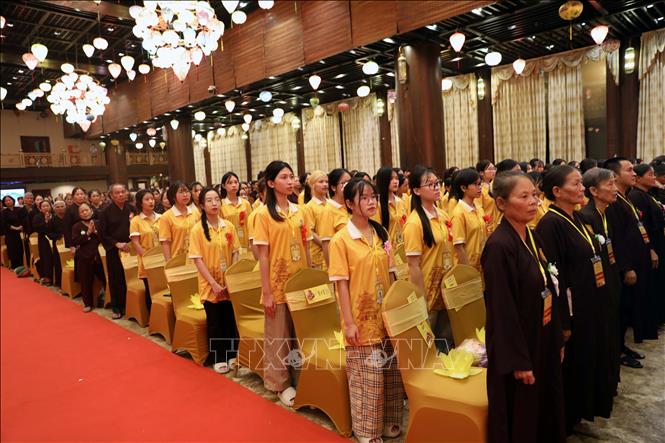
The Vu Lan Festival was attended by over 500 students from universities across the country and nearly 2000 Buddhist monks and nuns. Photo: Nguyen Chinh/TTXVN
In particular, the Vu Lan art exchange night "Filial Piety and the Sacred Soul of the Fatherland," organized by the Vietnam Buddhist Association on the evening of August 25th, along with a series of activities throughout the Vu Lan season (offering incense in gratitude at the Truong Son Martyrs' Cemetery in Quang Tri ; the "Nurturing Love" journey of donating books, school supplies, and scholarships for the new school year to students in the mountainous regions of Northwest Vietnam...), has had a strong impact on a large number of Buddhists and the general public who revere Buddhism; contributing to spreading the beautiful humanistic, humane, and karmic values of filial piety in society.
Venerable Thich Gia Quang, Vice Chairman of the Executive Council and Head of the Central Information and Communication Committee of the Vietnam Buddhist Sangha, stated that in Buddhist doctrine, filial piety is not limited to the parent-child relationship but is expanded to encompass the Four Great Debts: the debt to parents for giving birth and raising them – the root of all filial piety; the debt to the Three Jewels and teachers – the debt of their guidance and education; the debt to the nation and society – remembering those who have sacrificed for the country; and the debt to all living beings – gratitude for the mutual support of all creatures in life. Filial piety not only expresses the duty of children to their parents but also extends to filial piety towards the Dharma, towards the community, the nation, and towards life itself.
Let filial piety become a torch that illuminates the path of life.
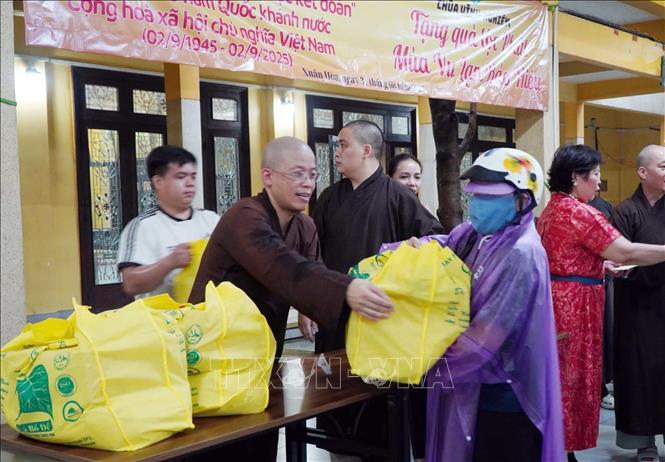
Monks, nuns, and Buddhist followers of Vinh Nghiem Pagoda donate gifts to the poor and those in difficult circumstances. Photo: VNA.
The five core elements of filial piety in modern life, highlighted in the Vu Lan - Filial Piety and Nation program organized by the Vietnam Buddhist Association in 2025, are: Filial piety, Respectful filial piety, Etiquette, Loyalty, and Trustworthiness.
Filial Piety - The Source of Spirituality: "A filial heart is a Buddha's heart, filial conduct is a Buddha's conduct." This teaching not only reminds us of our duty as children, but also forms the foundation for those who practice the Dharma. Filial piety is the root that allows a Buddhist to mature in wisdom and compassion. Filial piety stems from reverence for the Three Jewels, from a yearning for the light of truth and the principles of human conduct. A person who practices filial piety lives a life of self-improvement, preserving their virtue and cultivating themselves to become better, not only for themselves but also for those they love and respect.
Filial Piety - Complete Affection: Filial piety is not just love, but also gratitude and respect. Filial piety teaches us to live humbly, respectfully, and to cherish traditional moral values in the family and society. Filial piety is not limited to thoughts or words, but is expressed in respectful glances, loving actions, and a life of gratitude and reciprocation. Filial piety is an attitude of cherishing our parents, grandparents, teachers, and all those who have supported us with all our hearts.
Filial Piety and Respect - A Cultural Lifestyle: Filial piety and respect are expressed through behavior, speech, bowing to parents, paying homage to Buddha, and respecting sacred conventions in the national culture. Knowing how to bow respectfully, speaking with moderation, and living harmoniously with others are manifestations of filial piety and respect. No filial piety is truly complete without tact, humility, and the beauty of conduct in every small aspect of daily life.
Filial Piety and Loyalty – Devotion to the Nation: The homeland is the beginning and end of every journey of filial piety. Filial piety and loyalty are silent sacrifices, gratitude to those who have contributed, actions lived for the community and for things higher than oneself. Filial piety is also unwavering loyalty to the country, dedication to the community, and living for a greater cause. Loyalty and filial piety are inseparable; those who are filial to their ancestors will inevitably be dedicated to the nation, willing to devote themselves to the public good and the common future.
Filial piety and trustworthiness – Upholding faith: This means maintaining honesty, deeply believing in the law of cause and effect, and living up to the trust placed in one by parents and society. A filial child is one who lives uprightly, keeps their word, and fulfills their duties – as the Buddha taught: "Nothing is more noble than trustworthiness, nothing is more enduring than filial piety." Filial piety also means keeping promises, living with compassion and righteousness. As a child and as a person, living in a way that brings peace of mind to parents and earns the trust of society is the essence of filial piety and trustworthiness. It is the culmination of sincerity and action, of faith and virtue.
According to Venerable Thich Gia Quang, filial piety is essential in the current development of the country. We cannot simply pursue material things while neglecting the spiritual aspects of culture, morality, and filial piety. Filial piety is not only about parents and relatives but also about society and the nation. Morality and filial piety contribute to the full and positive development of society. For today's young generation, guiding them towards morality and filial piety is crucial. They need to understand the immense debt of gratitude they owe to their parents for giving them life and raising them; they need to know that the peaceful and joyful life they enjoy today is thanks to the sacrifices made by their ancestors for the country.
Emphasizing the virtues of filial piety, gratitude, and reciprocity, and being thankful for one's ancestors, Buddhist teachings promote the practice of cultivating a fragrant heart. Among all flowers, even the most exquisite ones only carry their fragrance with the wind; only the fragrance of the heart spreads in all directions, defying the wind and even the laws of nature. Filial piety is one of these fragrant virtues; how can this fragrance spread and permeate the lives of every family and every individual, regardless of religion, skin color, or ethnicity? Vu Lan is not just a festival, but a journey of living to show gratitude: Love while you can, show filial piety through actions, and let filial piety become a torch illuminating your life's path – affirmed Venerable Thich Gia Quang.
Source: https://baoangiang.com.vn/vu-lan-hanh-trinh-song-de-tri-an-a460864.html


























































Comment (0)