


As an "industrial hub" with a large population, one might expect Binh Duong 's traditional markets to be bustling, but the reality is not as good as expected.
Thu Dau Mot Market is located in a prime location in Phu Cuong Ward, Thu Dau Mot City, Binh Duong Province, but the stalls in this market are always deserted and quiet. Seeing a customer approaching her stall, Mrs. Muoi (60 years old, a vendor selling ready-made clothes) eagerly offered her goods.
Business is slow, with little to no profit.
Ms. Mười's stall, measuring about 8 square meters, is quite simple and lacks fashionable designs that follow current trends. Ms. Mười said that the golden age of her clothing stall was about 15-20 years ago, when she needed 2-3 helpers to keep up with demand, earning several million dong a day. Now, even earning 100,000 dong a day is difficult. "Now, there are tons of cheap goods online, so we're just doing business on a silver platter, hoping for the best. Luckily, the monthly rent is only 800,000 dong, so there's no pressure, and we can just get by," Ms. Mười sadly recounted.
Looking over at the kiosk next door, a woman was lying in a hammock, scrolling through her phone, even though it was peak shopping time (around 10 a.m.). Unlike Mrs. Muoi, Mrs. Thuan (49 years old), despite seeing customers, wasn't very welcoming. "I'm used to people mainly just looking at the clothes, asking for prices, then politely refusing, or complaining that the prices are higher than online, so I just have to accept it," Mrs. Thuan said. In the past few years, the monthly income from her family's clothing stall has only been a meager 3-4 million VND. The sharp decrease in income has forced them to drastically cut back on daily expenses.
According to our research, the majority of small traders selling goods in traditional markets are elderly people. Therefore, changing jobs or finding a new business option is something few consider; only those who rent stalls or kiosks at high prices seek alternative business ventures because they can no longer afford the rent.
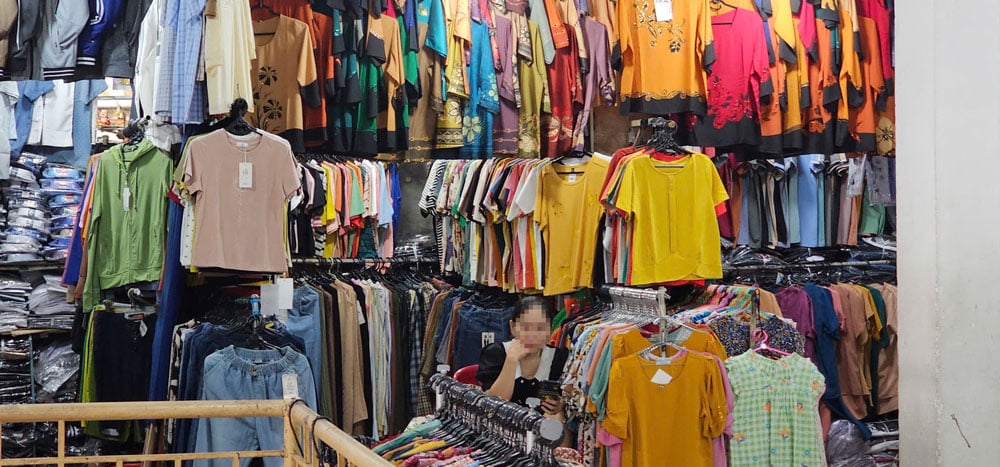
The general situation at traditional markets in Binh Duong is that there are very few customers.
A stroll through the markets in other bustling areas like Thuan An, Di An, or Tan Uyen reveals a common scene: vendors scrolling through their phones, chatting in small groups when bored, or simply sleeping in hammocks or on folding chairs when too tired. In these markets, stalls are almost empty, with only a few customers occasionally coming in to inquire about purchases.
According to Ms. Phan Thi Khanh Duyen, Deputy Director of the Department of Industry and Trade of Binh Duong province, there are currently 95 markets operating throughout the province, including 2 Class 1 markets, 15 Class 2 markets, and 78 Class 3 markets. Of these, 69 markets are invested in, operated, and managed by businesses; 26 markets are managed through Market Management Teams.
Implement all 6 solutions simultaneously.
Regarding the business performance of traditional markets, Ms. Duyen stated that most markets are currently facing numerous difficulties, partly due to traders' slow adaptation to new trends and consumer demands. Furthermore, traditional markets are facing unfair competition from numerous informal business locations scattered throughout Binh Duong province.
In light of the above situation, the Department of Industry and Trade is coordinating with the People's Committees of localities to review and analyze the causes, assess the difficulties and obstacles in order to support the operation of this traditional distribution channel and find directions and solutions to help traditional markets adapt and develop appropriately.
Accordingly, the Department of Industry and Trade has proposed six solutions to help traditional markets overcome difficulties in their business operations.
The department has coordinated with the People's Committees of districts and cities to review and assess the local trade and service development plan, the consumption needs of the people, and the current infrastructure of markets. Based on this, it has advised the Provincial People's Committee to issue a plan for the development of the domestic market in the period up to 2030, with a vision to 2050. This includes outlining a roadmap for upgrading, renovating, and building new traditional markets towards modern and civilized commerce; in line with the urbanization rate and population growth of the locality, and meeting the needs of the people.
In addition, the department will attract investment and encourage economic entities to participate in market business; encourage the transfer of markets to capable enterprises for management and operation through auction and bidding activities. Furthermore, it will improve the legal framework for market management. The department will implement solutions to support small traders in accessing and familiarizing themselves with online business methods in cyberspace.
This includes creating conditions for small traders to participate in the Binh Duong e-commerce platform and other major e-commerce platforms; providing cashless payment solutions; online sales solutions; Market 4.0...
In addition, it is necessary to strengthen efforts to completely resolve the issue of spontaneous business areas and locations, preventing their recurrence and the emergence of new ones; and to organize and arrange for spontaneous vendors to conduct business in vacant traditional markets in the area.
An economic expert observed that, in order to attract customers, small traders in traditional markets must change their service practices; improve service quality; ensure the sale of safe food with clear origins and sources; enhance competitiveness with similar goods on the market; and proactively approach online business channels to keep up with market trends and customer needs.
Auction conducted through a public-private partnership model.
Recently, the Nguoi Lao Dong newspaper has received many complaints about the Dong Tam market project in Dong Tam commune (Dong Phu district, Binh Phuoc province), which was built 20 years ago but has been left abandoned, with its components severely dilapidated.
"We had hoped the market would be a place for exchanging goods, creating momentum for local development and benefiting the people, but who would have thought it would be so deserted?" - said Ms. Nguyen Thi Hoa, who lives near Dong Tam market.
According to our research, Dong Tam Market is located about 80 meters from National Highway 14. It was built in 2005 with an area of about 1.2 hectares and a budget of 3.45 billion VND from the National Target Program under Program 135/1998/QD-TTg.
Mr. Pham Xuan Thach, Deputy Head of the Economic and Infrastructure Department of Dong Phu District, stated that the ineffective operation of Dong Tam Market is due to its location far from the central area and sparsely populated. Furthermore, the market's design is unsuitable, causing difficulties for traders and residents in their buying and selling activities. Regarding future solutions, Mr. Thach said that the Dong Phu District People's Committee plans to organize an auction through a socialized model.
S. Hung
Source: https://nld.com.vn/vuc-day-cho-truyen-thong-196250217204651664.htm























































































Comment (0)