

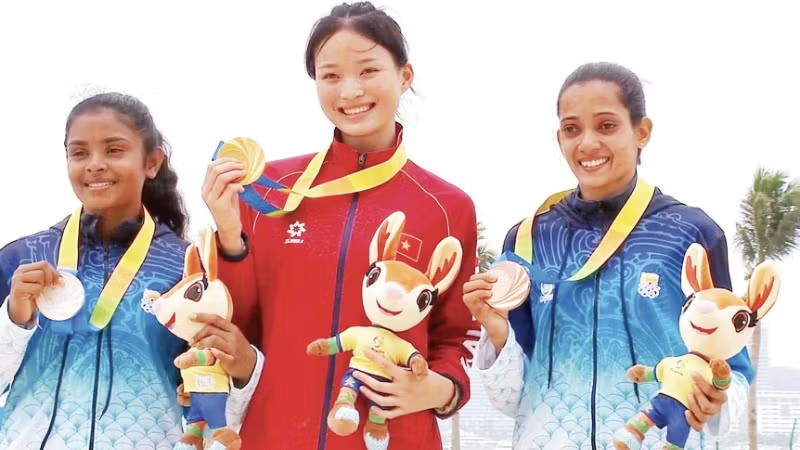
The runs and jumps on the sand at the 6th Asian Beach Games currently taking place in Sanya, China (from April 21st to May 1st) not only brought valuable medals, but also opened up a more positive prospect for Vietnamese athletics on its journey towards a bigger stage - the 20th Asian Games in Japan from September 19th to October 4th.
The fact that Ha Thi Thuy Hang won the gold medal in the women's long jump with a performance of 6.16m, followed by Pham Van Nghia's victory in the men's long jump with 7.44m, is not simply a matter of individual wins. It affirms the adaptability, competitive spirit, and depth of Vietnamese athletics in the context of increasingly fierce competition in the region.
In the unique conditions of beach athletics – where technique, physical fitness, and mental stability are all severely tested – Vietnamese athletes have proven that they are not only competitive but also capable of excelling. This is significant because success in such a demanding environment usually reflects a comprehensive physical foundation and skills, core elements when competing on the continental stage.
However, looking at the bigger picture, those gold medals are just the beginning of a larger problem: How to translate success on the beach into real achievements at the Asian Games, which will bring together Asia's leading athletics powerhouses. Vietnam's recent athletics history shows inconsistency: from two silver medals in 2014, to a surge with two gold medals in 2018, and then a complete failure at the most recent Games. This fluctuation reflects the gap that has not been sustainably narrowed between Vietnam and strong athletics nations like China, Japan, or South Korea. In this context, the goal of winning at least one gold medal at the 20th Asian Games is not only an ambition for achievement but also a test of the effectiveness of years of investment strategy.
Key athletes like Nguyen Thi Oanh, Hoang Nguyen Thanh, and Nguyen Trung Cuong continue to maintain their form and serve as the backbone of the team. However, the crucial challenge lies in creating a breakthrough – something Vietnamese athletics has achieved before but hasn't consistently maintained. Therefore, the emergence of new talents, from Thuy Hang and Van Nghia to other young athletes, is opening up hope for a new cycle of success, where youth and experience can complement each other.
From a professional standpoint, these positive signs are not accidental. Behind them lies a systematic preparation process, from focusing resources and designing individual training plans for each discipline to increasing international exposure. Sending athletes to train and compete in international competitions has helped them become accustomed to pressure and improve their technical skills, especially in disciplines that were previously weak points, such as sprinting. Simultaneously, investments in equipment, nutrition, and psychological support are gradually improving, creating a more professional training environment.
It is noteworthy that the current approach focuses not only on traditional strengths but also aims to expand competitiveness in events that previously offered few medal opportunities. However, challenges remain: events such as javelin throw, shot put, and long-distance races still require long-term investment, while the gap in skill level with the top Asian teams cannot be narrowed overnight. This necessitates not only significant resources but also unwavering commitment to the development strategy.
Looking ahead, the 20th Asian Games is not just a tournament, but a landmark event shaping the future of Vietnamese athletics. Success or failure here will reflect the maturity of the entire system, from youth training and coaching to management and investment. Gold medals on the beach may not be a guarantee of success in larger competitions, but they are certainly a positive sign confirming that Vietnamese athletics still has the potential to break through if it follows the right path.
In the context of increasingly competitive regional and continental sports, leveraging the morale boosts like those at ABG 6 is essential, but more importantly, it must be transformed into long-term motivation. If this can be achieved, the journey from running on sand to the podium at the Asian Games will no longer be a distant dream, but a feasible goal, opening a new chapter for Vietnamese athletics on the Asian sports map.
Source: https://nhandan.vn/vuot-cat-nong-huong-den-asiad-2026-post959050.html

![[Image] Close-up view of the interchange connecting the two expressways and Long Thanh Airport.](https://vphoto.vietnam.vn/thumb/1200x675/vietnam/resource/IMAGE/2026/05/25/1779703378210_ndo_br_z7863716673926-224453a31600126cce10622af6290afd-4549-jpg.webp)



![[Image] Hanoi's urban life under the challenge of a "scorching hot" environment](https://vphoto.vietnam.vn/thumb/1200x675/vietnam/resource/IMAGE/2026/05/25/1779706979265_nang-nong-t5-2026-minh-duy-7-4636-jpg.webp)



















































































Comment (0)