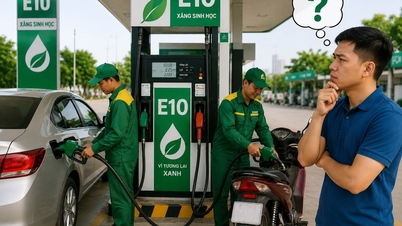
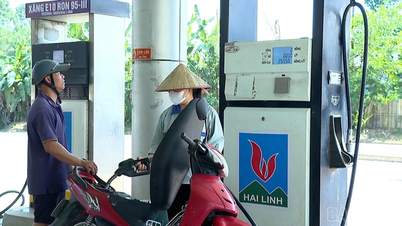
E10 gasoline helps agricultural products reduce their dependence on market outlets.
According to the Ministry of Industry and Trade , when E10 gasoline is rolled out nationwide, the demand for ethanol will be approximately 92,000 - 100,000 m³ per month. Meanwhile, domestic production currently only reaches about 25,000 m³/month, with the remaining 75,000 m³ to be imported. Global ethanol supply is currently quite abundant, especially from the US and Brazil. Regarding domestic production, Vietnam currently has four operating ethanol plants located in Dong Nai, the former Quang Nam, Dak To (formerly Kon Tum, now part of Quang Ngai), and Quang Ngai. Two other plants in the former Binh Phuoc (now part of Dong Nai) and former Dak Nong (now part of Lam Dong) are still undergoing restructuring and technological improvements.

Cassava is the main raw material for ethanol production in Vietnam.
Photo: Thanh Quan
Deputy Minister of Industry and Trade Nguyen Sinh Nhat Tan emphasized that the development and use of biofuels brings many important benefits, especially in terms of energy security, environmental protection, and contributing to promoting agricultural production by expanding local markets for certain agricultural products.
Ethanol production projects in Vietnam primarily use cassava chips as raw material. According to previous studies, producing 100 million liters of ethanol requires 250,000 tons of dried cassava chips, equivalent to 600,000 tons of cassava tubers. On average, each hectare of land planted with high-yield cassava varieties produces 20 tons. Therefore, the land area needed to supply raw materials for an ethanol plant is approximately 30,000 hectares.
In Vietnam, cassava has been a billion-dollar export commodity for many years, albeit quietly. As of 2024, the total cassava cultivation area nationwide was 511,000 hectares, distributed across many provinces and cities. The total national cassava production reached 10.4 million tons, with an average yield of 20.4 tons/ha. Provinces with high yields include Tay Ninh (33.3 tons/ha) and Dong Nai (25-27 tons/ha).
In 2025, cassava exports are expected to bring Vietnam $1.26 billion, making us the world's third-largest exporter. On the other hand, customs data analysis shows that while export volume is projected to increase by over 52.2% in 2025, the revenue will only increase by 9.8%. According to experts and the Vietnam Cassava Association, the main reason for this significant increase in volume while value remains relatively low is the low price and the dependence on the Chinese market for 94% of production. Facing economic pressure from other crops, the area under cassava cultivation is continuously shrinking. In the development plan for this sector until 2030, the Ministry of Agriculture and Rural Development has adjusted the area down to approximately 480,000 hectares, a reduction of about 30,000 hectares compared to the current area. Furthermore, the export target is set at $1.8-2 billion. Therefore, if Vietnam boosts ethanol consumption and production, it will have abundant raw materials at competitive prices. This will also help expand local markets for cassava products and contribute to increasing export value.
In terms of production, the resumption of operations at biofuel plants is a positive sign for Vietnamese cassava producers. This is also reflected in Government Directive 07, issued at the end of February 2026, which assigns the Ministry of Agriculture and Environment to research policies for developing raw material areas for biofuel production, prioritizing non-food crops, agricultural by-products, and circular economy models.
From a country with an advantage in agriculture, we will become one of the leading countries in the field of bioenergy in the future… However, the barriers we must overcome are a fragmented agricultural sector, limited connectivity, and inconsistent infrastructure, resulting in low utilization of by-products in ethanol production. Therefore, in the initial phase, we need sufficiently good policies to attract investment in this field; building an efficient supply chain and processing infrastructure.
Associate Professor Dr. Nguyen Hong Quan, Vietnam National University Ho Chi Minh City
From agricultural powerhouse to leader in bioenergy?
Globally, there are currently three major ethanol producers. The United States leads with approximately 65 million cubic meters, primarily using corn as its raw material. Brazil ranks second, with production roughly half that of the US, sourcing its raw materials from sugarcane. India follows, with production about one-tenth that of the US. A key advantage of this Asian nation is its flexibility in using various raw materials, including corn, sugarcane, and rice. The "boom" in India's ethanol industry is also driven by the fact that its gasoline blending rate now reaches E20.
Dr. Nguyen Huu Hoang, Director of the Center for High-Tech Application Research in Agriculture (Faculty of Science, Vietnam National University Ho Chi Minh City), commented: In the context of increasingly limited global oil supply, the use of biofuels means partially self-sufficiency in energy needs. This is a sustainable solution, especially for a country with a competitive advantage in agriculture like Vietnam. Biofuel, or more specifically ethanol, is produced from the fermentation of various agricultural products such as corn, cassava, and even some agricultural by-products including sawdust and straw. The industrial-scale alcohol fermentation process consumes a large amount of agricultural products or by-products. This process converts low-value raw agricultural products into biofuels. For example, in India, when low-grade rice prices plummet, they use it to produce ethanol. Furthermore, this conversion requires special, high-efficiency yeast strains that domestic units are currently unable to produce independently. This is a challenge that Vietnamese businesses must overcome.
Sharing the same view, Associate Professor Dr. Nguyen Hong Quan, Director of the Institute for Circular Economy Development Research - ICED (Vietnam National University Ho Chi Minh City), said: "We have great potential in ethanol production because we are a country with a strong agricultural sector. From agricultural products to by-products, everything can be developed to produce ethanol. Vietnam can also take advantage of the agricultural raw material advantages of downstream Mekong River countries such as Laos and Cambodia to develop the ethanol industry. These countries can also become our ethanol consumption market if the product is truly good enough. Thus, from a country with an advantage in agriculture, we will become one of the leading countries in the field of bioenergy in the future. In the theory of the circular economy, even surplus food in a large city like Ho Chi Minh City can be utilized to produce industrial ethanol. However, the barriers we must overcome are the fragmented agricultural sector, limited connectivity, and unsynchronized infrastructure, making it difficult to utilize by-products." The input of raw materials into ethanol production is low. Therefore, in the initial phase, sufficiently good policies are needed to attract investment in this sector; building an efficient supply chain and processing infrastructure."
The commitment to using biofuels is not only about achieving energy self-sufficiency and net-zero emissions. It is also about ensuring the market development of the bio-industry and biotechnology sector, a new development trend.
Dr. Nguyen Huu Hoang, (Faculty of Science, Vietnam National University Ho Chi Minh City)
Source: https://thanhnien.vn/xang-e10-giup-gia-tang-gia-tri-nong-san-viet-185260528214441366.htm




![[Image] Nearly 125,000 Hanoi students completed the Literature exam for the 10th grade entrance exam.](https://vphoto.vietnam.vn/thumb/1200x675/vietnam/resource/IMAGE/2026/05/30/1780117233041_ndo_br_thiet-ke-chua-co-ten-2-png.webp)




























































































Comment (0)