

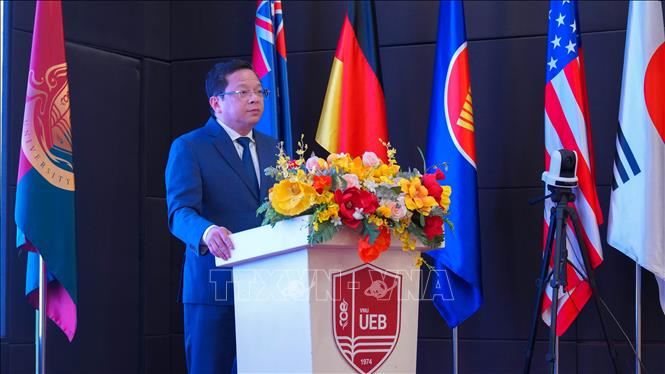
At the Forum, Mr. Nguyen Duc Hien, Deputy Head of the Central Policy and Strategy Committee, highly appreciated the University of Economics (Vietnam National University, Hanoi) for its pioneering role in organizing international forums and its important policy advice contributions to the socio-economic development of the country.
Mr. Nguyen Duc Hien noted that, amidst the volatile global economy, Vietnam continues to maintain a positive growth rate. In 2024, Vietnam's GDP growth rate reached a high of 7.09%, ranking among the leading countries in ASEAN and Asia; affirming Vietnam as a safe and attractive destination for international investors. This provides a solid foundation for expanding cooperation with Australia – a strategic partner with strong potential and a leading reputation in the region.
As of the beginning of this year, Australia is among the leading countries in direct investment in Vietnam with 670 investment projects totaling US$1.863 billion, providing A$3 billion in official development assistance (ODA) over the past 50 years. Bilateral trade reached US$14 billion in 2024. Currently, Australia is Vietnam's ninth largest trading partner, while Vietnam ranks tenth among Australia's largest trading partners. These figures demonstrate the enormous potential for cooperation between the two countries, particularly in the fields of trade, investment, education , and science and technology.
The two countries can jointly implement research, development, and technology transfer projects, promote bilateral trade, and expand cooperation in new areas such as digital transformation, energy transition, and climate change response. This cooperation will not only boost economic growth but also contribute to addressing global challenges and promoting shared peace, stability, and prosperity.
“It is important to emphasize building trust and mutual understanding through cultural and educational exchanges. The increasing number of scholarship programs, research collaborations, and student exchanges between the two countries is vivid evidence of long-standing trust and commitment, creating a solid foundation for sustainable economic and social cooperation,” said Mr. Nguyen Duc Hien.
In the coming period, the two countries need to focus on building and implementing concrete cooperation programs with clear objectives, practical actions, and measurable results. This process requires flexibility, adaptability to global changes, and is based on the principles of equality, mutual benefit, and mutual respect. From there, both sides can propose breakthrough and substantive solutions, contributing to continuing the success story of Vietnam-Australia relations in the 21st century, bringing benefits to the people of both countries, the region, and the world .
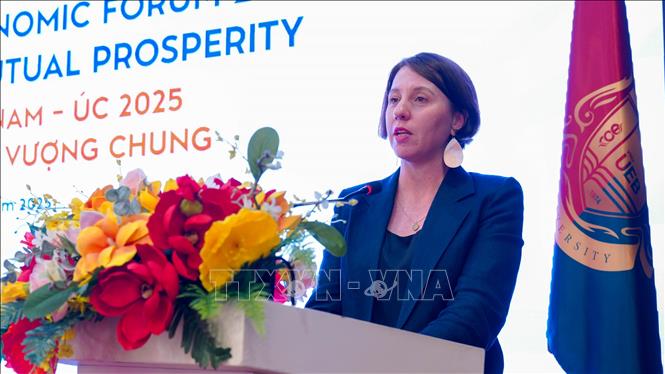
Highly appreciating the Forum's organizing committee for bringing together experts at the event, Deputy Ambassador of Australia to Vietnam Renee Deschamps emphasized that the Forum's theme, "Building Bridges to Shared Prosperity," clearly reflects the spirit of cooperation between Australia and Vietnam. The Vietnam-Australia relationship is built on a foundation of people-to-people ties, mutual trust, and shared interests, fostering cooperation for the economic development of both countries and the region to ensure shared prosperity. The establishment of a Comprehensive Strategic Partnership between the two countries demonstrates strategic trust and a commitment to long-term, comprehensive cooperation in many important areas, including digital transformation, climate change resilience, clean energy, innovation, and education.
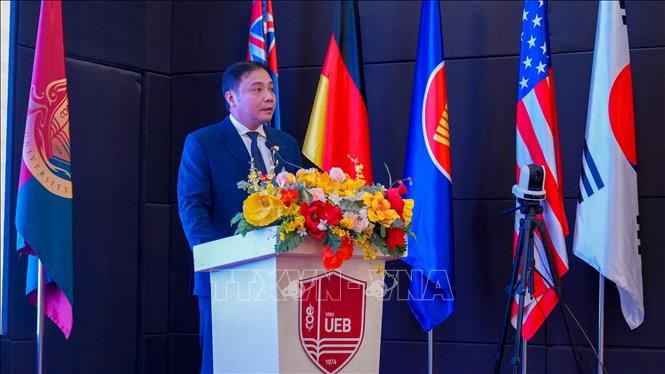
Speaking at the Forum, Associate Professor, Dr. Dao Thanh Truong, Vice Director of Vietnam National University, Hanoi, affirmed that the Forum is clear evidence of the positive contributions of the University of Economics and Vietnam National University, Hanoi in implementing breakthrough research that aligns with global trends. With the participation of leading experts, the Forum provides important arguments for the process of national policy planning and evaluation, especially in the development of the foreign-invested economic sector in Vietnam, including Australia. This is a significant step forward, helping Vietnam integrate more deeply into the regional and global economy, shaping a sustainable future that meets the stringent requirements of the digital age.
According to Associate Professor, Dr. Dao Thanh Truong, more than 80,000 Vietnamese students have studied or are currently studying in Australia, and over 200 educational institutions in both countries participate in diverse collaborations. Universities in Vietnam and Australia have conducted more than 5,000 joint research projects.
In the context of a global economy rapidly shifting towards digitalization, greenness, and sustainability, both Vietnam and Australia face new opportunities and challenges. Vietnam has the advantage of a young workforce, competitive costs, and a strategic geographical location in Southeast Asia; while Australia possesses advanced technology, a high-quality education system, and the governance capacity of a developed economy. This complementarity creates a solid foundation for a comprehensive, effective, and sustainable partnership, enhancing the standing of both countries in the region and internationally.
The achievements made would not have been possible without the contributions of the business community, organizations, and individuals both domestically and internationally who have strived to promote Vietnam-Australia cooperation. It is this perseverance that has transformed commitments into concrete results, taking bilateral relations further.
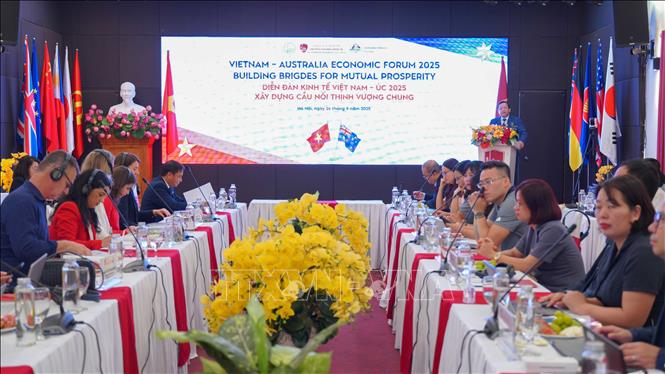
As a leading higher education institution in Vietnam, ranked among the top 401-600 universities in the world according to the Times Higher Education rankings, Vietnam National University, Hanoi is committed to promoting the internationalization of education and strengthening Vietnam's ties with the world, including Australia. This not only enhances the prestige of Vietnamese education internationally but also opens up opportunities for multifaceted cooperation in training, research, and knowledge transfer, aiming to build an internationally recognized education system.
At the Forum, delegates discussed and agreed on the importance of linking policies, businesses, and universities, proposing feasible solutions to realize common priorities, from digital commerce, innovation, and sustainable development to training high-quality human resources.
Source: https://baotintuc.vn/thoi-su/xay-dung-cau-noi-thinh-vuong-chung-viet-nam-australia-20250926151306605.htm

![[Photo] General Secretary and President To Lam presides over a meeting with the Central Organizing Committee.](https://vphoto.vietnam.vn/thumb/1200x675/vietnam/resource/IMAGE/2026/06/03/1780482764658_a1-bnd-4741-3342-jpg.webp)

![[Photo] Secretary of the National Assembly Party Committee, Chairman of the National Assembly presides over the meeting of the Standing Committee and Executive Committee of the National Assembly Party Committee.](https://vphoto.vietnam.vn/thumb/1200x675/vietnam/resource/IMAGE/2026/06/03/1780480353201_ndo_br_bnd-2585-jpg.webp)

































![[Video] Sunset at Lap An Lagoon – Where the sun sets over the fishing nets](https://vphoto.vietnam.vn/thumb/1200x675/vietnam/resource/IMAGE/2026/05/31/1780192137701_beach-landscape-sea-water-nature-grass-745871-pxhere-com.jpeg)






![[Photo] General Secretary and President To Lam attends the 14th Congress of the Vietnam Trade Union](https://vphoto.vietnam.vn/thumb/402x226/vietnam/resource/IMAGE/2026/06/04/1780543339765_anh-man-hinh-2026-06-04-luc-10-22-07.png)






















Comment (0)