

Expedite the construction of the land database.
The 2024 Land Law, recently passed by the National Assembly, clearly stipulates that the national land information system model will be centralized, unified from the central to local levels, synchronized, multi-purpose, and interconnected nationwide. It also clearly defines the responsibilities of the Ministry of Natural Resources and Environment and the provincial People's Committees in investing in the construction of technical infrastructure and system software, building databases, and ensuring that the national land information system is operational and exploitable by 2025.
Mr. Nguyen Khac The, Deputy Head of the Land Information Technology and Data Management Department (Ministry of Natural Resources and Environment), said that in recent times, the Ministry of Natural Resources and Environment has made efforts together with localities to implement many tasks and solutions to accelerate the progress of building land databases. The results of building land databases nationwide have shown positive changes; many localities have gradually integrated land databases into management, operation, and exploitation effectively and transparently, shortening the time for carrying out administrative procedures, connecting electronically with relevant agencies, and creating favorable conditions for people and businesses in carrying out administrative procedures related to land.
To date, the centrally managed land database has completed the construction of four component data blocks: data on the current land use status at the regional and national levels; data on national land use planning and plans; data on land price frameworks; and data on basic land surveys at the regional and national levels.
 |
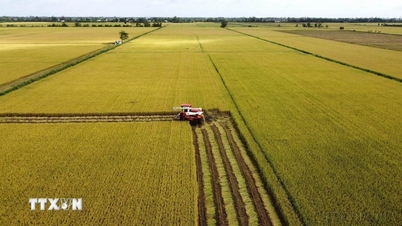
| Accelerating the construction of the national land database plays a crucial role in providing a data foundation, promoting transparency, and ensuring reliable access and utilization of land information. (Photo: VNA) |
Regarding land databases built by local authorities, currently all 63 provinces and centrally-administered cities are building and completing their land databases; 455 out of 705 district-level units have completed their cadastral databases with over 46 million land parcels put into operation to serve state management of land and resolve administrative procedures related to land for citizens and businesses; 705 out of 705 district-level units have completed their land statistics and inventory databases (from the 2019 inventory period) and put them into unified operation from the central to local levels; 325 out of 705 district-level units have completed the construction of land use planning and plan databases; and 300 out of 705 district-level units have completed the construction of land price databases.
A centralized and unified land information and database system will provide a platform where data can be widely shared with other ministries and agencies, promoting transparency and community access to reliable land information. The exploitation and sharing of land information among agencies and stakeholders such as tax authorities and residents has initially proven very effective, especially cadastral information used to determine land-related financial obligations, information related to land use origin, land prices, and land use planning, ensuring sustainability and efficient management and utilization of land resources. Specifically, the exchange of land data information between the Land Registration agency and the Tax agency in determining financial obligations when land users conduct transactions related to land and assets attached to land has been implemented in 48 out of 63 provinces and cities; all 63 provinces and cities have implemented the payment of land-related financial obligations through the National Public Service Portal.
According to Mr. Nguyen Khac The, the connection and sharing of the national land database with the national population database, as directed by the Prime Minister in Project 06/CP, has been implemented by the Ministry of Natural Resources and Environment. To date, the connection and sharing of the national land database with the national population database has been completed, covering data from 461 out of 705 district-level administrative units and 6,198 out of 10,599 commune-level administrative units.
In addition, the Ministry of Natural Resources and Environment has made efforts to direct and guide localities in implementing online public services as directed by the Prime Minister in Decision No. 06/QD-TTg dated January 6, 2022, and Decision No. 422/QD-TTg dated April 4, 2022.
Digital transformation, application of technology
In the roadmap for digital transformation towards a digital government, digital economy, and digital society, the central task set by the Prime Minister is the development of national digital data. Among these, data on natural resources and the environment is one of the three most important data groups that any country needs a strategy to manage and utilize effectively. National databases serving the deployment of basic and essential services related to citizens, businesses, and government agencies should be developed first.
The e-Government Development Strategy towards a Digital Government for the period 2021-2025, with a vision to 2030, has identified data on population, land, and businesses as core, pivotal data that needs to be completed and put into operation early to guide, link, and unify all data within state agencies across sectors and fields.
Mr. Nguyen Khac The, Deputy Head of the Land Information Technology and Data Management Department (Ministry of Natural Resources and Environment), said that digital transformation in the land sector helps to enhance transparency, efficiency, and modernity in land management, meeting the requirements of economic development and national construction in the current period.
Following the directives of the Party, the Government, and the Prime Minister, the Ministry of Natural Resources and Environment has issued a program for the digital transformation of natural resources and environment by 2025, with a vision to 2030… This program sets the goal of basically completing the national land database by 2025, updating it on a big data platform; and being ready to connect, share, and provide a land information data platform to implement online public services for citizens and businesses, operate e-government, and move towards digital government, digital economy, and digital society.
The 2024 Land Law, recently passed by the National Assembly, stipulates that the Ministry of Natural Resources and Environment is responsible for: "Organizing the construction of information technology infrastructure at the central level and developing software for the National Land Information System to ensure that the National Land Information System is operational and exploitable by 2025."
To achieve the assigned goals, in the coming period, Mr. Nguyen Khac The said that the Ministry will focus on advising the Government to issue Decrees and issuing Circulars within its authority to guide the implementation of the 2024 Land Law, aiming to complete the institutional framework, policies, and legal basis for building, operating, and exploiting the national land database.
In addition, the Ministry will focus on building the information technology infrastructure and application software of the National Land Information System, integrating and synchronizing land databases from localities for centralized and unified operation at the central level.
In particular, direct localities to actively and proactively accelerate the progress of building local land databases, ensuring that by 2025 they are connected and integrated with the national land database.
Fourth, continue to promote the connection and sharing of the national land database with other databases in order to maximize the effectiveness of the national land database.
Continue reviewing and restructuring land-related business processes, implementing administrative reforms and digital transformation in the field of land management, creating favorable conditions for people and businesses to easily access and utilize public land-related services.
Source: https://baothuathienhue.vn/chinh-polit-xa-hoi/phap-luat-cuoc-song/xay-dung-co-so-du-lieu-quoc-gia-ve-dat-dai-dong-bo-va-hieu-qua-143661.html




























































































Comment (0)