

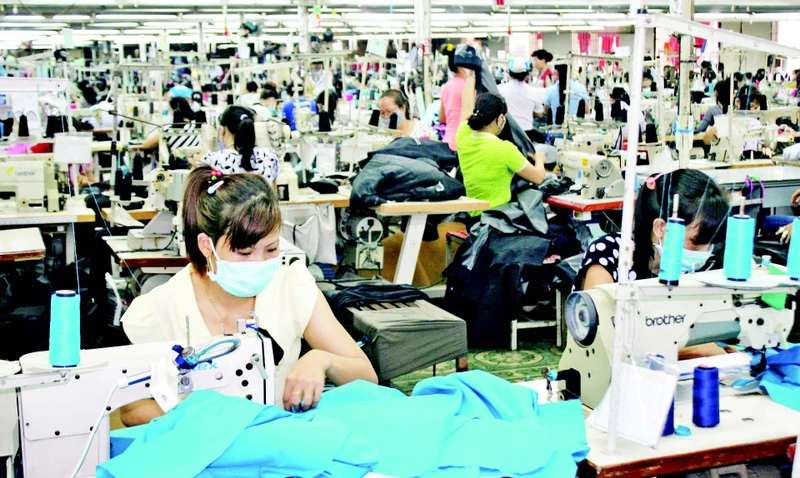
Garment manufacturing for export at Binh Duong Garment Joint Stock Company. (Photo: HOANG ANH)
According to Truong Van Cam, Vice President and General Secretary of the Vietnam Textile and Garment Association (Vitas), in 2024, textile and garment exports to the United States reached US$16.6 billion, accounting for 38% of the industry's total export turnover; imports from the United States totaled nearly US$1.2 billion, accounting for 4.8%, including US$681 million for cotton, US$46 million for fabrics, and US$469 million for raw materials and accessories.
According to Hoang Manh Cam, Deputy Chief of the Office of the Board of Directors of Vietnam Textile and Garment Group (Vinatex), the US decision to temporarily suspend the 46% retaliatory tariff for 90 days and reduce the tariff to 10% during this period will help businesses proactively develop solutions to adapt to market uncertainties, boost production and exports, and quickly achieve their set targets.
Mr. Hoang Manh Cam also argued that regardless of the tax rate, 10% or any other level will affect consumer demand in the United States, because increased taxes lead to decreased consumer demand. Textiles are a sensitive commodity and will certainly be affected.
Furthermore, US importers are negotiating and demanding that Vietnamese manufacturers share at least 50%, or even 100%, of the increased costs with consumers; meaning the selling price remains unchanged, with the manufacturer bearing the additional cost. This creates disadvantages for businesses as they face reduced orders and unit prices. If they do not agree, customers will shift to other countries with lower production costs.
Mr. Hoang Manh Cam suggested that the government should consider solutions to stimulate the domestic market to compensate for the shortfall; reduce VAT and personal income tax for citizens, while not increasing electricity prices and regional minimum wages to alleviate pressure on input costs and lessen the burden on businesses.
According to Le Tien Truong, Chairman of the Board of Directors of Vietnam Textile and Garment Group (Vinatex), increased import tariffs will reduce consumer demand in the US market, so businesses need to remain calm and wise in implementing sustainable solutions such as strengthening management, improving production efficiency, and upgrading the skills of workers to increase competitiveness in the market. In addition, they should negotiate with customers and brands in a spirit of sharing difficulties and ensuring the stability of the workforce.
As soon as US President Donald Trump announced a 90-day suspension of retaliatory tariffs on Vietnamese goods, businesses urgently stepped up production and simultaneously negotiated with customers to fulfill signed and ongoing orders.
According to Nguyen Xuan Duong, Chairman of the Board of Directors of Hung Yen Garment Corporation (Hugaco), the US market does not directly produce garments but mainly imports them, so it also presents an opportunity to negotiate tariff reductions.
Furthermore, businesses need to change their production methods, gradually shifting towards FOB (buy raw materials, manufacture, and sell finished products) and ODM (original design manufacturing) to increase value and enhance their position in the supply chain.
At the same time, businesses need to diversify their markets, take advantage of FTAs, and develop potential markets such as Russia, the Middle East, the Americas, and Africa.
According to Vu Duc Giang, Chairman of the Vietnam Textile and Garment Association (Vitas), Vietnam's garment exports to the US currently face various tariff rates, with some items subject to 0%, 7%, or 12% tariffs, and jackets currently subject to a 27% tariff. The government is implementing solutions and actively negotiating to review, apply, and utilize these tariff rates in the future.
In addition to response measures, businesses need to control and trace the origin and ensure transparency of information regarding the supply of raw materials and components, avoiding violations of regulations that could negatively impact production and export activities.
Source: https://baotuyenquang.com.vn/xay-dung-giai-phap-ung-pho-bien-dong-thi-truong-209933.html
![[Photo] Secretary of the National Assembly Party Committee, Chairman of the National Assembly presides over the meeting of the Standing Committee and Executive Committee of the National Assembly Party Committee.](https://vphoto.vietnam.vn/thumb/1200x675/vietnam/resource/IMAGE/2026/06/03/1780480353201_ndo_br_bnd-2585-jpg.webp)

![[Photo] General Secretary and President To Lam presides over a meeting with the Central Organizing Committee.](https://vphoto.vietnam.vn/thumb/1200x675/vietnam/resource/IMAGE/2026/06/03/1780482764658_a1-bnd-4741-3342-jpg.webp)
![[Photo] First session of the 14th Congress of the Vietnam Trade Union](https://vphoto.vietnam.vn/thumb/1200x675/vietnam/resource/IMAGE/2026/06/03/1780465947883_ndo_br_img-3852-jpg.webp)













































![[Video] Sunset at Lap An Lagoon – Where the sun sets over the fishing nets](https://vphoto.vietnam.vn/thumb/1200x675/vietnam/resource/IMAGE/2026/05/31/1780192137701_beach-landscape-sea-water-nature-grass-745871-pxhere-com.jpeg)




























Comment (0)