


In the context of the cultural industry and creative economy increasingly being identified as important drivers of sustainable development, contributing to promoting economic growth, human development, and national image promotion... many key programs and projects, along with policies supporting creative businesses, market development, investment attraction, and the formation of a creative ecosystem, are being implemented to create momentum for the development of the creative economy.
The draft Decree detailing certain provisions and guiding the implementation of Resolution No. 28/2026/QH16 of the National Assembly on the development of Vietnamese culture is currently being reviewed by the Ministry of Culture, Sports and Tourism on its electronic portal.
According to the draft decree, the Ministry proposes the following content: "Cultural creative industrial clusters and zones; cultural creative complexes and related regulations on the direction of construction and development; conditions for formation; authority to decide on formation; application dossier; procedures as well as the adjustment, supplementation or revocation of decisions for these models."
Mr. Le Minh Tuan, Deputy Director of the Copyright Department (Ministry of Culture, Sports and Tourism ), stated: “Cultural creative industrial clusters and zones” and “Cultural creative complexes” are new terms being stipulated for the first time in a National Assembly resolution. The Ministry of Culture, Sports and Tourism is developing specific content to establish these units, thereby focusing on developing the cultural industry. Organizations and units operating in the field of cultural industry creation within these models will benefit from many preferential tax policies and related support mechanisms.
According to the draft proposal, the "Cultural Innovation Industrial Cluster/Zone" model will carry out the following activities:
Providing support services in legal matters, intellectual property, design, communication, advertising, marketing, distribution, trade promotion, training and talent development; connecting creative activities, research and development, testing, production, distribution, exploitation and commercialization of cultural products and services; providing technical infrastructure, digital infrastructure, creative spaces, support services and necessary conditions for organizations and individuals operating in the cultural industry; supporting training, nurturing, and incubating talents, innovative startups, and small and medium-sized enterprises in the fields of culture, arts, and entertainment;
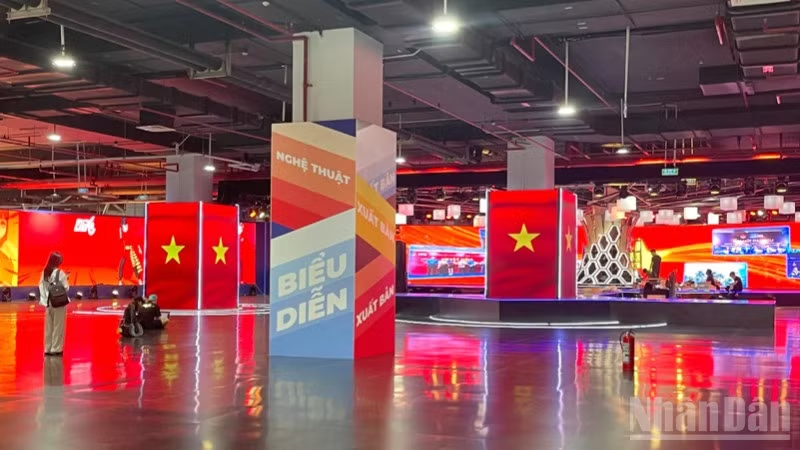
In addition, the "Cultural Innovation Industrial Cluster/Zone" model also carries out other activities such as: promoting the application of science, technology, high technology, digital transformation, innovative business models, and protecting intellectual property rights in the cultural industry; connecting businesses, training institutions, research organizations, investors, creative communities, and innovation centers in cultural industries; and connecting domestic and international markets.
The formation and development of cultural and creative industrial clusters and zones must conform to land use planning, urban planning, construction planning, and relevant legal regulations; ensure national defense, security, social order and safety, environmental protection, fire prevention and fighting; preserve and promote the value of cultural heritage and national cultural identity; and not distort, infringe upon, or illegally commercialize cultural values and cultural heritage.
For the "cultural creative complex" model, the following activities are implemented: leasing, exploiting, and utilizing creative spaces, co-working spaces, performance spaces, exhibition spaces, and cultural experience spaces; organizing creative activities, production, experimentation, performance, introduction, distribution, and commercialization of cultural products and services; providing support services in legal matters, intellectual property, design, communication, advertising, marketing, distribution, trade promotion, training, and talent development; combining commercial and service development in line with the goals of developing the cultural industry, focusing on developing cultural tourism, cuisine, entertainment, and experiential education.
In addition, activities include organizing cultural, artistic, and creative events, creative weeks, fairs, exhibitions, performances of cultural products and services; and cultural creative complexes operating under the model of enterprises, cooperatives, public service units, science and technology organizations, social organizations, professional organizations, or other legally recognized organizational models.
Source: https://nhandan.vn/xay-dung-khong-gian-moi-cho-cong-nghiep-van-hoa-post964029.html
![[Image] Hanoi's urban life under the challenge of a "scorching hot" environment](https://vphoto.vietnam.vn/thumb/1200x675/vietnam/resource/IMAGE/2026/05/25/1779706979265_nang-nong-t5-2026-minh-duy-7-4636-jpg.webp)

![[Image] Close-up view of the interchange connecting the two expressways and Long Thanh Airport.](https://vphoto.vietnam.vn/thumb/1200x675/vietnam/resource/IMAGE/2026/05/25/1779703378210_ndo_br_z7863716673926-224453a31600126cce10622af6290afd-4549-jpg.webp)


















































































Comment (0)