

Fame always comes with responsibility.
Showbiz, by its very nature, is a part of cultural life. It's not just a place for producing music , films, entertainment programs, or celebrity images, but also a space for shaping tastes, spreading lifestyles, shaping emotions, and influencing social behavior, especially among young people. Therefore, every scandal involving an artist never remains just a private matter. When an ordinary person makes a mistake, the impact may be confined to the individual, family, or small community. But when an artist makes a mistake, especially one with a large and devoted audience, who has appeared on stage, screen, in the media, and on social networks, that transgression immediately becomes a public cultural issue.
In the entertainment industry, fame sometimes comes faster than self-control; the spotlight shines brighter than a solid foundation of professional ethics; views, likes, and advertising contracts are sometimes valued more than kindness, standards, and social responsibility. When artists enter the entertainment market with the mindset of "becoming famous at all costs," when scandals are seen as a media technique, when shocking statements, controversial livestreams, exposure of private lives, and pointless arguments can become tools for making money, then showbiz can easily stray from the path of creativity and fall into a spiral of consuming curiosity.
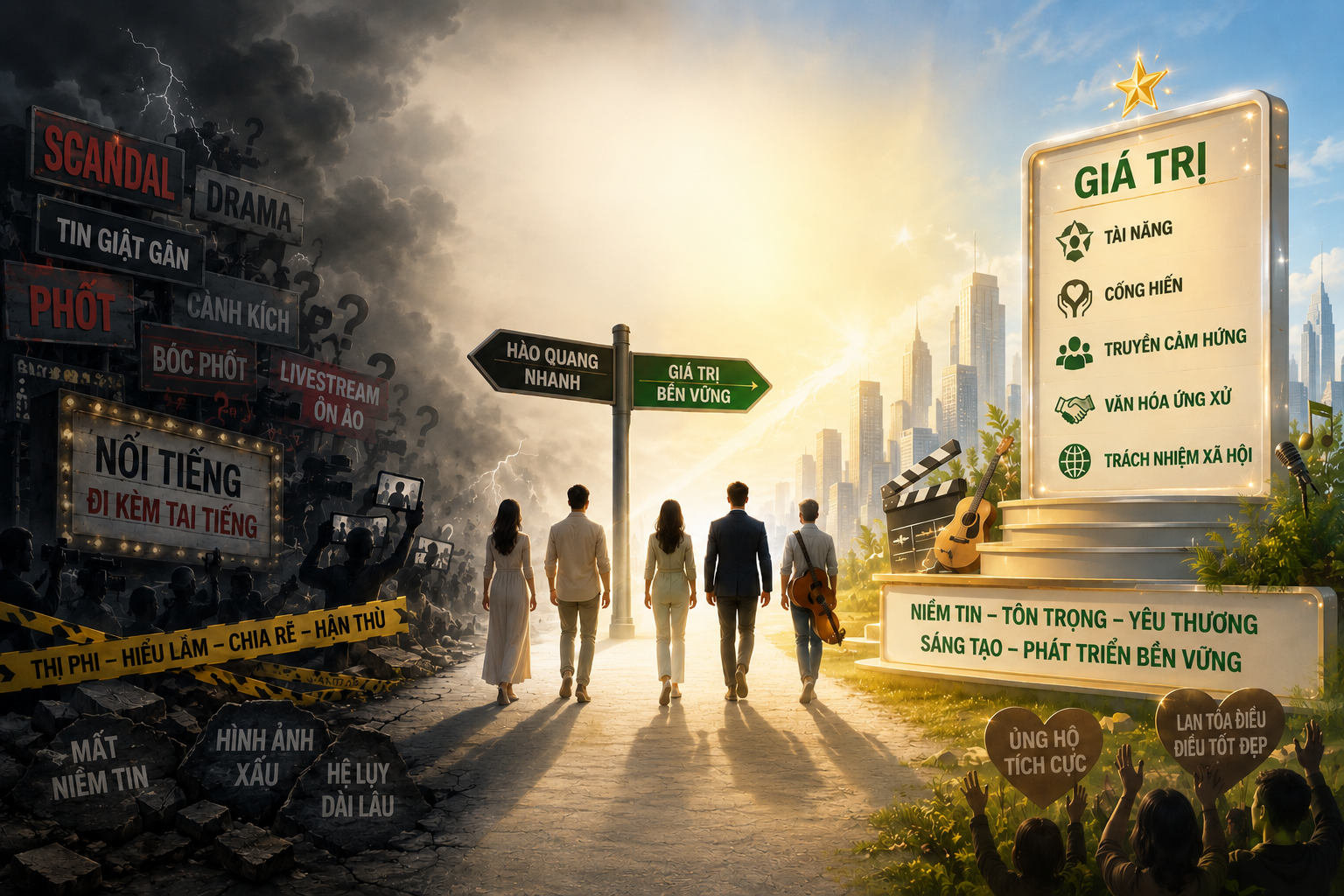
It's undeniable that artists are also human beings, with their own lives, pressures, and hurts. But fame always comes with responsibility. While artists receive public love and benefit from public attention, they must also accept a higher standard of conduct. Fame is not a privilege that can be tolerated. The greater the fame, the heavier the responsibility to maintain self-control. An artist may not be perfect, but they cannot disregard the law; they may make mistakes, but they cannot turn those mistakes into gimmicks; they may have a private life, but they cannot use it to shirk the social influence they create.
A multi-tiered processing mechanism is needed.
Recent incidents reveal a paradox: the public is becoming increasingly critical of artists, yet at the same time, the public and social media contribute to "nurturing" scandals. Every click driven by curiosity, every share of unverified information, every extremist comment, every time an offensive statement is pushed into the spotlight, inadvertently transforms controversy into a media resource. Social media doesn't create scandals; it's how we consume information that determines how long a scandal lasts, how far it spreads, and whether it becomes mere entertainment.
Therefore, it is crucial to cultivate a mature public: one that appreciates art more than controversy, values genuine talent over gimmicks, rejects harmful products, but also places its trust in decent values, hard work, and persistent dedication.
From a management perspective, the Ministry of Culture, Sports and Tourism has issued a Code of Conduct for those working in the arts, which defines the standards of conduct for artists in their professional activities, with the public, the media, and on the internet. Recently, Government Decree 87/2026/ND-CP on administrative penalties in the fields of culture and advertising, effective from May 15, 2026, further supplements the legal basis for handling violations in the fields of culture and advertising.
However, the question is whether these regulations will be implemented effectively, promptly, and consistently. Regarding legal violations, the principle is clear: all citizens are equal before the law, and artists have no immunity. But for violations of professional ethics, inappropriate speech, and offensive behavior in the digital environment, a more multi-layered mechanism is needed: the law to handle violations; regulatory agencies to handle violations in performance, advertising, and media activities; professional associations to monitor professional ethics; digital platforms to restrict harmful content; brands and event organizers with clear cooperation standards; and the public exercising their right to choose in a civilized manner.
The scandals in Vietnamese showbiz raise questions for the entire cultural ecosystem: What kind of entertainment industry do we want? One that thrives on scandals, controversies, shocking statements, and a series of image crises? Or one that develops through talent, creative work, professionalism, discipline, integrity, and social responsibility?
Vietnamese audiences haven't turned their backs on artists. The public still loves art, readily supports talent, and is tolerant of those who know how to correct their mistakes. But the public has the right to demand that artists be more deserving of that love. Young artists today have unprecedented opportunities: digital platforms, a wide-open market, international access, and the chance to bring Vietnamese culture to the world . But precisely because of this, they need to understand that fame is not the ultimate goal. The higher goal is to create value.
A great song, a beautiful performance, a decent work of art, and an artist's life built on self-respect will last much longer than a noisy scandal. True glory doesn't lie in being the most talked-about person, but in the fact that when mentioned, the public thinks of talent, character, and contribution. When artists know how to maintain their integrity, when the entertainment industry knows how to purify itself, when the public knows how to choose values, and when the law and professional ethics are strictly enforced, only then can we build a healthier entertainment environment, a more beautiful cultural life, and an art scene worthy of society's trust.
Source: https://daibieunhandan.vn/xay-dung-moi-truong-giai-tri-lanh-manh-10417607.html
![[Image] Hanoi's urban life under the challenge of a "scorching hot" environment](https://vphoto.vietnam.vn/thumb/1200x675/vietnam/resource/IMAGE/2026/05/25/1779706979265_nang-nong-t5-2026-minh-duy-7-4636-jpg.webp)


![[Image] Close-up view of the interchange connecting the two expressways and Long Thanh Airport.](https://vphoto.vietnam.vn/thumb/1200x675/vietnam/resource/IMAGE/2026/05/25/1779703378210_ndo_br_z7863716673926-224453a31600126cce10622af6290afd-4549-jpg.webp)






































































Comment (0)