

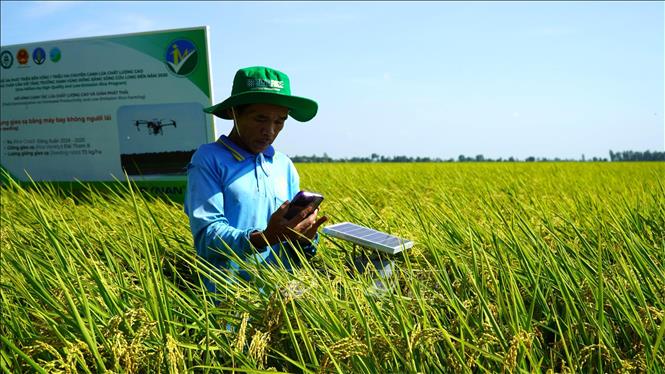
The project “Transforming the Rice Value Chain to Respond to Climate Change and Promote Sustainable Development in the Mekong Delta” (TRVC) was implemented with the goal of supporting the transition to low-carbon agriculture . The project has attracted the participation of many businesses in the rice value chain to promote the expansion of sustainable production models on a large scale, thereby increasing farmers' income, reducing greenhouse gas emissions, and protecting the environment.
After three production cycles, Vietnam Rice Company Limited (Vinarice), a subsidiary of Vinaseed Group - a member of PAN Group, has partnered with over 11,000 farming households across a total accumulated area of over 48,500 hectares, accounting for 57% of the total area of the TRVC project. As a result, the total emission reduction reached nearly 184,000 tons of CO₂, equivalent to an average reduction of approximately 3.76 tons of CO₂ per hectare of cultivated land.
According to Mr. Nguyen Van Be Hai, Acting General Director of Vinarice Company, the model has proven that sustainable rice production can be completely combined with economic efficiency. Not only does it reduce the amount of seeds, fertilizers, pesticides, and irrigation water, but it also helps improve rice quality and significantly improve farmers' income.
The farming practices applied focus on the "1 must, 5 reductions" principle, combining input management, post-harvest straw management, the application of alternating wet and dry irrigation (AWD) techniques, and many advanced processes suitable for the orientation of high-quality, low-emission rice production in the Mekong Delta.
Notably, the benefits of the model extend beyond reducing emissions to include significant economic efficiency. While the project aimed to increase farmers' income by approximately 30%, many production cycles recorded profit increases of around 50%, and in some areas even reached 55-58%.
Economic efficiency has become a crucial driving force for people to change their production practices. For farmers, a model can only be replicated if it both protects the environment and generates better income.
“PAN Group and its parent company Vinaseed play a crucial role in Vinarice's strategic direction for sustainable development. The focus is not only on increasing production volume, but also on building a sustainable, high-quality agricultural value chain capable of competing in the international market. In this context, Vinarice is identified as the unit developing rice raw material areas in the Mekong Delta region, aiming to reduce emissions, enhance the value of rice grains, and link with farmers and cooperatives to meet international environmental standards,” Mr. Hai stated.
At a cooperative implementing the model with Vinarice, the results after two production seasons showed significant changes. On a scale of 267 hectares, the amount of seeds sown decreased by about 30%, and the amount of fertilizer decreased by 20% compared to traditional methods. Production costs per hectare decreased from about 2.6 million VND to 2.3 million VND, equivalent to a reduction of 10-15%. Meanwhile, rice yield increased from 6.5 tons/ha to 6.7 tons/ha.
According to Mr. Nguyen Thanh Nghiep, Chairman and Director of My Dong III Agricultural Service Cooperative (Hamlet 2, My Qui Commune, Dong Thap Province), besides reducing costs, the model also contributes to addressing environmental issues through water-saving irrigation management and collecting straw after harvest instead of burning it as before. In particular, the stable purchase of products by the enterprise helps farmers reduce pressure from price fluctuations and price manipulation by traders.
Farmer Ho Thi Thuy Hang, residing in Hamlet 2, My Quy Commune, Dong Thap Province, said that her family has been collaborating with Vinarice Company for four seasons, using the OM18 rice variety. Farming practices aimed at reducing emissions have helped her family's fields achieve a profit increase of over 40%, thanks to reduced seed usage, fertilizer, and pesticides.
Not only are farmers' rice products guaranteed by businesses, but they are also purchased at a price about 100 VND/kg higher than the market price. After each harvest, farmers continue to receive guidance on how to handle rice straw to reduce environmental pollution. According to Ms. Hang, initially, applying the new process was somewhat unfamiliar and challenging, but once the economic benefits became clear, the people enthusiastically followed suit.
These results show that the role of businesses lies not only in transferring technology but also in acting as a "market anchor," helping people feel secure in changing their production methods.
According to Ms. Nguyen Thi Tra My, General Director of PAN Group, the biggest challenge in implementing the low-emission model is not the technology but changing farmers' farming habits. To solve this problem, the company has built a team of technicians who closely monitor the fields and organize regular training to guide farmers in applying the new process.
Although three production cycles is not a long period of time, it has proven that Vietnam's rice industry is fully capable of shifting to a high-quality, low-emission model if there is collaboration between the government, businesses, international organizations, and the people.
The role of businesses becomes even more important as export markets increasingly demand stricter requirements regarding traceability, carbon emissions, and environmental standards. Controlling the entire value chain, from seeds and inputs to production, processing, and branding, helps enhance the value of Vietnamese rice.
According to company representatives, while the price of regular exported rice fluctuates around 500-600 USD/ton, some of the company's product lines have reached approximately 1,300 USD/ton. Some export shipments even reached around 2,300 USD/ton – a price that demonstrates the enormous potential of the high-quality, low-emission rice segment.
Another notable milestone is that Vinarice became one of the first businesses to be granted the right to use the "Vietnamese Green Low-Emission Rice" trademark. This is seen as a "passport" for Vietnamese rice to access demanding markets such as Europe and the US – where green standards are increasingly becoming mandatory requirements.
Beyond just commercial value, businesses are also seeing new opportunities in the carbon credit market. According to Ms. Nguyen Thi Tra My, if value chains are well-organized and meet international standards, reduced emissions can be fully recognized as carbon credits, creating additional revenue for the rice industry and farmers. This opens up a new direction for development, where farmers not only earn income from selling rice but can also benefit from the value of reduced emissions.
PAN Group aims to increase the area of low-emission rice production to approximately 100,000 hectares by 2027, based on a comprehensive value chain: from rice seeds (Vinaseed), VFC's pesticides, cultivation and procurement (Vinarice), processing (VinaAgrifood) to brand building and market development. The goal is not only to expand scale but also to complete the high-quality rice value chain, increase income for rice farmers, and contribute to the sustainable development strategy of Vietnam's rice industry.
The Ministry of Agriculture and Environment announced that Phase 1 of the project to sustainably develop 1 million hectares of high-quality, low-emission rice cultivation in the Mekong Delta has reached over 354,800 hectares, nearly double the planned target. The models implemented within the framework of the TRVC project are considered an important foundation for businesses to expand their participation in this national-scale project.
Source: https://baotintuc.vn/kinh-te/xay-dung-thuong-hieu-gao-viet-xanh-phat-thai-thap-20260525100914992.htm

![[Image] Hanoi's urban life under the challenge of a "scorching hot" environment](https://vphoto.vietnam.vn/thumb/1200x675/vietnam/resource/IMAGE/2026/05/25/1779706979265_nang-nong-t5-2026-minh-duy-7-4636-jpg.webp)

![[Image] Close-up view of the interchange connecting the two expressways and Long Thanh Airport.](https://vphoto.vietnam.vn/thumb/1200x675/vietnam/resource/IMAGE/2026/05/25/1779703378210_ndo_br_z7863716673926-224453a31600126cce10622af6290afd-4549-jpg.webp)





































































Comment (0)