

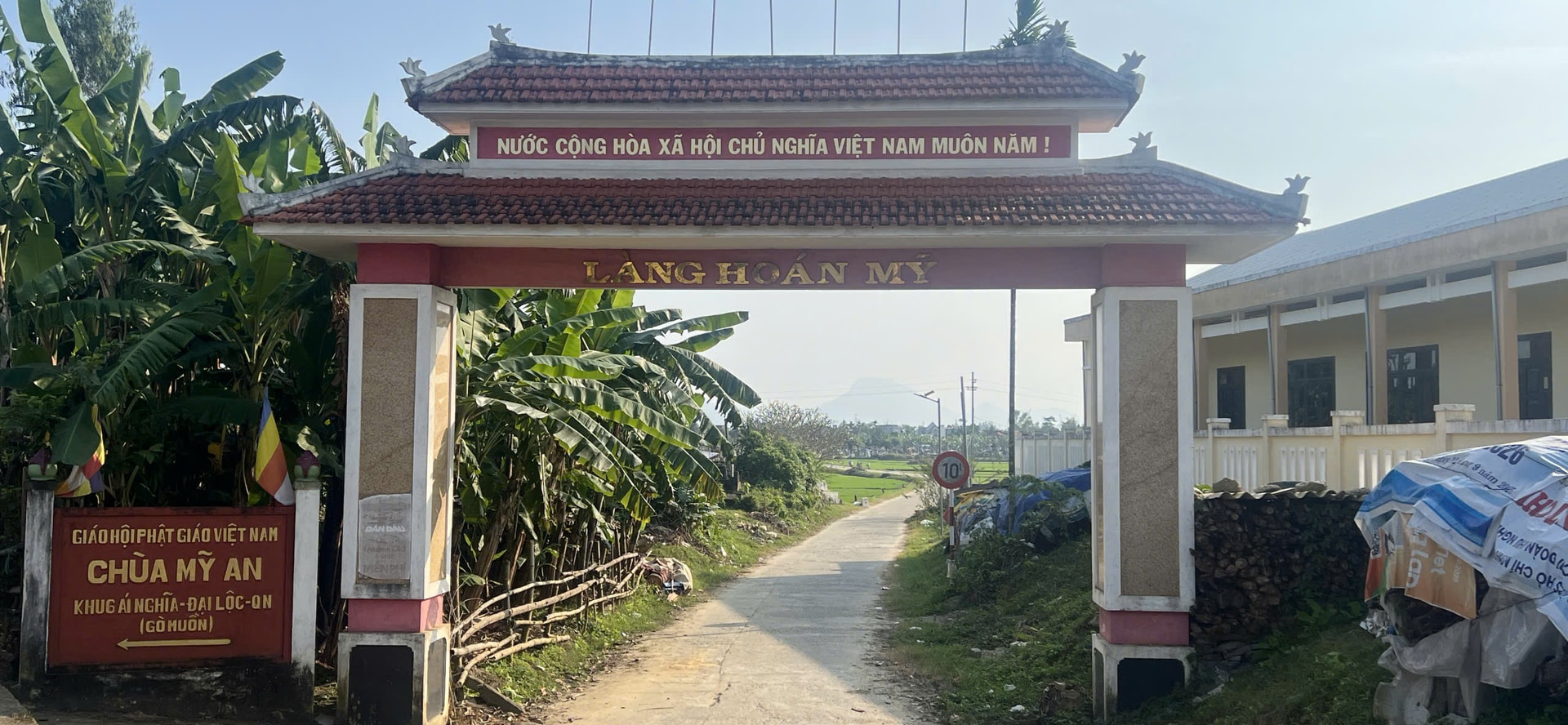
Beyond its military significance, that victory ignited a flame of patriotism, becoming a source of immense pride and inspiration for the entire army and people. This heroic spirit is vividly preserved in poems and literary works, in Nôm and Han-language couplets imbued with optimism and aspirations for independence, during the historic military feast—an immortal epic.
The imprint of resistance against the French.
France began its invasion of Vietnam. King Hàm Nghi issued the Royal Decree of the Can Vuong Uprising. The people of the whole country responded to the divine mandate. The Can Vuong Uprising took place throughout Đại Nam (Vietnam), beginning in 1885 and lasting until the end of the 19th century.
The Quang Nam Patriotic Association was established from the very beginning, with the key participation of hundreds of renowned scholars and intellectuals operating in the three provinces of Quang Nam, Quang Ngai , and Binh Dinh. The Quang Nam Patriotic Association left its mark on history through notable battles at Phu Thuong, Tra Kieu, Nam Chon, Bai Chai, Go Muong, etc.
Around March 1886, after a heavy defeat at the Battle of Bai Chai (Van Ly - Go Noi), the French army was furious and determined to retaliate and destroy the Nghia Hoi forces. They followed the old route from La Qua (Vinh Dien) to Phong Thu and then Bai Chai, encountering no resistance. Taking advantage of this, they landed and marched straight into Hoan My, aiming to penetrate deep into the Ai Nghia area with the goal of capturing the Nui Lo fort – a crucial base of the Nghia Hoi forces. This was a reckless move to quell the rising resistance movement in the northwestern region of the former Quang Nam province.
Faced with the enemy's plot, General Tran Huy (commander of the Binh Yen outpost) quickly coordinated with Provincial Commissioner Bui Xuan Bang to prepare a counter-plan. The two men mobilized skilled martial artists and those familiar with the terrain to organize a large-scale ambush. The chosen location was the Go Muong forest, a stretch of road about 2 kilometers long, ideal for ambushing and close-quarters combat.
"Gò Muồng wins"
When the French troops launched their offensive deep into the interior of Ai Nghia and advanced into the Go Muong area, they were completely unaware that they were falling into a pre-planned ambush. From their hiding places, the rebel forces simultaneously charged out, swiftly tightening the encirclement. In this close-quarters combat, their main weapons were not modern firearms, but rather their courage, their staffs, spears, and unwavering determination. Utilizing the terrain and their individual martial skills, they transformed Go Muong into a battlefield disadvantageous to the expeditionary army. The battle raged fiercely, but the agility and ingenuity of the rebel forces completely overwhelmed the enemy, disrupting their formations and forcing them to flee in chaos.
This victory held significant strategic importance, not only shattering the enemy's attempt to attack and seize the Nui Lo base, but also firmly protecting the rear of the resistance. Furthermore, the news of the victory was like a breath of fresh air, igniting the flame of determination and strengthening the unwavering faith of the entire province's people and soldiers in the just cause.
Celebrating couplets
In an atmosphere of excitement and heroism, couplets and poems praising the victory at Bai Chai - Go Muong were composed and proudly displayed by scholars such as Tu Tai Van Dong and Tu Tai Ly.
A couplet by scholar Van Dong from Quang Hue : “At Bai Chai, we sing songs of triumph, eat until we're full, drink until we're drunk, with wine, meat, rice, sticky rice, and cakes / At Go Muong, we win, if we run out, we carry more, if we're short, we stir-fry, roast, stew, braise, rare, and slice.”
This is a couplet written in Nôm script, with a folk style, expressing the celebratory atmosphere after the battles of Bãi Chài and Gò Muồng. The first line lists the food and drinks (wine, meat, rice, sticky rice, cakes), with "rội" meaning to take more; the second line lists the cooking methods (roasting, stewing, stir-frying, braising, parboiling), showing the satiety and exhilaration of the soldiers and civilians after the victory.
A couplet by Scholar Ly (i.e., Ly Thua Trach in Hoi An): “Heaven has protected our emperor and preserved the state/ People, following the will of Heaven, have developed their talents in governance to help the country.”
This couplet, written in classical Chinese, is solemn and reflects the concept of "heaven's mandate" and the people's devotion to the greater good. The author praises the support of heaven, earth, and the people for the patriotic cause of the Quang Nam Patriotic Association.
These two pairs of couplets, one in Nom script and one in Han script, were both composed during a feast celebrating the victory at Go Muong, reflecting the optimism, unity, and unwavering will of the resistance fighters and people of Quang Nam in the war against the French.
More than just a military victory, the Battle of Gò Muồng truly became a shining symbol of national spirit. It eloquently demonstrated the strength of unity and indomitable will of the people and soldiers of Quảng Nam under the banner of the Patriotic Association, capable of defeating a modernly equipped invading enemy. This heroic spirit was widely celebrated through poems and couplets during troop ceremonies, further strengthening and inspiring the resistance throughout the region.
Source: https://baodanang.vn/140-nam-tran-thang-go-muong-3332145.html
![[Photo] The courage of new recruits of Brigade 144 on the training ground.](https://vphoto.vietnam.vn/thumb/1200x675/vietnam/resource/IMAGE/2026/05/27/1779881651341_anh-man-hinh-2026-05-27-luc-18-32-52.png)
![[Photo] General Secretary and President To Lam and his wife begin their official visit to Thailand.](https://vphoto.vietnam.vn/thumb/1200x675/vietnam/resource/IMAGE/2026/05/27/1779881249412_anh-man-hinh-2026-05-27-luc-18-10-51.png)











![[Video] Weather forecast for tonight and tomorrow, May 28, 2026: Northern Vietnam to see a drop in temperature, Central Vietnam to continue experiencing intense heat.](https://vphoto.vietnam.vn/thumb/402x226/vietnam/resource/IMAGE/2026/05/27/1779887047052_thumb-toi-2705-png.webp)


































![[Photo] The courage of new recruits of Brigade 144 on the training ground.](https://vphoto.vietnam.vn/thumb/402x226/vietnam/resource/IMAGE/2026/05/27/1779881651341_anh-man-hinh-2026-05-27-luc-18-32-52.png)

















Comment (0)