

During the hot summer months, snakes often crawl into houses or gardens to escape the heat and find food, easily leading to unwanted encounters between humans and these animals. Knowing how to quickly distinguish between venomous and non-venomous snakes will help you proactively maintain a safe distance and handle situations correctly to minimize risks to people and pets.
Here are five key identifying characteristics to help you distinguish between these two groups of snakes:
1. Snake head shape
This is the easiest characteristic to observe from a safe distance when the snake is lying still:
Venomous snakes: Most venomous snakes (such as vipers and cobras) have a distinctly triangular head and a narrow neck. This is because they have two enlarged venom glands on either side of their cheeks.
Non-venomous snakes: Their heads are usually oval, round, or elongated, with the head seamlessly connected to the body in a smooth curve, without a constriction at the neck.

Dangerous exception: The krait, also known as the banded krait, belongs to the family of venomous snakes, but its head is quite round, almost like that of a non-venomous snake.
2. The shape of the pupil of the eye
If you are close enough to observe the snake's eyes (or view them in photographs):
Venomous snakes: Their pupils (the black part of the eye) often have vertical lines, similar to a cat's eye.

The beaded snake is a non-venomous snake with round eyes.
Non-venomous snakes: Their pupils are round, similar to human or bird eyes.
3. Tail scales
This feature is located on the underside of the snake's tail (from the anus down towards the tip of the tail):
Venomous snakes: They usually have a single row of scales running the entire length of their tail. The large scales are arranged closely together and are not divided in two.
Non-venomous snakes: They usually have two rows of alternating double scales (the scales under the tail are divided in half by a groove in the middle).
4. Color and pattern on the leather
Venomous snakes: Often possess vibrant colors, strong contrasting patterns, or distinctive warning signs (for example, the black and yellow rings of the krait, the black and white rings of the banded krait, or the flared, spectacle-like gill arches of the cobra).
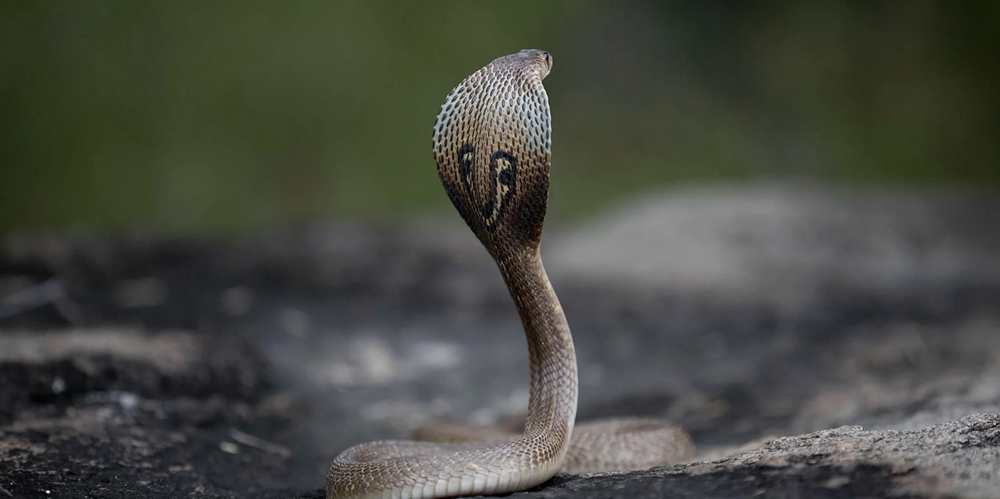
Non-venomous snakes: Their coloration is usually duller, serving as camouflage to blend into the environment, such as earthy brown or light green (like the betta snake or water snake), and they do not have the ability to inflate their hoods to pose a threat.
5. Behavior and reactions when meeting people
Venomous snakes: Often more confident, aggressive, or stubborn. When encountering a person, they tend to stand still, assume a defensive posture (broadening their hoods, raising their heads, raising their tails, making crackling or loud hissing sounds), and be ready to strike instead of running away.
Non-venomous snakes: They are usually very shy. When they see a person or hear a noise, their first reaction is to quickly slither away to hide.
Note:
The above rules are only general guidelines and there are always exceptions. In the low light conditions of summer or when panicking, it's easy to mistake a venomous snake for a non-venomous one.
Therefore, the safest rule you should always remember is that no matter which snake you encounter, you should maintain a minimum distance of 2 meters and never attempt to catch it yourself, as this can provoke the animal's aggressive instincts, causing it to attack and endanger you.
In addition, you should also keep the following in mind to avoid attracting snakes to your home:
Regularly clean and tidy your house, avoiding piles of belongings, firewood, and garbage that can easily become hiding places for snakes.
Limit the planting of climbing plants and dense shrubs; if planted, they must be regularly trimmed to ensure good ventilation and easy visibility.
Avoid leaving food scattered around the house and garden area, as this will attract rodents and, consequently, snakes.
Source: https://baovanhoa.vn/doi-song/5-cach-phan-biet-ran-khong-doc-va-ran-co-doc-de-de-phong-trong-mua-he-233326.html




















![[Photo] Reception to welcome General Secretary and President To Lam and his wife on their State visit to the Philippines](https://vphoto.vietnam.vn/thumb/1200x675/vietnam/resource/IMAGE/2026/06/01/1780295488620_vna-potal-chieu-dai-chao-mung-tong-bi-thu-chu-tich-nuoc-to-lam-va-phu-nhan-tham-cap-nha-nuoc-toi-philippines-8798060-7855-jpg.webp)




































































Comment (0)