Eighty years bridging two centuries (1945-2025) is not a long time in the long history of the nation, but Ha Tinh literature has left many important marks in the flow of national literature, continuing the tradition of previous centuries, and rightfully earning its reputation as a great cultural region of the country.
Many researchers highly value the literature of Nghe An province (including Ha Tinh province), both in terms of folk and written literature, considering it one of the three major cultural regions of the country, second only to Thang Long - Hanoi and Hue. This is quite convincing because it has sound scientific reasons. From the 13th century to the end of the 20th century, from the early stages to the flourishing periods of national literature, Ha Tinh made significant contributions in terms of both authors and works.

With its unique natural and cultural features, Ha Tinh's literature has made a significant contribution to the national literary landscape. (Photo: Dau Ha ).
In the early 20th century, especially after the August Revolution (1945), the patriotic and revolutionary movement nationwide, as well as in Ha Tinh, underwent a new transformation: a renewal of ideology. It shifted from feudal ideology to bourgeois ideology and then to proletarian ideology. The birth of the Democratic Republic of Vietnam in 1945 marked a new historical period for the nation, ushering in a new phase for Vietnamese literature. Literature is a mirror reflecting the national soul. Ha Tinh literature, through the two wars of resistance against France and the United States, vividly reflected the life and people of Ha Tinh during that heroic half-century. During the years of resistance and national reconstruction, Ha Tinh literature was primarily composed using the method of Socialist Realism, reflecting local life and people harmoniously within the national literary framework, yet retaining the distinct characteristics of the Hong Lam region.
During the war, works of literature portrayed people who were brave in battle, pure and noble in morality, and delicate in their personal feelings: "The Pass Ahead" by Tran Huu Tong, "A Patch of Sky" by Nguyen Sinh, "Ten Days for a Lifetime" by Xuan Thieu. The war left behind indelible legacies, both negative and positive. Faced with demanding and diverse requirements, people have undergone differentiation, and the hierarchy of values has changed significantly compared to the past. This is the fertile ground for the development of narrative literature. Nguyen Quang Than in "The Man Who Didn't Travel on the Same Train," Van Phan in "Time Through the Rose Garden," Nguyen Quoc Trung in "The Cashew Harvest Season," and Van Linh in "The Beggar" extol noble individuals who dare to take responsibility, are fond of creative labor, and are ready to embrace difficulties. The authors' humanistic perspective helps readers recognize and believe in the light of goodness. People live to love and to fight.

The image of the hardworking, courageous, resilient, and creative people of Ha Tinh has become a constant source of inspiration for the province's literature.
Alongside prose, poetry also profoundly portrays the people of Ha Tinh during the two resistance wars, with unique and unmistakable beauties. These include children who were both suffering and heroic, soldiers who were defiant and optimistic, brave and courageous workers, and honest and hardworking farmers… Pham Ngoc Canh, a military poet, has a famous poem, "Division," which encapsulates the formation and growth of our army: "There will be steel divisions / Anywhere / Unyielding, imprisoned, and slaughtered." Yen Thanh, with the image of the Dong Loc girls overcoming sacrifices, highlights the tradition of the heroic sons and daughters of Ha Tinh.
The squad lined up in a row.
Cúc! Where are you? Why aren't you coming back to join the group?
Nine friends were all gathered together:
Small - Spring - Ha - Huong - Hoi -
Radiant Spring
Squad leader Vo Thi Tan calls roll...
(Cuc ơi)
During the period of reform, the literature of Ha Tinh – a land with unique natural and cultural characteristics – contributed to the national literary landscape a rich and diverse reflection of the Vietnamese people's souls in this era. Following the triumphant celebrations of victory, Ha Tinh literature continued to paint a picture of the homeland's progress, overcoming numerous difficulties and challenges, including poverty and the threat of natural disasters and floods. The literature is quite truthful to the life and people of Ha Tinh, continuing the traditional beauty and highlighting the courage and creativity in labor during the new era. Writing about the sea, the new rural areas, industrialization, the homeland's traditional crafts, culture, and tourism in the open-door period, literary works and poems flourished in newspapers and books both within and outside the province. The image of the hardworking, courageous, resilient, and creative people of Ha Tinh is reflected in many works.

Provincial leaders held discussions with artists and writers on the sidelines of a meeting commemorating 50 years of literature and art in Ha Tinh province after the reunification of the country (April 30, 1975 – April 30, 2025).
Developing over time and aligning with the mainstream literary landscape, contemporary Ha Tinh literature, in terms of subject matter, is no longer confined to aspects of life, struggle, and construction, but has expanded its scope to encompass many areas such as history, revolution, social issues, and love. A long series of representative works on historical and revolutionary themes, echoing the voices of the past, are presented here. We encounter the image of the patriotic hero Nguyen Bieu from the Tran Dynasty through "Fire of the Thousand Deep" (Duc Ban), are moved by the heroic beauty of the transport heroes on the unmarked trains carrying weapons to the South through the epic poem "The Awakened Road" (Nguyen Ngoc Phu), learn about the noble sacrifices of young men who left their homeland to achieve victories in the South during the anti-American war through "Memories of War" (Vuong Kha Son), and see the strong camaraderie between soldiers in wartime and peacetime in "The Field of Time" (Bui Quang Thanh)...
Regarding social issues, the authors paint a picture of the homeland in the post-war period, a landscape of hardships and difficulties no less severe than those during wartime, characterized by conservative lifestyles, self-serving calculations, and outdated customs hindering progress: "Steps of Time" (Tung Bach), "Where Shadows Are Sent" (Yen Thanh), "Buddha's Birth" (Nguyen Trung Tuyen)... Nevertheless, shining examples still stand out, leaving room for goodness and beautiful sentiments amidst the difficulties: "Marks of Time" (Phan Trung Hieu), 80 Poems (Duy Thao); living honestly sows hope for future generations: "Writing While Waiting for the Lotus to Bloom" (Tran Nam Phong), "Now It's Autumn" (Phan Trong Tao), "No Promise for the Rice Harvest Season" (Tran Quynh Nga), "Silence After the Rain" (Tran Tu Ngoc), "The Autumn Train" (Tran Hai Van)...
In the atmosphere of renewal, many authors have published numerous poetry collections about family, mothers, and love with humanistic colors that have received much affection from readers: "Mother's Smile" (Nguyen Van Thanh); "Self-Reflection", "Chrysanthemum" (Le Van Vy)...
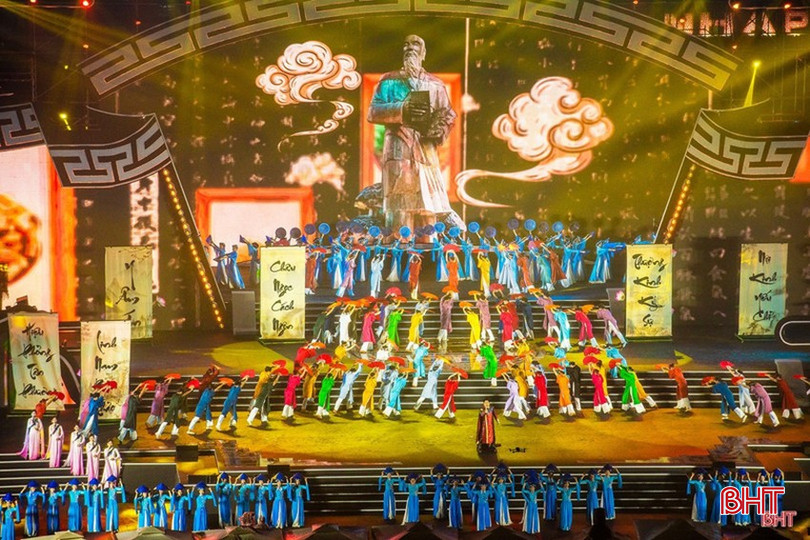
The culture of the homeland has become a source of inspiration in Ha Tinh literature. In the photo: The opening performance of the art program "One Hundred Years, a Thousand Years of Hai Thuong Lan Ong" at the 300th anniversary celebration of the birth of Hai Thuong Lan Ong Le Huu Trac, organized by Ha Tinh province. Photo: Dau Ha.
Novelty breathes life into the work. In terms of art, the authors of Hong Lam have constantly explored, surpassed themselves, and overcome old habits to find a new, modern writing style that is rich in national identity. Generally, prose from Ha Tinh mostly follows a traditional style, structured according to a sequence of events and a linear timeline. Images of the past and present intertwine, emphasizing each other with a consistent writing style.
Regarding characters, while some works incorporate fantastical elements, they are generally creative and realistic, building distinct personalities alongside commonalities. Characters act in typical circumstances. The language has undergone many changes, becoming closer to life and more vibrant. Some young writers are exploring innovative methods of expression, even exploiting the unconscious and fantastical aspects. Lyrical poetry shows new characteristics, shifting from traditional realistic imagery to a combination of surrealism and modern symbolism. The poetic form has shifted from mostly metrical to free verse. The language, in general, has changed significantly, becoming closer to life and more lively. Syntax is less rigid than before, the rhythm is free and unrestrained, and the vocabulary uses more dialects and colloquialisms.
The literary community of Ha Tinh harmoniously combines generations: the generation of writers who fought against the US, the generation of writers after the reunification of the country, including writers from the đổi mới (renovation) period. Although the number of authors is not large and the number of works published annually is not high, the literary scene of Ha Tinh has created its own unique character: its connection to a vibrant land rich in literary traditions, a treasure trove of folk literature encompassing many diverse genres such as folk tales, chants, and ballads, whose influence on written literature is quite varied. Many authors have left their mark on the national literary scene, such as: Xuan Hoai, Duc Ban, Duy Thao, Nguyen Ngoc Phu, Phan Trung Hieu, Tung Bach, Phan Quoc Binh…; A younger generation also showed considerable energy, including: Tran Nam Phong, Nguyen Van Thanh, Le Van Vy, Quynh Nhu, Nguyen Trung Tuyen, Tran Hau Thinh, Dang Thanh Que, Nguyen Xuan Dieu, Ha Le, Nguyen Ngoc Vuong, Dinh Quang Lan, Yen Thanh, Tran Quynh Nga, Hanh Loan, Tran Tu Ngoc, Ho Minh Thong, Nguyen Thi Nguyet, Tran Hai Van, Phan The Dung Toan, Tong Phu Sa...
In modern times, Vietnamese literature has achieved many successes, and the contribution of Ha Tinh literature cannot be overlooked. Ha Tinh literature has converged on the national literary trajectory by knowing how to build upon the achievements of its rich literary tradition, while also being vibrant, innovative, and receptive to new achievements.
Source: https://baohatinh.vn/80-nam-van-chuong-mot-vung-dat-post293772.html



![[Image] Hanoi's urban life under the challenge of a "scorching hot" environment](https://vphoto.vietnam.vn/thumb/1200x675/vietnam/resource/IMAGE/2026/05/25/1779706979265_nang-nong-t5-2026-minh-duy-7-4636-jpg.webp)



![[Image] Close-up view of the interchange connecting the two expressways and Long Thanh Airport.](https://vphoto.vietnam.vn/thumb/1200x675/vietnam/resource/IMAGE/2026/05/25/1779703378210_ndo_br_z7863716673926-224453a31600126cce10622af6290afd-4549-jpg.webp)










































































Comment (0)