


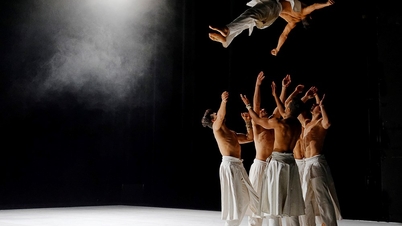
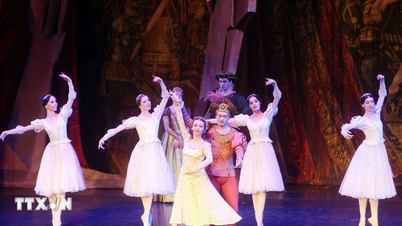
The Anna Karenina ballet by the Eifman Ballet is coming to Vietnam for the first time - Photo: Organizing Committee
It was an Instagram post from the English National Ballet, one of the UK's five largest ballet companies, after Timothée Chalamet said that nobody cared about ballet and opera anymore.
The post received 41,900 likes, compared to other purely ballet-related posts on the site, which only receive a few hundred to a few thousand likes.
Is this proof that these art forms are dying? Normally, hardly anyone discusses the works or what's happening there. Ironically, the most attention is drawn to them because of an insensitive remark from a movie star at the peak of his career.
Actually, this isn't the first time someone has declared that an art form or genre is dying.
For the past twenty years, people have lamented: rock is dying! A valid lament, because it's been a long time since we've had a rock star of the caliber of Queen or The Rolling Stones.
For the past hundred years, people have always said that the novel is dying, that fictional literature is on its deathbed. Even a great novelist like DH Lawrence was once pessimistic about his field: "It's increasingly difficult to finish a modern novel." Or in China today, people are saying: "TV series are dying, television dramas are dying. Short films will replace them."
When was the last time an average audience member heard of a great opera composer? When was the last time a major ballet was performed that gained worldwide fame?
When compiling lists of renowned ballet composers, Tchaikovsky, Prokofiev, and Stravinsky are still included. It's not that there aren't newer composers, but they simply haven't reached the same widespread popularity as their predecessors.
And audiences still consider Philip Glass's operas to be "pioneering," even though his peak was 50 years ago. The list of the most performed operas in the world during the first 20 years of the 21st century is entirely comprised of works by deceased composers (and those who died long ago): Verdi, Mozart, Puccini, Rossini...
For example, imagine if cinema were now dominated solely by Hollywood filmmakers; it would lack dynamism. After all, the most exciting innovations in cinema often come from small-scale auteur films, not multi-million dollar blockbusters.
To know whether an art form is alive or dead, we must see what questions the world is asking and how that art form is responding—whether it is still quick and enthusiastic in responding to the world around it.
And is this field only suitable for large, well-funded, and prestigious organizations, or is there plenty of room for smaller, independent, and underground groups?
By that criterion, perhaps opera and ballet—despite still attracting hundreds of thousands of viewers and filling major theaters every night—are truly dying. It's not that they're no longer good, beautiful, or sophisticated; it's simply that they no longer create new waves that shape how people interpret and express the world.
But does that really matter? Is there any art form that doesn't always come to an end, in one way or another?
Film legend Juliette Binoche, upon hearing Chalamet's remark, said, "I think cinema is dying." And she was right. The original cinematic experience—sitting huddled in the darkness before a large screen—is also fading, replaced by other viewing styles and therefore demanding different filmmaking aesthetics. But even so, it doesn't matter.
Binoche advises us not to make a big deal out of Chalamet's comment, because the important thing lies elsewhere. "What nourishes your heart and soul is what matters."
Opera is dying. Ballet is dying. Novels are dying. And cinema is dying. As long as we encounter a moment where they evoke emotion, a moment of enlightenment, they are not truly dead. They are still alive in that moment.
Source: https://tuoitre.vn/ai-con-ban-tam-den-ballet-va-opera-20260315091822446.htm












































































Comment (0)