The spirit of music blazed from the Tri Thien front.
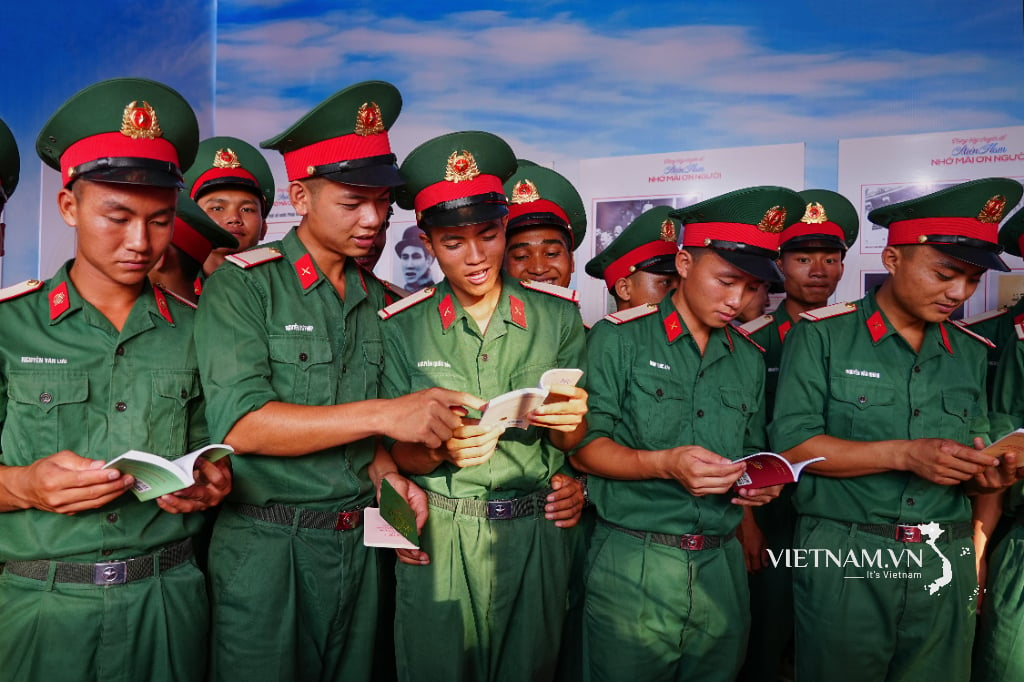
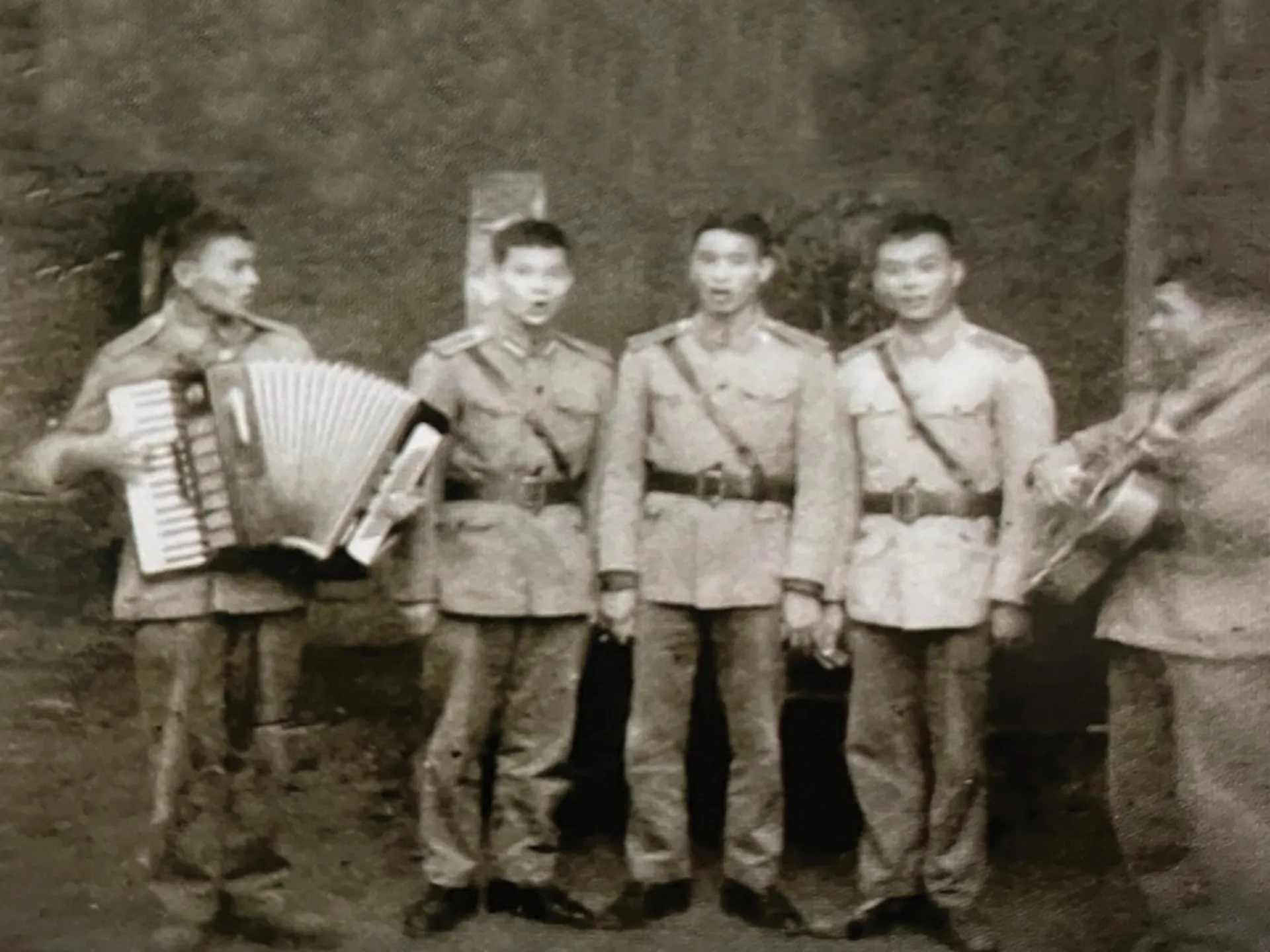
That veteran, whose birth name was Vu Van Vang, commonly known as Vo Vang, was born in 1952 in Thai Binh province (now Hung Yen province), the "5-ton" homeland. In 1970, at the age of 18, the tall, handsome young man Vo Vang volunteered to enlist in the army. After basic training, he was deployed to fight in the Tri Thien battlefield (Hue). Just one year later, in 1971, he was transferred by the Tri Thien Military Region to the North to attend an accelerated accordion training course so that he could return to the battlefield to serve the troops in his units. After completing his training, he returned to the battlefield at the same time that the Paris Agreement on Vietnam was signed. At that time, the artist-soldier took his accordion and performed throughout Quang Tri and Thua Thien provinces.
Musician Vo Vang recalled: “While on the battlefield, I had many emotions about the life of a soldier fighting with a gun in hand. I used to sing and play the flute and trumpet that I made myself for the soldiers to listen to. Because of this, the commanders and soldiers knew I had a talent for performing arts, so everyone often encouraged me, which made me bolder to play and sing for the unit during collective activities or during short breaks on the training ground.” And then, during the years of fighting from the Tri Thien - Hue battlefield, Route 9 - Quang Tri to the battlefields of Southern Laos and Cambodia, young soldier Vo Vang always brought his singing and music to serve the soldiers. From then on, the image of the soldier holding a gun on the front lines always motivated him to engage in artistic activities.
From the battlefield back to the university lecture halls.
During his early years on the smoke-filled battlefield, composer Võ Vang was particularly impressed by the New Year's Eve of 1971 in Southern Laos. Even though the bombing hadn't stopped, the soldiers gathered together, singing heartfelt folk songs about their homeland to bid farewell to the old year and welcome the new. That moment instilled in him a powerful emotion, and one moonlit night, under an unsettled sky, with the lingering smell of bombs and bullets, a young soldier, with a small flute in his hand, began to play the melodies of songs like "Crossing the Bridge Soon" and "Old Words"... These were the sounds of songs carrying the breath of longing for home, the echoes of family affection that warmed the hearts of many soldiers far from home, giving them renewed faith and courage on the battlefield.
In 1974, he was sent by his superiors to study engineering at the Military Engineering Faculty of Hanoi University of Technology. With the spirit of a soldier returning from the battlefield to study in Hanoi, he studied diligently, and upon graduation, he was retained by the Military Engineering Faculty as a teacher. However, he still dedicated time to composing, arranging, and orchestrating music. He also directed mass art programs at the military and national levels. Most of his works are deeply rooted in folk music, reflecting the working lives of local people from all over the country.


In 1993, he continued his studies in Composition at the Hanoi Conservatory of Music. After graduating with honors, he worked at the Air Defense - Air Force Art Troupe as Deputy Head in charge of professional matters. Later, he was transferred to the Propaganda Department of the Air Defense - Air Force Political Department. In April 2005, he changed professions and retired in 2012.
Works imbued with love for the homeland.
Composer Võ Vang has many famous works such as "Mother's Footprints," "Where the Moon and Sun Meet," the choral piece "Sacred Sea and Sky," and "Forever a Soldier of Uncle Ho." He also wrote songs about children such as "Every Time I Look Up at Uncle Ho's Picture." He is also the author of many important choral works and chamber music arrangements, most notably "Sacred Sea and Sky," which demonstrates his dedication to historical themes and national sovereignty. He was also one of the authors involved in composing and directing the massive and spectacular art program for the Grand Celebration of the Millennium of Thang Long - Hanoi in 2010.
Composer Dang Minh Tuan - Literature, Arts and Music Department (VOV3) of the Voice of Vietnam Radio shared: “Composer Vo Vang is a talented musician; he has composed many impressive musical works. Holding the arrangement of composer Vo Vang in my hands, I felt as if I saw an entire Vietnamese countryside appearing, simple yet full of life. From the first lines of music, I felt the warmth of the alluvial soil, the fragrant smell of straw from the newly harvested rice, the gentle sound of the wind over the fields and rice paddies still glistening with morning dew. In his music, each tone is associated with an image, each rhythm carries the memories of generations of hardworking and resilient Vietnamese people. Especially for me, the instrumental suite of traditional Vietnamese music titled “Golden Grains of Rice” by composer Vo Vang is not just a work to perform, but truly a journey home – a return to childhood memories beside the golden rice fields, a return to the days filled with folk songs and melodies.” "Reason is the breath of life. It is also a journey back to our roots, to the simple things that help us recognize ourselves in the flow of our nation."
In 2022, as part of a music project by the Ministry of Culture, Sports and Tourism, composer Vo Vang was assigned by the Vietnam Musicians Association to write a "National Orchestral Suite." He was extremely excited and inspired to name the suite "Golden Grain of Rice," using folk music from all three regions of Vietnam, very close to the lives of Vietnamese farmers. The suite is like a colorful musical painting, depicting the life cycle of a grain of rice – a symbol of diligent labor, embodying the silent hardships but also the profound and sacred love of Vietnamese farmers.
Composer Võ Vang has been and continues to contribute to the national music scene with a rich body of work, particularly in epic, revolutionary, and chamber music. His works include stirring choral pieces about soldiers, and lyrical melodies imbued with love for his homeland, such as the folk song scene "The Sound of the Zither" from Trị Thiên; and the Quan Họ folk performance "The Source of the Thương River"... Beyond composing, composer Võ Vang also devoted much time to preserving, teaching, and revitalizing the traditional music of his homeland.


For many years, musician Vo Vang has simultaneously taught, composed, and staged performances for various agencies and organizations in Hanoi, including festivals celebrating major holidays. With his tireless dedication to his artistic work, musician Vo Vang has been recognized by Hanoi for many consecutive years as an outstanding citizen and a "Good Person, Good Deed."
For his tireless contributions, in 2022, Lieutenant Colonel and musician Vo Vang was honored with the State Award for Literature and Arts for his works "Where the Moon and Sun Meet," "Hue Improvisation," and "Sacred Sea and Sky Chorus," along with many other music awards he has won during his composition and arrangement career.
Source: https://cuuchienbinh.vn/am-dieu-cung-dan-que-huong-d43507.html
![[Image] Schools organize meetings and introduce teaching models to students admitted to grade 10.](https://vphoto.vietnam.vn/thumb/1200x675/vietnam/resource/IMAGE/2026/06/25/1782368077271_ndo_br_z7970052192242-1ec8daeb77a6eed1a4e9f58c564ddd3e-jpg.webp)
![[Photo] General Secretary and President To Lam receives Palestinian Ambassador Saadi Salama](https://vphoto.vietnam.vn/thumb/1200x675/vietnam/resource/IMAGE/2026/06/25/1782365384740_a1-bnd-9423-8322-jpg.webp)
![[Image] Ho Chi Minh City: Ma Lang area, Chicken-Rice Market about to change its appearance](https://vphoto.vietnam.vn/thumb/1200x675/vietnam/resource/IMAGE/2026/06/25/1782377698627_ndo_br_m1-jpg.webp)