|
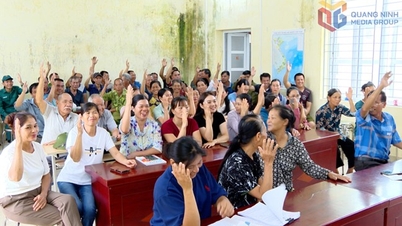
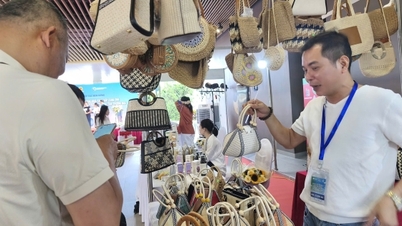
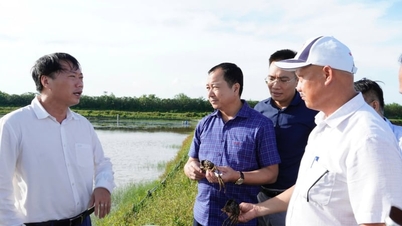
| Residents of Na Rì commune share their experiences in selling goods online. |
From selling online
Na Rì commune was established by merging three communes: Kim Lư, Sơn Thành, and Yến Lạc town. The commune comprises 26 villages, with over 2,800 households and more than 14,000 inhabitants. Thanks to government support and the consensus of the people, the appearance of Na Rì commune is improving day by day. Currently, the commune has 654 poor and near-poor households, a reduction of 38 poor households compared to 2024.
Upon arriving in Na Ri, the first stories we heard were about farmers selling their goods online; stories about OCOP products such as Dong Tam oranges, Pho Co rice cakes, Son Thanh persimmons, and Que Thanh wine… products made by the diligent hands of the ethnic minorities: Tay, Nung, Kinh, Dao, and Mong, bearing the distinctive flavors of the Viet Bac mountains.
The once barren lands of Pò Đồn, Pò Chẹt, Phiêng Cuôn, Nà Pàn, Háng Cáu… are now vastly different, with fields shifting according to the seasons. New rice and corn varieties are being widely cultivated by the villagers, along with orchards of oranges and persimmons promising ripe fruit, accompanied by the bleating of mountain goats and herds of buffalo, cows, and goats grazing on abundant grass. Villages nestled on the mountain slopes now boast farms and livestock operations raising pigs and chickens, generating billions of dong annually.
According to Ms. Nong Thi Tho, Chairwoman of the People's Committee of Na Ri commune: In economic development, the commune identifies agriculture as the main foundation. But importantly, it is crucial to propagate and encourage people to abandon outdated farming practices, gradually improve production skills, and help them change their mindset towards family-based economic activities and concentrated commodity production.
 |
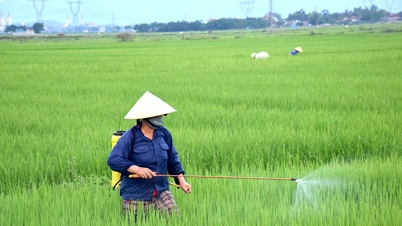
| The entire Na Rì commune has nearly 150 hectares of land planted with various types of vegetables, yielding over 5,000 tons per year. |

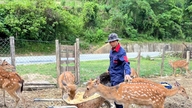
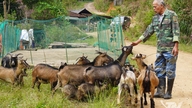
In recent years, many economic development models, such as cultivating new rice varieties, growing citrus fruits, and livestock farming, have been effectively implemented and widely replicated. To successfully implement these models, the commune actively organizes training conferences to transfer scientific and technical knowledge on crop cultivation and livestock farming to the people. Through these conferences, people are provided with additional knowledge on techniques for selecting seeds, caring for crops, and preventing diseases in plants and animals; at the same time, it creates opportunities for them to access new production methods.
Thanks to the application of scientific and technological advancements, agricultural production in Na Ri is becoming increasingly stable and developing. By 2025, the commune will have a total cultivated area of nearly 1,343 hectares of food crops, including 588 hectares of rice and nearly 755 hectares of corn. Grain production is expected to exceed 4,900 tons. Local food security is ensured, creating a source of goods to serve the market.
Along with grain crops, nearly 350 hectares are dedicated to high-value economic crops such as ginger, tea, oranges, tangerines, seedless persimmons, and bananas. Previously, Na Ri had large areas of hilly land overgrown with grass, but this has now been replaced with crops such as sweet potatoes, taro, soybeans, peanuts, vegetables, beans, black jelly, cassava, sugarcane, and various medicinal plants. According to the commune's compiled data, nearly 400 hectares of land have been reforested with these crops. This has provided the local people with a diverse range of products, contributing to a more stable livelihood.
Let's look at the two "pillars" of wealth creation.
Speaking with us, Mr. Hoang Dai Minh from Hat Luong village said: "Thanks to the State's support in capital and technology, people have been further motivated to strive for wealth... Mr. Minh's family is one of the exemplary households in developing household economy in the commune. In addition to growing fruit trees, his family also acts as a buyer for local people, purchasing about 10 tons of various fruits per year."
 |
| Farmers in Na Rì commune receive fruit tree seedlings. |
Mr. Minh's story reminded me of ten years ago, when I visited Khuoi It Dao village and witnessed the movement of clearing the hillsides to make way for tea plantations. Mr. Trieu Van Tuan, the village head, shared: "Thanks to some government support, the previously abandoned hills have now become tea plantations, bringing prosperity to the villagers. 35 out of 46 households in the village grow tea, with some having nearly 2,000 square meters and others nearly 10,000 square meters. Thanks to tea, the lives of our Dao people have become less difficult."
In Na Ri's agricultural economy, crop cultivation and livestock farming are considered two important "pillars." Crop products not only meet the food needs of the people but also serve as feed for livestock and poultry. To ensure sustainable livestock development, the State has supported the people with many effective livestock development programs and projects.


In 2025 alone, the commune will implement two community-based projects: a broiler chicken farming project and a project linking the value chain of horse breeding towards commercial production. To date, the commune has nearly 850 buffaloes and cows, nearly 1,400 pigs, and nearly 71,000 poultry. In 2025, the commune aims to achieve a total output of over 815 tons of live meat of all types for export.
Prosperity and abundance have been and are being achieved through the diligent labor and innovative economic thinking of the ethnic people in this region...
Source: https://baothainguyen.vn/xa-hoi/202603/an-tuong-na-ri-22a0f1a/