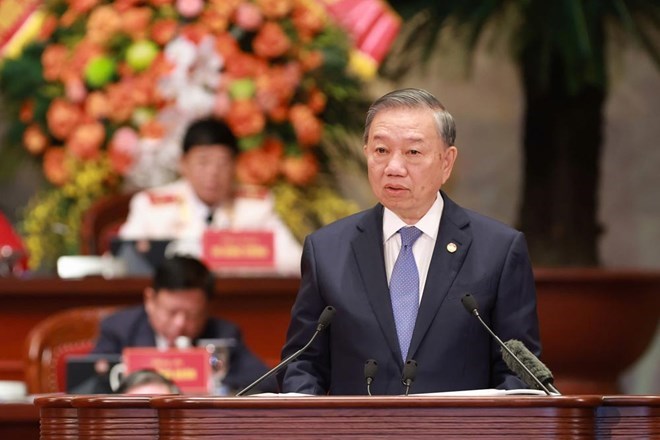
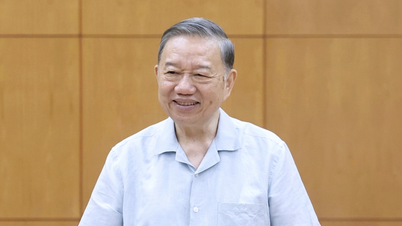
General Secretary and President To Lam. Photo: Hai Nguyen
On May 19, 2026, the entire Party, people, and army of Vietnam will commemorate the 136th anniversary of the birth of the great President Ho Chi Minh at a particularly significant time. The 14th National Congress of the Party was a resounding success, defining strategic directions to lead the country into a new era, building a peaceful, independent, democratic, prosperous, civilized, and happy Vietnam, steadily advancing towards socialism. The elections for the 16th National Assembly and People's Councils at all levels for the 2026-2031 term have opened a new chapter with very high demands for innovative thinking, improved institutional quality, governance effectiveness, and the capacity to serve the people. The political system is gradually operating according to a new, more streamlined, and efficient organizational model, requiring higher performance, effectiveness, and efficiency, closer ties with the people, and better meeting the demands of national development in the new situation.
In this momentous transition, we have become even more deeply aware of the enduring value of Ho Chi Minh Thought—the spiritual foundation, the guiding light, the compass for all the victories of the Vietnamese revolution and the Vietnamese nation. If the Party's 14th Congress documents define the new path of national development, then Ho Chi Minh Thought is the guiding light that leads us on that path with unwavering resolve, correct goals, scientific methods, and profound faith in the people.
President Ho Chi Minh was not only the one who found the path to national salvation and liberation, but also the one who laid the ideological foundation for the building, protection, and development of Vietnam in the new era. For him, national independence was inextricably linked to the freedom and happiness of the people, and to socialism. National liberation was the starting point of a great journey: building a peaceful, unified, and independent Vietnam where the people are masters of their own destiny, live in prosperity, freedom, and happiness, receive education, achieve comprehensive development, and enjoy the fruits of the revolution.
That is the profound humanistic depth, the enduring value, and the enduring vitality of Ho Chi Minh Thought. This thought not only illuminated the path to national independence and reunification in the 20th century, but continues to illuminate the task of protecting national sovereignty and territorial integrity, innovating, reforming, and achieving rapid and sustainable development in the 21st century. In this new era, as the country faces the demand for strong progress, enhanced strategic self-reliance, and catching up with the trends of the times, Ho Chi Minh Thought becomes an even more crucial spiritual anchor, a foundation of thought, and a decisive direction for action.
The 14th National Congress of the Communist Party of Vietnam is a very important milestone in the country's development process. The Congress not only summarized the development journey and reviewed the great and historically significant achievements after 40 years of reform, but also established the methodology, vision, and strategic decisions for the future development phase. This includes a path towards rapid and sustainable development; building a clean, strong, and efficient Party and political system; building a socialist rule of law state of the people, by the people, and for the people; developing the country based on science, technology, innovation, and digital transformation; developing Vietnamese culture and people as a foundation, endogenous resource, and important driving force; building an independent, self-reliant economy that actively integrates deeply into the international community; and strengthening national defense and security.
Looking deeper, these strategic orientations are the inheritance, application, and creative development of Ho Chi Minh's thought in new historical conditions. Ho Chi Minh's thought is not a set of immutable, closed propositions, but a dynamic system of viewpoints, always connected to reality, taking reality as its starting point, taking the interests of the nation and the happiness of the people as its highest goal, and using self-reliance, democracy, innovation, creativity, and action as the methods to realize revolutionary ideals.
First and foremost, President Ho Chi Minh's ideology of "the people are the foundation" continues to be the guiding principle of all policies and strategies in the current period. In his thought, the people are the subject of history, the inexhaustible source of strength for the revolution, and the highest goal of service for the Party and the State. All benefits are for the people. All rights belong to the people. The government, from the central to the local level, is the servant of the people. Cadres and Party members must be close to the people, understand the people, trust the people, respect the people, learn from the people, work for the people, and be responsible to the people.
This spirit sets very clear requirements for the current reform process: all reforms must be people-centered, aiming to better serve the people, and using the people's satisfaction, trust, and happiness as the measure of evaluation. Streamlining the apparatus is not just about reducing bureaucracy, hierarchical levels, and costs, but more fundamentally, about making the apparatus closer to the people, more connected to the grassroots, handling work faster, and serving citizens and businesses better. Decentralization and delegation of power aim to clearly define responsibilities, tasks, and accountability, fostering initiative, creativity, and self-responsibility at each level, sector, and locality. Digital transformation aims to modernize management tools, creating a more transparent, convenient, fair, thoughtful, and faster governance system.
Secondly, President Ho Chi Minh's ideology of independence, self-reliance, and self-strength continues to illuminate the path of national development in the context of strategic competition, supply chain shifts, the fourth industrial revolution, and profound global changes. During his lifetime, he always emphasized that national independence must be linked with self-reliance and self-strength; that we must rely primarily on our own strength while simultaneously seeking international support and cooperation; and that we must combine national strength with the strength of the times.
Today, this ideology is being developed in the context of building an independent, self-reliant, highly resilient economy with international competitiveness, actively integrating deeply but without dependence; strongly developing science, technology, innovation, and digital transformation; mastering strategic technological fields; and forming new productive forces and new modes of production. The aspiration to "stand shoulder to shoulder with the great powers of the world," which President Ho Chi Minh entrusted to the generations of Vietnam today, has become a practical development requirement, demanding that the entire Party, people, and army strongly innovate their thinking, act decisively, overcome complacency, and overcome the risk of falling behind, especially in technology, productivity, and the quality of development.
Thirdly, Ho Chi Minh's thought on Party building continues to be a particularly important foundation for the building and rectification of the Party and the political system in the new period. President Ho Chi Minh instructed that our Party is the ruling Party; every cadre and Party member must truly internalize revolutionary ethics, be diligent, thrifty, honest, upright, and selfless; must keep the Party truly clean; and must be worthy of being a leader and a truly loyal servant of the people. He considered ethics to be the root of a revolutionary, and the close, blood-and-flesh connection with the people to be the source of strength and the condition for the Party's existence and development.
In the current context, this requirement is even more vital. A country that wants to develop rapidly and sustainably must have a truly clean, strong Party with sufficient courage, intelligence, morality, prestige, and leadership capacity. A streamlined political system that wants to operate effectively must have a team of officials with sufficient qualities, capabilities, responsibility, who dare to think, dare to act, and dare to take responsibility for the common good. A modern governance system that wants to succeed must be based on discipline, order, integrity, transparency, and accountability.
Therefore, combating corruption, waste, negative practices, and bureaucracy is not only a task of Party building, but also a task of development. Combating corruption aims to purify the system, strengthen the people's trust, protect national resources, and create a healthy environment for development. Combating waste aims to unlock resources, effectively utilize public assets, public time, and development opportunities for the country. Combating negative practices aims to maintain discipline, prevent the abuse of power, and create a fair and civilized foundation for sustainable national development. Combating bureaucracy ensures that the system is not detached from the people, policies are not detached from reality, and officials are not indifferent to the lives of the people.
Fourth, Ho Chi Minh's thought on national unity continues to be a strategic source of strength in the new era. He affirmed that unity is an extremely precious tradition of our nation, a decisive factor in the victory of the revolution. Unity within the Party, unity among the people, national unity, international unity; unity among classes, strata, ethnic groups, religions, compatriots at home and Vietnamese people abroad—this is the method of gathering forces and also the art of building national strength of the great President Ho Chi Minh.
In the current era, national unity is not only a political requirement but also a driving force for development. For the country to prosper, it must awaken and maximize the intellect, courage, aspirations, creativity, and dedication of all Vietnamese people. Workers, farmers, intellectuals, entrepreneurs, artists, youth, women, veterans, people of all ethnic groups and religions, and Vietnamese people abroad are all important forces in the cause of building and defending the Fatherland. National development in the new era cannot rely solely on state resources; it must mobilize, unleash, and connect all social resources and the creative potential of the people.
Fifth, Ho Chi Minh's thoughts on culture and people continue to illuminate the requirements for sustainable national development. For him, culture does not stand outside of politics, economics, and society, but must guide the nation's path. People are both the goal and the driving force of the revolution. National development is not just about economic growth, but also about raising the intellectual level of the people, cultivating character, building morality, developing culture, and caring for the material and spiritual lives of the people.
In the new era, rapid development must go hand in hand with sustainable development; economic growth must go hand in hand with social progress and equity; technological innovation must go hand in hand with human development; and international integration must go hand in hand with preserving national cultural identity. A nation is only truly powerful when it has a strong economy, modern institutions, solid national defense and security, a rich and distinctive culture, well-rounded human development, and a humane, compassionate, disciplined, and creative society.
From this, it can be seen that recent reform policies, from streamlining the political system's organizational structure, rearranging administrative units, operating a two-tiered local government model; reforming institutions, perfecting laws; promoting decentralization and delegation of power, administrative reform, digital transformation; developing science, technology, and innovation; developing the private economy, improving the efficiency of the state economy, building an independent and self-reliant economy; developing culture and human resources, improving the quality of education, healthcare for the people, and ensuring social security; to proactively integrating into the international community, strengthening national defense and security, and combating corruption, waste, and negative phenomena, all need to be examined through the lens of Ho Chi Minh Thought. This examination is necessary to maintain the correct objectives. It is necessary to choose the right methods. It is necessary to ensure that all reforms do not alienate the people, that all development does not lose its identity, and that all reforms do not separate from the ideals of national independence and socialism.
Therefore, commemorating the 136th anniversary of President Ho Chi Minh's birth in the current context is not only an occasion to remember and express gratitude for his immense contributions. It is also an opportunity for the entire Party, the entire people, and the entire army to reflect on themselves in light of his thoughts, ethics, and style; to strengthen faith in the chosen path; to enhance responsibility to the Fatherland and the People; and to transform Ho Chi Minh's thought into concrete revolutionary actions in each agency, each locality, each cadre, Party member, and citizen.
Studying and following Ho Chi Minh's ideology, ethics, and style today cannot stop at mere words, catchy slogans, or superficial movements. More importantly, it must transform into public service ethics, disciplined implementation, a culture of integrity, a spirit of innovation and creativity, responsibility to serve the people, organizational capacity, and concrete results in daily life. Every correct policy must be put into practice. Every policy must reach the people. Every official must use the satisfaction, trust, and happiness of the people as the measure of their work.
The era of national progress places very high demands on the entire political system. We must be steadfast but not conservative; innovative but not deviating from the path; develop rapidly but sustainably; integrate deeply but maintain independence and self-reliance; build a streamlined apparatus but ensure better service to the people; develop a strong economy but ensure social progress, equity, and the happiness of the people. This is also the spirit of Ho Chi Minh in the new conditions: steadfast in goals, creative in methods, practical in action, humane in purpose, putting the people first, and placing national interests above all else.
The more significant the historical transition, the more we must uphold Ho Chi Minh's ideology. The further we advance on the path of modernization, the more deeply we must return to the fundamental values he left behind: independence, freedom; the people are the foundation; unity; self-reliance and self-strength; diligence, frugality, integrity, and righteousness; a clean Party; a State serving the people; and development for the people and for their happiness.
Under the guidance of Ho Chi Minh, with the courage, wisdom, will, and aspirations of Vietnam, the entire Party, people, and army will certainly successfully implement the Resolution of the 14th National Congress of the Party, achieve the two strategic goals for the 100-year period, and realize the aspiration for a strong and prosperous nation, standing shoulder to shoulder with the great powers of the world, as our beloved President Ho Chi Minh always wished.
Source: https://laodong.vn/thoi-su/anh-sang-ho-chi-minh-soi-duong-cho-chung-ta-di-1703171.ldo


![[Image] Close-up view of the interchange connecting the two expressways and Long Thanh Airport.](https://vphoto.vietnam.vn/thumb/1200x675/vietnam/resource/IMAGE/2026/05/25/1779703378210_ndo_br_z7863716673926-224453a31600126cce10622af6290afd-4549-jpg.webp)


![[Image] Hanoi's urban life under the challenge of a "scorching hot" environment](https://vphoto.vietnam.vn/thumb/1200x675/vietnam/resource/IMAGE/2026/05/25/1779706979265_nang-nong-t5-2026-minh-duy-7-4636-jpg.webp)





















































Comment (0)