

Our first impression upon meeting Major Dao Nguyen Tuc was his tall stature, warm voice, and simple, approachable demeanor. When asked about his work for the local people, he said, "Like all my comrades, I always uphold the sense of responsibility and affection of a soldier of Uncle Ho towards the people."
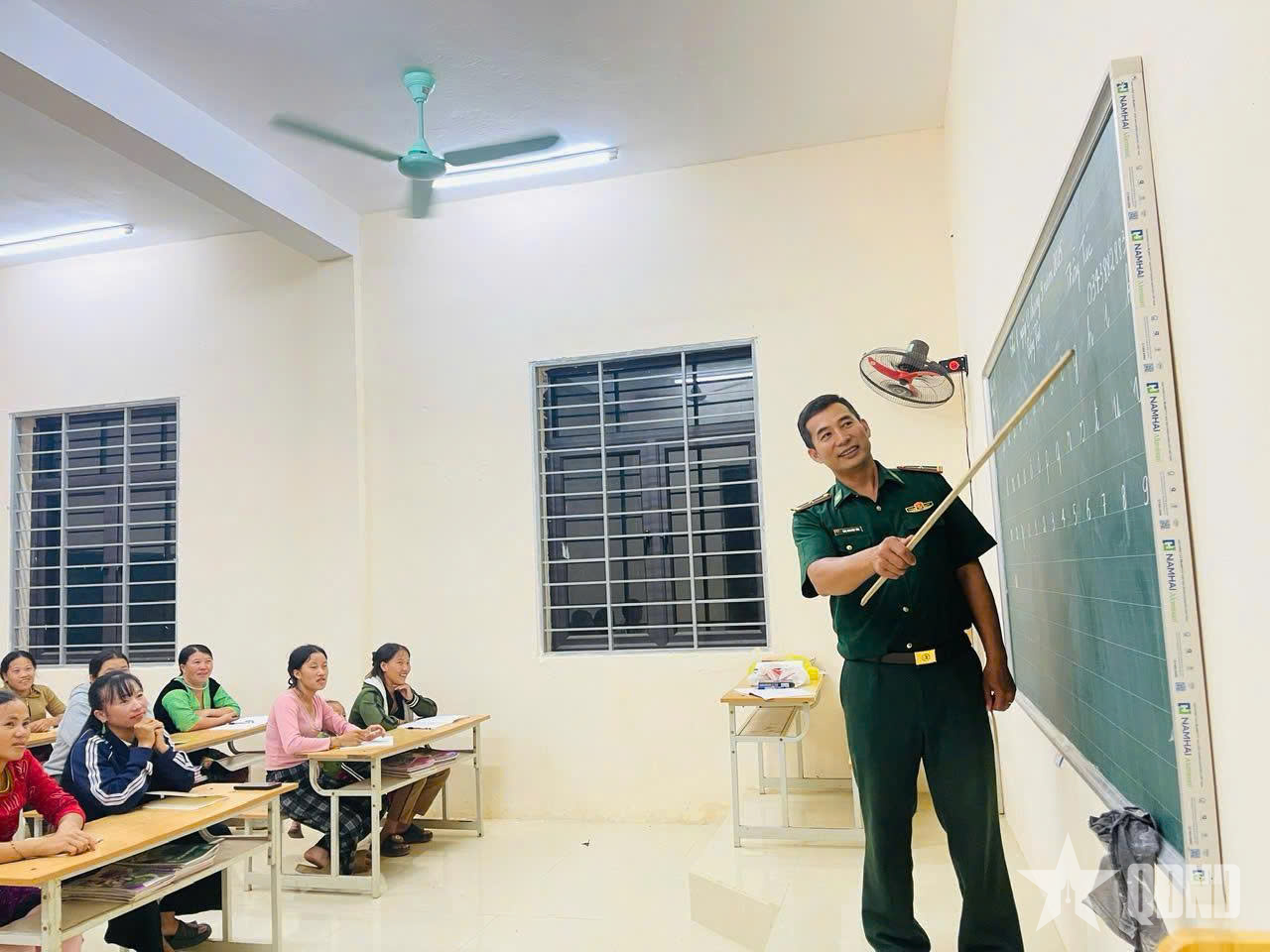 |
| Major Dao Nguyen Tuc, a military officer, teaches literacy to the Mong ethnic minority people in a border village. |
Born and raised in the mountainous region of Thanh Hoa province, Dao Nguyen Tuc understood the hardships of life in the highlands from an early age. In 2003, he enlisted in the Border Guard, carrying with him the aspiration to contribute to protecting the border and helping the people escape poverty and backwardness. Many years of working at the grassroots level gave him the opportunity to be close to the people and understand the difficulties faced by ethnic minorities in border areas. Therefore, he always strives to stay in his assigned area, fulfill his duties, and support the people in improving their lives, especially since he was transferred to work at Tam Chung Border Guard Post - an area with a large Hmong population living in remote and isolated villages.
According to Major Dao Nguyen Tuc, poverty in Tam Chung commune, Thanh Hoa province, stems not only from barren land or harsh natural disasters but also from the awareness of the people themselves: "What worries me is that many people, especially women in border villages, are illiterate, unable to read or write, making it difficult for them to access policies and guidelines, apply science and technology to production, and even easily exploited by unscrupulous individuals." During his time working alongside the local people, he witnessed many heart-wrenching stories. Some people couldn't read instructions for using animal medicine and treated diseases incorrectly. Others were exploited by traders selling agricultural products because they lacked the ability to calculate prices. Many women had never held a pen and couldn't even sign necessary documents...
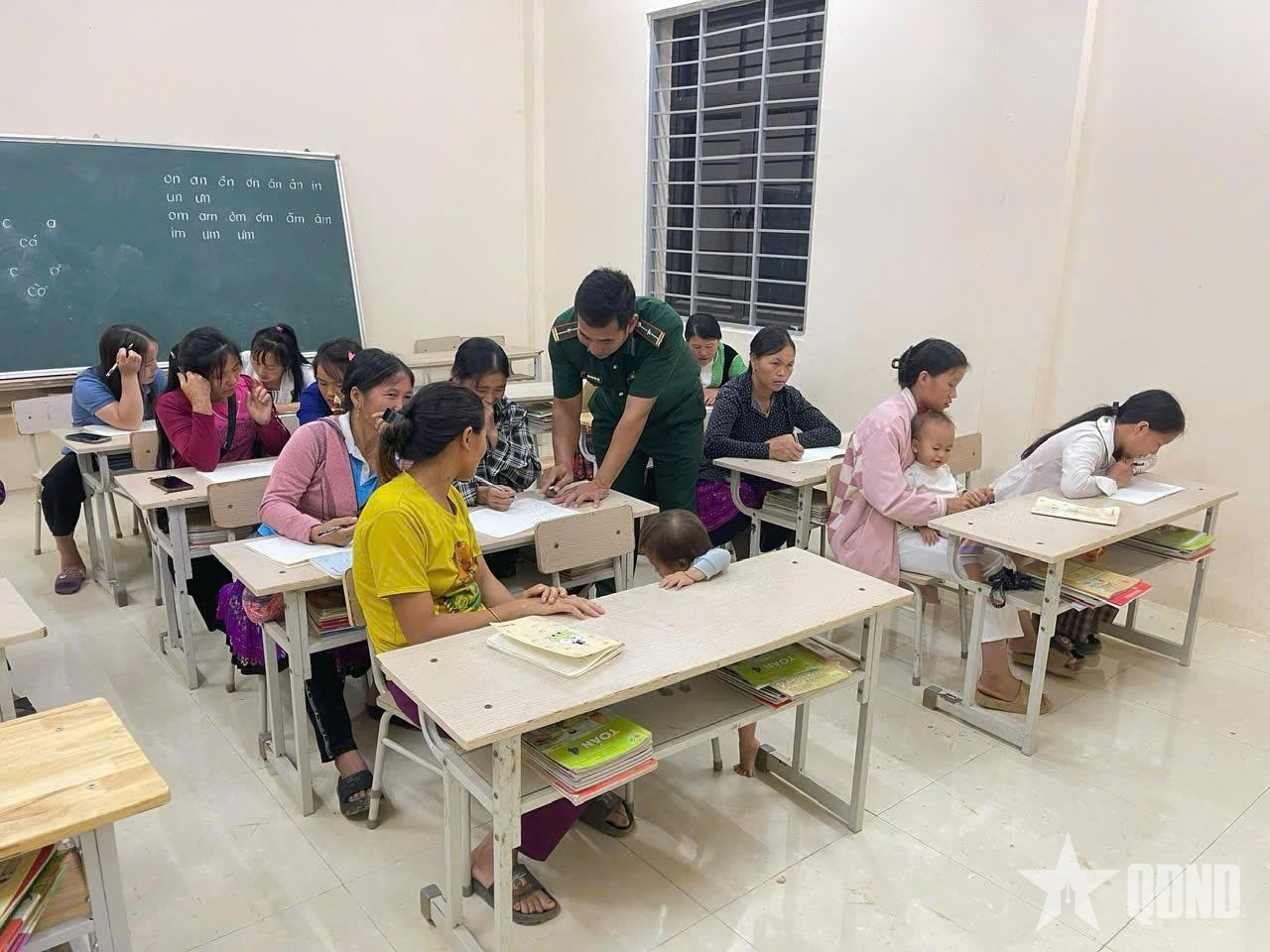 |
| Major Dao Nguyen Tuc, a military officer, teaches literacy to the Mong ethnic minority people in a border village. |
Based on that reality, he boldly advised the Party committee and the unit's commander to coordinate with the local government to open literacy classes for the Hmong people in the area, and he personally taught the classes. The idea received support, but the journey of bringing literacy to the village was never easy, because the people were still hesitant and unwilling to participate. Coming from a mountainous region, he didn't use abstract words to persuade the people, but went to each house to persuade and explain using the most familiar things: knowing how to read and write helps with better livestock farming, knowing how to read prevents being cheated, knowing how to calculate when buying and selling, knowing how to take care of children... Persuading people to attend classes was only the beginning; maintaining the number of students was much more difficult. During the day, the women had to work in the fields, and everyone was exhausted when they returned home in the evening. Some families lived far from the class location. Dao Nguyen Tuc and his comrades continued to go to each house to persuade and explain many times. He remembers most vividly the case of Ms. Thao Thi Su in Phai village. In the beginning, her husband, Giàng A Phử, disagreed with her going to school, believing that learning to read and write was just a waste of time. Undeterred, Đào Nguyên Túc visited their home many times to talk to her and explain the benefits of literacy. Gradually, Mr. Phử changed his mind and agreed to let his wife attend class.
Thanks to the night classes on the border taught by "teacher" Dao Nguyen Tuc, many people have become literate, more confident in communication, able to read documents, and able to do calculations when buying and selling. Some have even become active propagandists in their villages, encouraging their neighbors to send their children to school. Besides teaching reading and writing, the classes also incorporate knowledge about healthcare, livestock farming, production, and law. Stories about preventing child marriage, maintaining environmental hygiene, and protecting the border and boundary markers are also included in his lectures using simple, easy-to-understand language. Since 2023 alone, Major Dao Nguyen Tuc, along with officers and soldiers of the Tam Chung Border Guard Post, has advised on and opened three literacy classes with over 145 students in the villages of Suoi Long, Suoi Phai, and On (Tam Chung commune).
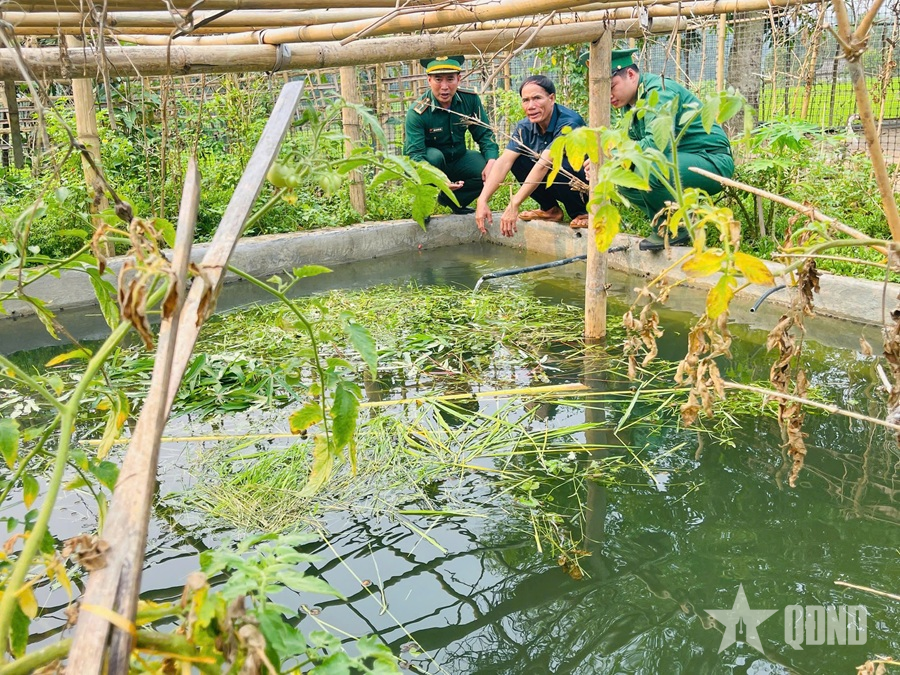 |
| Thanks to the support of border guards, Mr. Ha Van Dich's family in Tam Chung commune, Thanh Hoa province, has risen out of poverty sustainably. |
In addition to teaching literacy classes to help the local people change their mindset, Dao Nguyen Tuc also persistently supports their livelihoods, helping them gradually escape poverty sustainably. For many years, he has consistently and effectively implemented the "Border Guard Party Member in Charge of Households" model. According to him, being in charge is not just about visiting and disseminating policies, but about truly helping people change their lives. To achieve this, he regularly goes to each village and each house to understand their circumstances and outline specific support plans for each household. He knows very well which households lack capital, seedlings, livestock, or experience in animal husbandry.
Like many of his comrades in the unit, Dao Nguyen Tuc always sets aside a portion of his salary to buy seedlings and livestock to support poor households. At times, after receiving his salary, he would find and buy seedlings, livestock, and animal feed, then personally transport them to the villages to help the villagers. Many households were initially hesitant, fearing they wouldn't be able to raise the animals, but he patiently encouraged and guided them step by step. "Helping the villagers with a few bags of rice only provides enough food for a while. To escape poverty long-term, we must help them have a livelihood and learn how to do business," he confided.
In Lat village, Tam Chung commune, Mr. Ha Van Dich still remembers the days when his family was in difficult circumstances. After being "sponsored" by border guard officer Dao Nguyen Tuc, who visited his home to survey and guide him in developing a VAC (gardening, animal husbandry, and aquaculture) model, his family's life gradually became more stable. "Officer Tuc is very close to the people. He keeps his promises. He provides seedlings and livestock, and regularly comes to our house to guide us on how to build shelters and care for the animals. Thanks to him, my family is now much less burdened," Mr. Dich shared.
Beyond providing material support, more importantly, Dao Nguyen Tuc consistently guided the villagers in changing their production mindset. Previously, many households in Tam Chung mainly raised livestock in a free-range manner, completely dependent on nature, resulting in low efficiency and frequent disease outbreaks. Major Dao Nguyen Tuc persistently encouraged the villagers to build hygienic barns, store feed for livestock during the winter, and properly vaccinate and care for their animals.
His comrades at the Tam Chung Border Guard Post recount that during his trips to the villages, Dao Nguyen Tuc's motorbike was often loaded with seedlings, livestock, or necessities for the poor. Many times, the villagers offered him money, but he always refused. What made him happiest was seeing the people gradually change their way of thinking and doing things, and their lives becoming more stable. Thanks to the dedicated guidance of border guard officers, many households in Tam Chung now know how to grow more vegetables, develop livestock and poultry farming in a more efficient way, have savings, and their children can attend school regularly. According to Major Dao Nguyen Tuc, to help the people in the highlands escape poverty, the first thing to do is to build trust. When people trust the soldiers and believe in the new methods, they will be more willing to change.
Perhaps that's why, in the eyes of the ethnic minority people in Tam Chung, he is not only a border guard officer but also like a family member. Whether it's good news or a time of difficulty, the villagers always turn to him to share their joys. Amidst the vast borderlands, this soldier in green uniform quietly "sows" literacy, diligently helping the people develop their economy and contributing to changing the face of the highland villages. The simple yet responsible and compassionate actions of Major Dao Nguyen Tuc have contributed to beautifying the image of the Border Guard in the hearts of the people in the border regions of the Fatherland.
Source: https://www.qdnd.vn/phong-su-dieu-tra/cuoc-thi-nhung-tam-guong-binh-di-ma-cao-quy-lan-thu-17/anh-tuc-bien-phong-o-tam-chung-1041407
![[Photo] The courage of new recruits of Brigade 144 on the training ground.](https://vphoto.vietnam.vn/thumb/1200x675/vietnam/resource/IMAGE/2026/05/27/1779881651341_anh-man-hinh-2026-05-27-luc-18-32-52.png)

![[Photo] General Secretary and President To Lam and his wife begin their official visit to Thailand.](https://vphoto.vietnam.vn/thumb/1200x675/vietnam/resource/IMAGE/2026/05/27/1779881249412_anh-man-hinh-2026-05-27-luc-18-10-51.png)






























![[Photo] The courage of new recruits of Brigade 144 on the training ground.](https://vphoto.vietnam.vn/thumb/402x226/vietnam/resource/IMAGE/2026/05/27/1779881651341_anh-man-hinh-2026-05-27-luc-18-32-52.png)


















Comment (0)