

What remains is the image of the flowing ao dai dresses amidst the sea and sky. Hundreds of nautical miles from the mainland, in the vast expanse of the ocean, the ao dai appears both familiar and sacred...
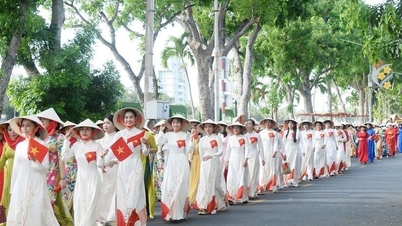
As the delegation set foot on Truong Sa Island, we were greeted by women in vibrant red ao dai (traditional Vietnamese dress). The striking red stood out against the blue backdrop of the sea, sky, trees, and the simple houses of the remote island. Ms. Pham Thi Bay, a resident of Truong Sa Island, recounted that she had been on the island for three years. Every Monday morning, the women on the island wear their traditional ao dai and join the officers and soldiers in the flag-raising ceremony. On holidays, anniversaries, or cultural events, the women also wear ao dai together. Ms. Bay's story is simple, but in Truong Sa, that simplicity holds great significance. Because the morning flag-raising ceremony on the island is unlike any on the mainland. In front is the red flag with a yellow star, surrounded by the vast ocean, behind are the small houses of the residents, the barracks of the soldiers, and the daily life of those clinging to and defending the island.
 |
| Women on Sinh Ton Island wearing vibrant red ao dai dresses. |
Ms. Pham Thi Bay shared: “Every Monday morning, the women on the island wear the traditional ao dai dress and join the officers and soldiers in the flag-raising ceremony. Except during storms, even in heavy rain, the entire island still holds the flag-raising ceremony in the assembly hall. Each time I wear the ao dai and stand solemnly for the flag-raising ceremony, I feel an indescribable emotion. Far from the mainland, the women on the island always remind each other to preserve the traditional beauty of Vietnamese women. For me, the ao dai is not just for wearing on happy days or holidays. It is a way for women on this remote island to remind themselves that even living in the middle of the ocean, they still carry the traditions of their homes and villages, the flavors of the mainland, to Truong Sa.”
The story of Ms. Bay is also the story of families who have chosen to settle on the island. Mr. Le Thanh Tuan, born in Cam Lam, Khanh Hoa (currently a resident of Sinh Ton Island), has been familiar with the sea since childhood. Upon reaching adulthood, he volunteered to enlist and served on Song Tu Tay Island. The image of the sea seems to have become ingrained in his blood and flesh. After marrying Ms. Bui Thi Kim Ngoc and learning about the policy of registering as a permanent resident on the island, Mr. Tuan discussed with his wife: "How about we move to the island to live?" That question, seemingly simple, represents a major decision for a young family.
With mutual understanding and support, Mr. Tuan and Ms. Ngoc brought their young child to Sinh Ton Island. In the beginning, Ms. Ngoc couldn't help but feel a little disoriented. Life on the island was different from the mainland. Far from family, markets, and the familiar rhythm of city life, everything had to be gradually adjusted. But thanks to the close bond between the military and civilians, and the support of officers, soldiers, and neighboring households, her family adapted to their new life. Every day, the couple tended their vegetable garden, nurtured their family life, and raised their child amidst the sounds of waves and wind, surrounded by the love of the entire island.
On Sinh Ton Island, the residents' houses are close together. In front of each house are lush green trellises of gourds and loofahs. Some houses have added tables and chairs so that in the evenings, people can sit and chat after a busy day. If a family has something to do, the other households pitch in to help. After a sweaty walk around the island, receiving a cool cup of herbal tea from Ms. Nguyen Thi Ut Lan, another resident of Sinh Ton Island, made us feel the heat lessen. Ms. Lan said: "Coming to the island makes you miss home, the mainland, and your loved ones. After staying here for a while, you get used to it. When you go on leave to return to the mainland, you miss the island, the sound of the temple bells echoing in the waves, the innocent laughter of children playing; you miss the soldiers who shared joys and sorrows with you." We complimented Ms. Lan's beautiful green ao dai, which was cool and comfortable in the summer sun, peaceful amidst the lapping waves. She said that here, the sea breeze dries clothes quickly but also makes them fade and wear out quickly. The women wear them sparingly... I only dare to dress up when there are distinguished guests, for flag ceremonies, on the full moon days when going to the temple, or for cultural performances.
Ms. Lan added that her biggest worry on the first day on the island wasn't whether she would get used to it, but whether her daughter would adapt to the new environment. Therefore, she spent a lot of time accompanying and guiding her daughter to become a true "young citizen" on the island. The children on the island receive a lot of love and care from the officers and soldiers. Thanks to this, her daughter adapted quite quickly to the new life. She often tells her daughter about Truong Sa, about the soldiers' duties, and why everyone lives and protects this place. The children listen and express their love and pride for the soldiers.
In remote, windswept islands, the beauty of the ao dai (Vietnamese traditional dress) becomes even more special, helping women overcome their longing for the mainland to build a home on these distant islands. This trip allowed me to see ao dai fluttering in the harbor of Sinh Ton Island, amidst the vast, verdant expanse of the island. I saw ao dai fluttering before the sovereignty marker on Truong Sa Island, amidst the boundless sea and sky. I saw ao dai gracefully flowing on Da Tay A Island, amidst the tranquil sound of temple bells. What could be more beautiful, more sacred, more moving, and more inspiring than this!
Source: https://www.qdnd.vn/van-hoa/doi-song/ao-dai-o-truong-sa-1038053


![[Photo] National Assembly Chairman Tran Thanh Man working with the Standing Committee of the Law and Justice Committee](https://vphoto.vietnam.vn/thumb/1200x675/vietnam/resource/IMAGE/2026/05/21/1779378929214_ndo_br_1-4610-jpg.webp)
![[Photo] General Secretary and President To Lam presides over a working session with the Central Policy and Strategy Committee on the development of the materials industry.](https://vphoto.vietnam.vn/thumb/1200x675/vietnam/resource/IMAGE/2026/05/21/1779359935432_a3-bnd-3129-1412-jpg.webp)













































































Comment (0)