

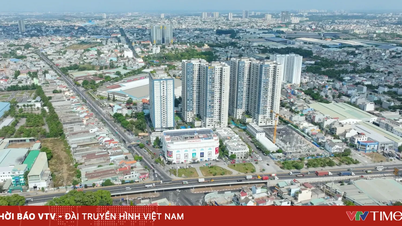
Despite positive developments in the real estate market, some experts remain concerned about the risk of real estate companies defaulting on bond payments next year.
Despite positive developments in the real estate market, some experts remain concerned about the risk of real estate companies defaulting on bond payments next year.
According to Dr. Can Van Luc, Chief Economist of BIDV , during the most difficult period of the real estate market (from June to August 2023), Government Decree 08/2023/ND-CP was issued, allowing businesses and investors to negotiate extensions and deferrals of bond payments. With this "lifeline," 60% of businesses were granted an extension of two years, thus bringing the repayment deadline to June 2025.
Statistics from a credit rating agency indicate that the outstanding balance of corporate bonds (both principal and interest) maturing in 2025 is estimated at approximately VND 334,000 billion. For the real estate sector alone, the projected maturing balance is around VND 135,000 billion.
Commenting on the above figures, the expert from BIDV believes that bond pressure in 2025 is not a cause for concern. Defaults are unlikely to occur due to the gradually improving real estate market. Many businesses only need to offer a product discount of around 10% to sell their goods, instead of 40-50% as in the previous period.
Furthermore, Mr. Luc confidently asserted that the real estate market is benefiting from macroeconomic factors. Specifically, inflation is rising within control; interest rates in Vietnam remain low; the exchange rate is gradually stabilizing; and the budget deficit, public debt, foreign debt, and government debt repayment obligations are within the limits permitted by the National Assembly . In addition, the institutional and legal framework is gradually being improved thanks to the presence of the three new real estate laws.
The market recovery was clearly reflected in the Ministry of Construction 's Q3/2024 report. Specifically, the total number of successful transactions in the apartment and detached house segments reached 38,398. This figure increased by 48.3% compared to Q2/2024 and by 29% compared to the same period in 2023. With improved market sentiment, the prospects for the return of real estate businesses are becoming increasingly clear.
Sharing the same view, Mr. Nguyen Quang Thuan, General Director of FiinRatings, said that the largest source of capital for real estate businesses does not come from bank loans or bonds, but from customer payments. If the government removes legal issues in projects and creates conditions for developers to launch sales sooner, handling bond debt will no longer be a difficult problem.
In fact, progress in resolving legal obstacles is accelerating. From the third quarter of 2024, many projects that had been stalled for years have resumed sales. In Hanoi, these include Hanoi Melody Residences (Hoang Mai district) and QMS Top Tower (Nam Tu Liem district). In Ho Chi Minh City, revived projects include Dat Xanh Homes Riverside (Thu Duc City), Metro Star (Thu Duc City), D-Homme (District 6), Lavida Plus (District 7), etc.
However, from the perspective of Dr. Vu Dinh Anh, an economic expert, the number of bonds maturing in 2025 remains a significant pressure on businesses. In particular, bonds issued by real estate companies have a much higher risk of default and potential bad debt than the market average.
The expert's conclusion is well-founded, especially when compared with a recent report. According to that report, over the past 10 months, residential real estate companies accounted for 60% of the total amount of delinquent bonds. Furthermore, 56% of issuers with weak creditworthiness belonged to the residential real estate and construction sector.
"Over the next 12 months, approximately VND 109 trillion in bonds maturing belong to the residential real estate sector, accounting for nearly half of the total value of maturing bonds. Of these, we estimate that around VND 30 trillion in bonds are at risk of defaulting on principal repayment," the report stated.
According to Mr. Duong Duc Hieu, Director of the Credit Rating and Analysis Division, Non-Financial Enterprise Segment of VIS Rating, the debt repayment capacity of residential real estate businesses remains weak, and the disparity in debt repayment capacity is widening.
According to an expert from VIS Rating, businesses with projects focused on the residential segment, concentrated in major cities like Hanoi and Ho Chi Minh City, will experience relatively good sales and a recovery in 2024. These businesses will have better resources and a high debt repayment capacity.
"Conversely, some businesses will remain in a difficult situation, due to their previous focus on highly speculative projects. Demand for this segment remains low, resulting in weak debt repayment capacity," Mr. Hieu commented.
VIS Rating emphasized that up to two-thirds of listed developers have weak to extremely weak cash flow to repay debt, specifically operating cash flow below 5% of total debt. This is particularly serious for developers affected by project legal issues.
Given the above situation, it is predicted that 50% of the bonds maturing of investors in late 2024 and into 2025 may be at risk of defaulting on principal and interest payments, with the majority of these being businesses that frequently delay payments.
Source: https://baodautu.vn/ap-luc-dao-han-trai-phieu-bat-dong-san-trong-nam-2025-d231455.html

![[Photo] Reception to welcome General Secretary and President To Lam and his wife on their State visit to the Philippines](https://vphoto.vietnam.vn/thumb/1200x675/vietnam/resource/IMAGE/2026/06/01/1780295488620_vna-potal-chieu-dai-chao-mung-tong-bi-thu-chu-tich-nuoc-to-lam-va-phu-nhan-tham-cap-nha-nuoc-toi-philippines-8798060-7855-jpg.webp)
![[Photo] General Secretary and President To Lam and the President of the Philippines hold talks.](https://vphoto.vietnam.vn/thumb/1200x675/vietnam/resource/IMAGE/2026/06/01/1780286997787_anh-man-hinh-2026-06-01-luc-11-09-43.png)









































































































Comment (0)