

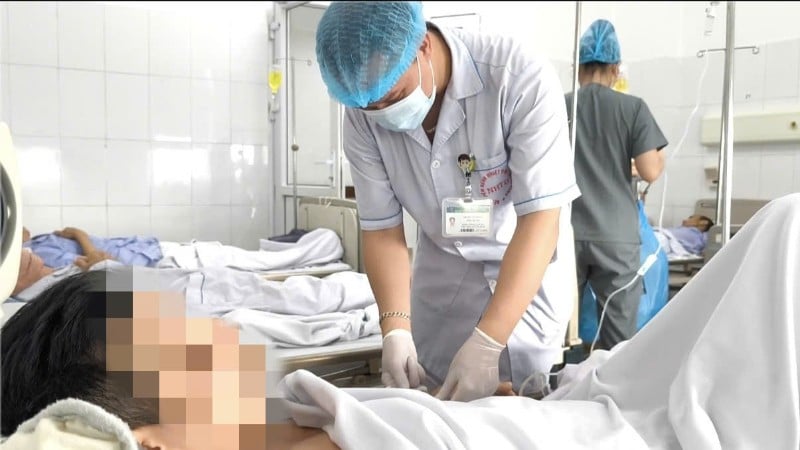
Patient DTL was admitted to the hospital with severe abdominal pain in the right lower quadrant, a mild fever of 38-38.5°C, tenderness on palpation, and abdominal wall rigidity. Laboratory results showed an elevated white blood cell count (12 G/L), leading to an initial diagnosis of acute appendicitis.
Mr. L. stated that he frequently eats fish. The morning before his hospitalization, he ate fish noodle soup, after which he experienced a dull pain in his upper abdomen. Thinking he had a stomach ache (due to a history of stomach pain), he self-medicated but it didn't help. Around noon that day, the pain moved to his lower abdomen. By afternoon, the pain intensified, and he had to go to a nearby clinic for examination.
He was diagnosed with irritable bowel syndrome and possibly appendicitis, and was placed under observation. By 5:30 PM, the pain had not subsided and he had developed a slight fever, so his family took him to the National Hospital for Tropical Diseases.
At the Center for Hepatobiliary and Digestive Surgery, based on the results of laboratory tests, ultrasound, CT scans, and clinical monitoring, Mr. L. was diagnosed with a perforated small intestine due to a foreign body and was scheduled for emergency surgery that same night.
During surgery, the surgical team discovered cloudy fluid and severe infection in the patient's abdominal cavity. The right iliac fossa appendix was inflamed and congested. An abscess was found in the small intestine approximately 1 meter from the ileocecal junction, caused by a 4cm fish bone puncturing the small intestine. Tencm away, a large Meckel's diverticulum was present.
The doctors removed the inflamed appendix, excised the segment of the small intestine containing the diverticulum and abscess, and cleaned the abdominal cavity. Two days after the surgery, the patient recovered well and will be discharged soon.
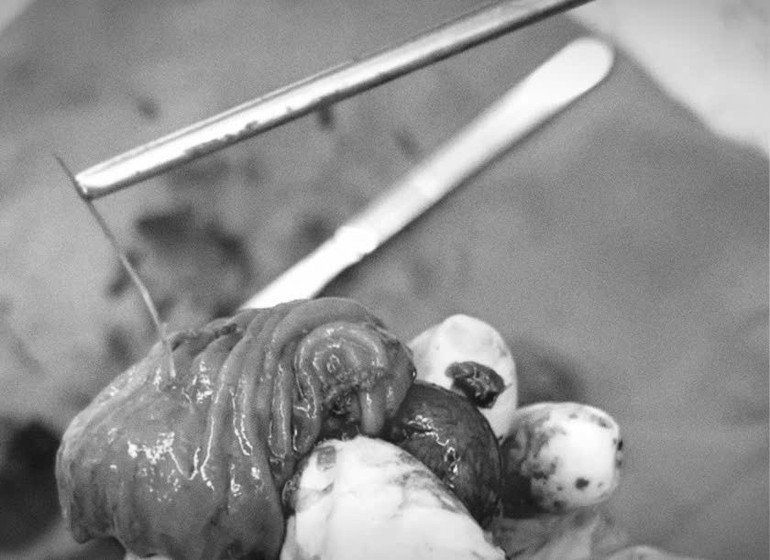
Dr. Nguyen Minh Trong, Director of the Center, said that in most cases of swallowing fish bones, the foreign object is usually expelled naturally. However, with abnormally shaped fish bones, they can become lodged in the wall of the small intestine and gradually penetrate deeper, causing perforation, inflammation, pain, and abscess formation.
Dr. Trong emphasized that fish bones can harm the digestive tract due to their piercing and stabbing mechanism, leading to dangerous complications such as: abscesses and esophagitis if lodged in the esophagus; perforation of the stomach, small intestine, or large intestine. More seriously, bones can puncture surrounding organs or cause peritonitis (abdominal infection), threatening life and making treatment difficult. People need to be extremely cautious when eating fish, especially those with many bones.
If you suspect you have swallowed a fish bone and experience symptoms such as abdominal pain, fever, or prolonged discomfort, you should immediately seek medical attention for early detection of the foreign object.
Source: https://nhandan.vn/ap-xe-o-bung-vi-xuong-ca-dai-4cm-dam-thung-ruot-non-post910124.html

![[Video] Sunset at Lap An Lagoon – Where the sun sets over the fishing nets](https://vphoto.vietnam.vn/thumb/1200x675/vietnam/resource/IMAGE/2026/05/31/1780187239592_2222.jpeg)










![[Video] Sunset at Lap An Lagoon – Where the sun sets over the fishing nets](https://vphoto.vietnam.vn/thumb/800x450/vietnam/resource/IMAGE/2026/05/31/1780187239592_2222.jpeg)

















































































Comment (0)