


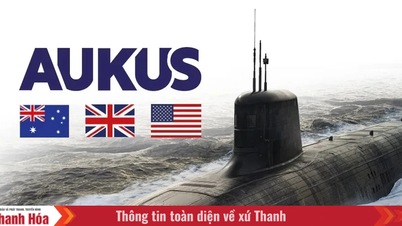
In recent years, AUKUS has focused its investment on nuclear submarines for Australia - Photo: The Week
At the recently concluded Shangri-La Dialogue 2026 in Singapore, the AUKUS alliance, comprising the US, Australia, and the UK, announced a project to develop a next-generation unmanned underwater vehicle (UUV) – marking the first time the alliance's second pillar has been realized through a concrete collaborative program after a long period of delay.
Scheduled for deployment starting in 2027, the project aims at three strategic objectives: protecting submarine cable infrastructure, enhancing surveillance of the Indo-Pacific region, and conducting precision strikes against enemy targets.
Talk less, do more.
While much public attention has so far focused on the first pillar – the plan to supply Australia with nuclear-powered submarines – the second pillar, which focuses on developing sophisticated military technology, has been largely neglected. The recently announced UUV project is the first program under this pillar to be officially formalized, according to a statement from the UK Ministry of Defence .
A joint statement by the three Defence Ministers, Pete Hegseth (US), John Healy (UK), and Richard Marles (Australia), following a meeting on the sidelines of the Shangri-La Dialogue, stated that the project aims to "significantly enhance the capabilities of AUKUS partners in protecting critical national infrastructure on the seabed; deploying advanced surveillance, reconnaissance, and strike capabilities; logistics; and strengthening advantages in anti-submarine warfare, anti-surface ship warfare, anti-mine warfare, electronic warfare, and exercises in disputed coastal areas."
The UK was the first to announce specific figures: at least £150 million (approximately $201.8 million) to equip AUKUS partners with the capacity to detect, deter, and respond to maritime threats, particularly targeting underwater cables and pipelines.
"This is an unprecedented breakthrough in the AUKUS partnership," said Mr. Healy. Neither Australia nor the U.S. has publicly committed to a similar figure until now.
Technically, documents published by the UK Ministry of Defence indicate the project will enhance interoperability through common standards, a framework concept for tripartite operations, and a common control system, aiming for interchangeable equipment that can be integrated by each nation before joint development and production.
Mr. Marles called the program "extremely important" and confirmed that the new technology would be delivered starting in 2027, while Mr. Hegseth emphasized that the next-generation UUVs would help the three countries maintain their "collective advantage" in technology.
Summarizing the spirit of the entire project, Mr. Healy said: "For too long with AUKUS, we have talked too much and done too little."
Hidden rivals
Although AUKUS officials did not name any specific country, the geopolitical context behind the project is quite clear. Mr. Marles had previously warned of a series of underwater cable cuts in the Baltic Sea and near Taiwan, and said that if this was intentional, some countries might be "testing our political will to respond."
Justin Bassi, head of the Australian Strategic Policy Institute, told ABC that the new statement "sends a signal that acts of sabotage and aggression on the seabed will no longer be tolerated by AUKUS nations."
Both pillars of AUKUS are widely seen as a U.S.-led effort to counter Beijing's assertiveness in disputed areas such as the South China Sea.
China has repeatedly called AUKUS "dangerous" and warned that the alliance's programs could provoke a regional arms race.
A vast amount of global data and communications flows through undersea cables – now vital lifelines for most countries around the world – making the protection of this infrastructure an increasingly strategically important task that cannot be overlooked.
Nuclear submarines: Australia adjusts procurement plans.
The joint statement at the Shangri-La Dialogue 2026 also announced adjustments to Australia's plan to purchase Virginia-class submarines under the first pillar of AUKUS.
Accordingly, Australia will streamline the contract by simplifying supply chain management, reducing operational and maintenance requirements, and maximizing cost efficiency.
This change allows Australia to purchase three Virginia-class ships already in service with the US Navy, instead of the previously planned mixed purchase of two active Block IV ships and one new Block VII ship.
Australia will continue to work with the UK to develop the SSN-AUKUS class submarines, which are expected to enter service in the 2040s.
Source: https://tuoitre.vn/aukus-lien-minh-ngam-va-cuc-dien-day-bien-20260531233145094.htm





























![[Photo] Reception to welcome General Secretary and President To Lam and his wife on their State visit to the Philippines](https://vphoto.vietnam.vn/thumb/1200x675/vietnam/resource/IMAGE/2026/06/01/1780295488620_vna-potal-chieu-dai-chao-mung-tong-bi-thu-chu-tich-nuoc-to-lam-va-phu-nhan-tham-cap-nha-nuoc-toi-philippines-8798060-7855-jpg.webp)





























































Comment (0)