

The Ministry of Transport is seeking opinions on three scenarios for a high-speed North-South railway, including two scenarios with a speed of 350 km/h for passenger transport only and a reserve for freight transport.
Scenario 1 involves investing in the construction of a new double-track, 1,435 mm gauge, 1,545 km long North-South high-speed railway with a design speed of 350 km/h and a load capacity of 17 tons per axle, operating only passenger trains. The existing North-South railway line would be upgraded to transport freight, tourists , and short-distance passengers. The total investment would be approximately US$67.32 billion.
According to the consulting firm, the advantage of this scenario is lower land acquisition and investment costs compared to the other two options, but it lacks the capacity to increase if freight demand on the existing railway line becomes overloaded. International freight connectivity is also unfavorable because all countries use 1,435 mm gauge rails.
Scenario 2 involves constructing a new double-track North-South railway line with a 1,435 mm gauge, a load capacity of 22.5 tons per axle, and shared operation for both passenger and freight trains. The design speed would be 200-250 km/h, with freight trains running at a maximum speed of 120 km/h. The existing North-South railway line would be modernized to specialize in freight, tourist passenger transport, and short-distance passenger travel. The total investment is estimated at approximately US$72.02 billion.
The advantage of scenario 2 is that it transports both passengers and goods on the same route. International connectivity is convenient, but the traffic speed is low.
Scenario 3 involves investing in a double-track North-South railway line with a 1,435 mm gauge, a load capacity of 22.5 tons per axle, a design speed of 350 km/h, operating passenger trains and providing a reserve for freight transport when needed. The total investment for the project is $68.98 billion. If infrastructure, equipment, and vehicles for operating North-South freight trains are also invested, the project investment would be approximately $71.69 billion.
Under this scenario, the North-South high-speed railway line would be completely rebuilt, with 60% being bridges, 10% tunnels, and 30% running on ground. The entire line would have 23 passenger stations, 5 maintenance and repair areas, 40 infrastructure maintenance facilities, 5 freight stations, and 28 km of connecting lines to operate freight trains when freight demand exceeds operating capacity.
The advantage of scenario 3 is that the trains are dedicated to passenger transport, resulting in high speed, comfort, safety, and competitiveness with other modes of transport. The market share of transport on the North-South corridor is restructured in a more optimal way. Furthermore, this option has the potential to transport goods in case the capacity of the existing North-South railway line is overloaded.
However, the drawback of this scenario is the high investment cost, and the greater the speed difference between passenger and freight trains, the lower the throughput capacity.
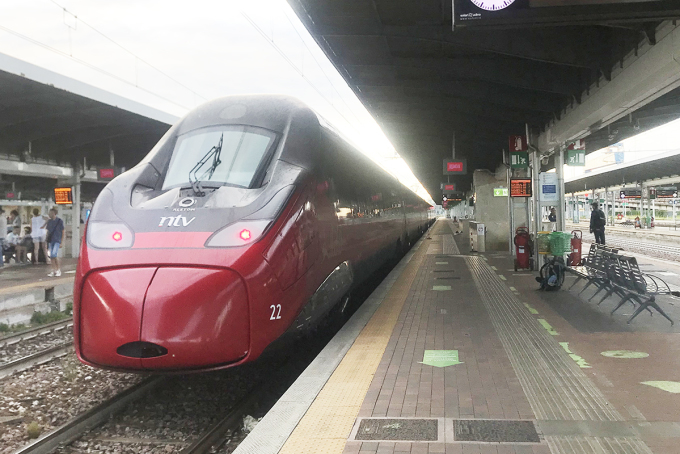
High-speed rail in Europe reaches speeds of approximately 200 km/h. Photo: Anh Duy
In its recent comments, the Ministry of Construction selected scenario 3 and proposed that the Ministry of Transport coordinate with localities through which the project runs to maintain the agreed-upon route alignment when developing provincial plans, avoiding adjustments that would increase investment costs. The Ministry also noted that the project's investment costs amount to tens of billions of USD, so to ensure feasibility, the Ministry of Transport needs to supplement the legal basis for its preliminary proposal of total investment capital.
Thus, compared to previous proposals, the Ministry of Transport has added scenario 3. Previously, in 2019, the Ministry submitted to the Government a pre-feasibility report for the North-South high-speed railway project. This is a double-track line with a 1,435 mm gauge, electrified, with a design speed of 350 km/h and an operating speed of 320 km/h.
At the end of 2022, the project appraisal consultant pointed out several drawbacks of investing in a 350 km/h high-speed railway and recommended a hybrid option for both passenger and freight trains, with an operating speed of 225 km/h for passenger trains and 160 km/h for freight trains, at an investment of over 61 billion USD. The Government Party Committee and the State Appraisal Council requested the Ministry of Transport to further study this option.
In early October 2023, the Prime Minister established the Steering Committee for the construction and implementation of the North-South high-speed railway investment plan, assigning the Ministry of Transport as the permanent agency to gather opinions from committee members on investment scenarios. At the Steering Committee meeting at the end of October, Deputy Prime Minister Tran Hong Ha, head of the committee, stated that the development of the North-South high-speed railway must be synchronized, modern, and in line with global trends, with a design speed of 350 km/h.
Regarding the timeline, the Politburo's conclusion sets the goal of completing the approval of the investment policy for the North-South high-speed railway project by 2025 and commencing construction before 2030. The Hanoi-Vinh and Ho Chi Minh City-Nha Trang high-speed railway sections are prioritized for commencement in the 2026-2030 period; striving to complete the entire North-South high-speed railway line before 2045.
Source link

![[Image] Hanoi's urban life under the challenge of a "scorching hot" environment](https://vphoto.vietnam.vn/thumb/1200x675/vietnam/resource/IMAGE/2026/05/25/1779706979265_nang-nong-t5-2026-minh-duy-7-4636-jpg.webp)


![[Image] Close-up view of the interchange connecting the two expressways and Long Thanh Airport.](https://vphoto.vietnam.vn/thumb/1200x675/vietnam/resource/IMAGE/2026/05/25/1779703378210_ndo_br_z7863716673926-224453a31600126cce10622af6290afd-4549-jpg.webp)






















































































Comment (0)