

Despite being in the peak of the dry season, the 24 cows and goats belonging to Mr. Kadá Khôi's family in Ma Ty village, Phước Thắng commune, still have enough food. Mr. Khôi shared: "Previously, my family's herd mainly grazed in the open air, and during the dry season, the lack of food caused their health to deteriorate. For the past two years, taking advantage of the water resources in reservoirs, I decided to plant one sao (approximately 1000 square meters) of elephant grass to supplement the fresh feed for the herd. In addition, during the dry season, I categorize the herd to provide appropriate care; those with poor health are moved to confinement and given a separate diet. Thanks to this, the herd is developing normally."
Like Mr. Khoi's family, thanks to proactively securing fresh feed and stockpiling dry straw and corn stalks, Mr. Katơr Lơn's herd of 9 cows and goats in Dong Day village, Phuoc Trung commune, is thriving. Mr. Lơn said: "During the dry season, the herd often suffers from malnutrition due to lack of food and the emergence of parasitic diseases, liver flukes, etc. At the beginning of 2024, I sold off 4 bulls, rebuilt the barns to proper standards, and planted more elephant grass as fresh feed for the herd. In addition, I stockpiled dry straw, rice bran, and molasses to supplement the animals' nutrients, so the herd is developing normally."
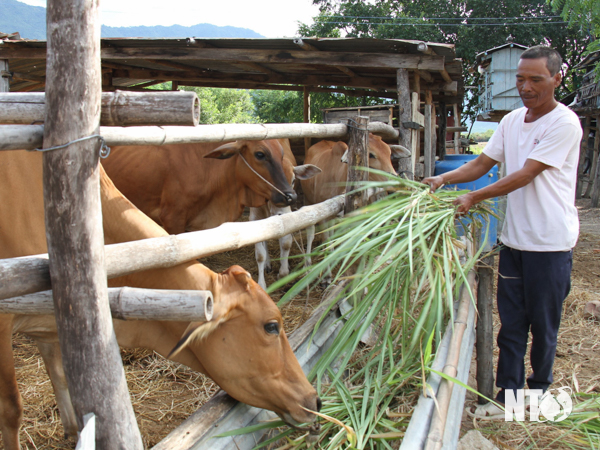
Thanks to proactively securing a source of green fodder, the livestock of Mr. Kadá Khôi's family in Ma Ty village thrived during the dry season.
Livestock farming is the main source of income for people in the mountainous district of Bac Ai. However, during the dry season, livestock farming faces difficulties due to a shortage of feed for the herds. To help people change their farming practices, in recent years, Bac Ai district has regularly coordinated with the Department of Livestock and Veterinary Medicine to organize training courses on livestock farming techniques for people to apply in practice. As a result, many households have mastered livestock farming techniques, enabling them to promptly detect diseases in their herds and proactively treat them.
In addition, to help people improve the efficiency of livestock farming, some communes have implemented the model "Each family has one enclosed barn for raising cattle, combined with growing grass for cattle farming." This model has attracted the participation of many households in the localities. Through this, it helps people change from small-scale, scattered farming to concentrated farming, contributing to improving the quality of the cattle herd and protecting the green and clean environment in the locality. Mr. Dao Van Linh, Vice Chairman of the People's Committee of Phuoc Trung commune, said: The commune actively propagates and encourages livestock farmers to implement solutions to minimize the possibility of cattle malnutrition during the dry season, focusing on growing grass, stockpiling sufficient feed, and supplementing nutrients for cattle to maintain herd stability. As a result, the cattle herd in the commune is currently developing stably.
Currently, the total number of horned cattle in Bac Ai district is over 43,840; including over 1,690 buffaloes, over 24,800 cows, and over 17,840 goats and sheep. Thanks to the proactive efforts of the people in stockpiling feed and providing proper care from the beginning of the dry season until now, the cattle population has not suffered any losses or outbreaks of disease.
Kha Han
Source


![[Infographics] - 5 types of money transferred into personal accounts that are subject to tax.](https://vphoto.vietnam.vn/thumb/402x226/vietnam/resource/IMAGE/2025/7/11/18141e7ce49d4ad2815e79e2084362f1)


















![[Photo] Prime Minister Pham Minh Chinh presides over the conference announcing the establishment of the International Finance Centre in Vietnam.](/_next/image?url=https%3A%2F%2Fvphoto.vietnam.vn%2Fthumb%2F1200x675%2Fvietnam%2Fresource%2FIMAGE%2F2025%2F12%2F21%2F1766309817714_ndo_br_dsc-3400-jpg.webp&w=3840&q=75)
























































Comment (0)