

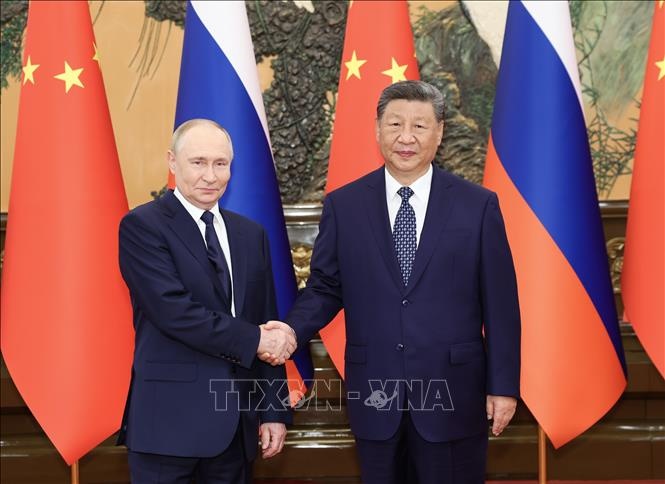
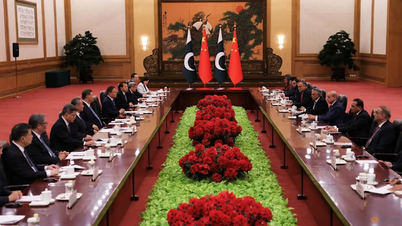
Exactly two years later, Russian President Vladimir Putin will pay an official visit to China on May 19-20. This will be the 20th visit to China by the Russian leader, taking place against the backdrop of bilateral relations described as being at an "unprecedented high" in history.
The South China Morning Post noted that the visit was part of regular contacts between Moscow and Beijing, to the point that there was no official welcoming ceremony or large-scale parade as is customary.
However, Putin's visit to Beijing just days after US President Donald Trump left China for a state visit drew particular attention to the Russia-China-US triangle, a complex web of competition and interests among the three superpowers that have shaped the global order in recent times.
In Beijing, President Putin and Chinese President Xi Jinping are expected to discuss not only bilateral relations but also seek to deepen their "comprehensive strategic partnership without limits."
The visit coincides with the 25th anniversary of the Russia-China Treaty of Friendship and Cooperation, and the two leaders will also attend the opening ceremony of the Russia-China Education Year 2026-2027.
According to the agenda, the leaders of the two countries will exchange views on key issues in bilateral relations, identify directions for strengthening strategic cooperation, and coordinate positions on regional and international issues.
The two sides are expected to adopt a high-level joint statement and sign several intergovernmental and inter-ministerial documents. President Putin will also meet with Chinese Premier Li Qiang to discuss prospects for trade and economic cooperation.
Kremlin spokesman Dmitry Peskov emphasized that the top priority of the visit was to strengthen the "special" bilateral relationship, in which economic and trade cooperation continues to play a central role. Energy and machinery are currently the cornerstones of Russia-China economic relations.
Russia exports oil, gas, coal, electricity, and timber to China, while importing machinery, equipment, and consumer goods from the world's second-largest economy. Russia is currently China's largest gas supplier, accounting for approximately 30% of Beijing's gas imports, and is also the leading exporter of oil to China, accounting for about 18%.
Amidst escalating Western sanctions related to the Ukraine conflict, the Chinese market is increasingly becoming a "lifeline" for the Russian economy. However, this also gives rise to new challenges in bilateral relations.
Starting in late 2024, the US began imposing sanctions on Chinese companies accused of collaborating with Russia in the defense sector, including the production of unmanned aerial vehicles (UAVs).
Under President Donald Trump, secondary sanctions continued to expand. In September 2025, the US Department of Commerce imposed export restrictions on several companies suspected of supplying goods to Russia, including about 20 Chinese businesses.
Another factor causing Moscow considerable concern is Chinese President Xi Jinping's recent commitment during President Donald Trump's visit last week to increase oil purchases from the United States.
Against the backdrop of Russia's energy exports facing significant pressure from sanctions and the global transport crisis, this move has created a degree of caution from Moscow, even though the Kremlin insists that Russia is not "playing a triangular game" in its relations with the US and China.
In his welcoming message at the 10th Russia-China EXPO in Harbin (Heilongjiang, China) on May 17, President Putin emphasized that this year's event fully reflects the high dynamism of the comprehensive partnership and strategic cooperation between Russia and China.
While the Russian President emphasized that the two countries could overcome any obstacles together, Russian Deputy Prime Minister Yury Trutnev made a highly metaphorical statement, saying, "Russia brought crabs and honey to Expo, while China brought UAVs and robots."
This statement partly reflects the increasingly clear gap in technological capabilities between the two countries. This is considered a rare "shadow" in current Moscow-Beijing relations. Despite being in sync on many international issues and coordinating to overcome pressure from the West, Russia still needs to strive to avoid becoming overly dependent on China, especially in high-tech fields.
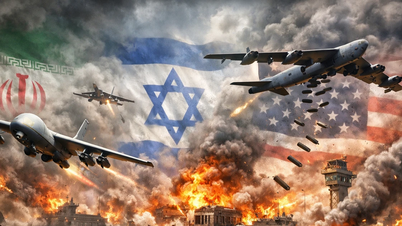
In contrast to the "seesaw" nature of their economic cooperation, Russia and China have virtually no significant differences on major international issues. Iran is expected to be a central topic in these discussions.
Moscow and Beijing both argue that Tehran should not possess nuclear weapons, and emphasize that the Strait of Hormuz must be kept open for international navigation. However, both also oppose using these reasons to justify military action against Iran.
Regarding the Ukraine issue, Russia and China continue to express similar views, both calling for a peaceful solution. The United States and the European Union (EU) hope that Beijing will pressure Moscow, but China shows no sign of being willing to use that leverage.
Part of the reason lies in Beijing's need to ensure energy security amid the growing risk of disruptions to shipping through the Strait of Hormuz. At the same time, China also needs Russia's support in the face of tensions related to Taiwan.
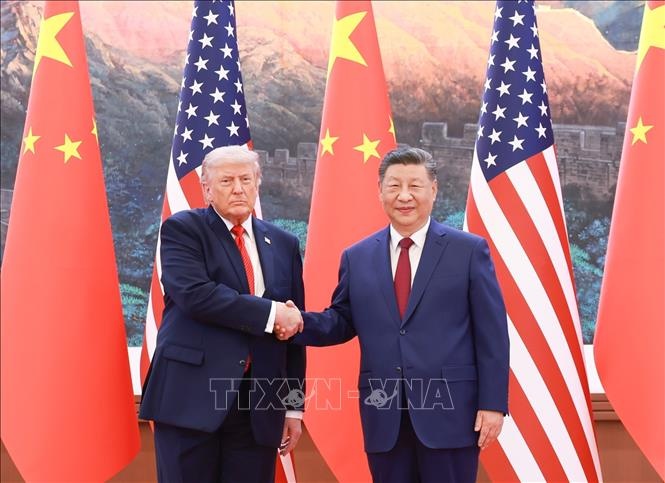
Commenting on the visit, the Spanish newspaper El Mundo noted that Putin's arrival in China immediately following US President Donald Trump's visit was an affirmation that relations with Russia remain a priority in Beijing's foreign policy.
According to this newspaper, despite the tactical rapprochement with Washington, the strategic alliance with Moscow remains one of China's main pillars.
Meanwhile, some Russian experts suggest that the early and unexpected visit indicates that the leaders of the two countries may need to consult directly on some urgent issue. Professor Marat Bashirov, a political science professor at the Hong Kong School of Economics, commented that this was an "urgent" consultation, unlikely to have been conducted solely over the phone.
Despite much speculation, this visit sends a clear message: Moscow-Beijing relations have become so "normal" and close that they no longer depend on ostentatious diplomatic formalities.
Against the backdrop of a world that continues to be polarized and increasingly fierce strategic competition, the coordination between Russia and China is predicted to remain one of the major variables in the current international landscape.
Source: https://znews.vn/bac-kinh-diem-hen-chien-luoc-my-trung-nga-post1652419.html



![[Image] Hanoi's urban life under the challenge of a "scorching hot" environment](https://vphoto.vietnam.vn/thumb/1200x675/vietnam/resource/IMAGE/2026/05/25/1779706979265_nang-nong-t5-2026-minh-duy-7-4636-jpg.webp)
![[Image] Close-up view of the interchange connecting the two expressways and Long Thanh Airport.](https://vphoto.vietnam.vn/thumb/1200x675/vietnam/resource/IMAGE/2026/05/25/1779703378210_ndo_br_z7863716673926-224453a31600126cce10622af6290afd-4549-jpg.webp)








































































Comment (0)