

Waste of public resources
According to the initial plan, the commune-level post office -cultural centers provided public postal and newspaper delivery services; carried out postal financial services such as money transfer, collection and disbursement; participated in providing public administrative services; paid pensions, social welfare benefits, and preferential treatment for meritorious individuals; provided essential goods, distributed publications, and insurance… These were once familiar addresses for rural people for many years.
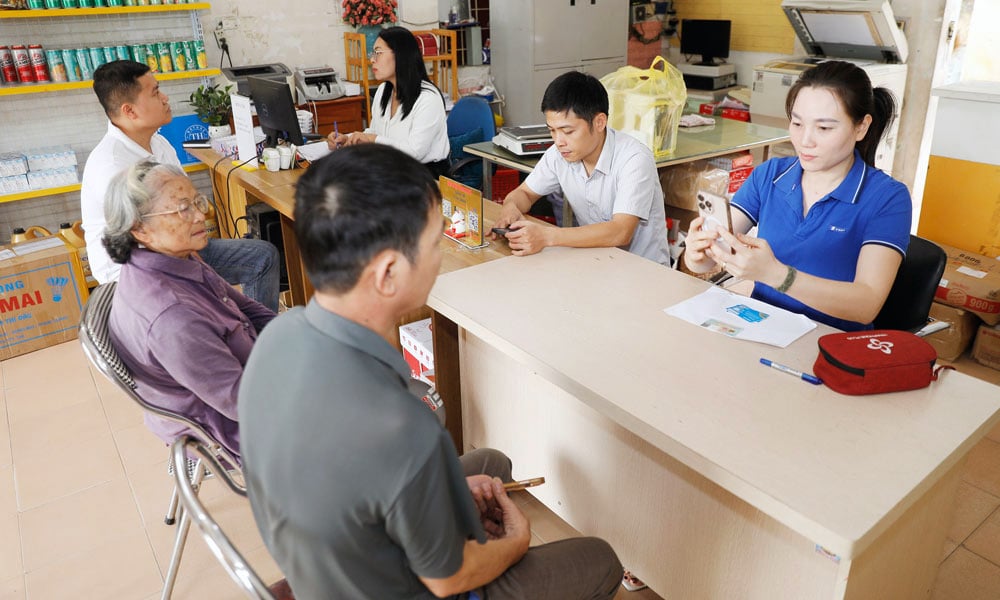 |
VNPT Bac Ninh staff assist residents in verifying mobile phone subscriber information at the Post Office - Cultural Center in Song Mai commune (Da Mai ward). |
However, after nearly 30 years of operation, many commune-level postal and cultural centers no longer fulfill their former roles. The province currently has 367 service points, of which 345 are operational, including 295 commune-level postal and cultural centers and 50 post offices. In reality, dozens of these points have ceased operations, and many operate with low efficiency.
Observations at the Huong Lac Commune Post Office - Cultural Center in Tu village (Lang Giang commune) on the morning of April 24, 2026, showed that the building was dilapidated, with peeling walls, faded signs, damaged fences, and overgrown weeds. Despite being past morning working hours, the center remained closed. When contacted by phone, the person in charge stated that they were still distributing public service newspapers, pension payments, and collecting electricity bills, but did not know the exact number of newspapers distributed each day...
At the Tam Son Commune Post Office - Cultural Center in Tan Son village (Tan Dinh commune), the situation is even more serious. This location has been abandoned for a long time, with moss-covered walls, a rusty iron gate, and weeds growing taller than a person's head in the yard.
Not only in Huong Lac or Tam Son, but after the administrative boundary merger, the number of commune-level post offices and cultural centers has become excessive. Mr. Nguyen Van Dong, Chairman of the People's Committee of Tam Tien commune, said that the commune currently has three post offices and cultural centers, but all three are practically closed because people have no need to use them for transactions. This situation leads to worrying consequences: State-invested infrastructure is left unused; land used to build these post offices and cultural centers in prime locations remains undeveloped; workers lack stable income; and the state budget suffers losses.
Innovation, autonomy, and integration with digital transformation.
The biggest reason for the inefficiency of many community post offices and cultural centers stems from the rapid development of digital technology . The internet, smartphones, social media, and e-commerce platforms have fundamentally changed the way people access information and use services. Meanwhile, many administrative procedures have shifted to an online environment, allowing people to complete them from home.
Another reason is the slow pace of innovation in operating models. Many community post offices and cultural centers still operate in the old way, only maintaining newspaper delivery and pension payment services, lacking new services to generate revenue.
| The province currently has 367 service points, of which 345 are operational, including 295 commune-level post office-cultural centers and 50 post offices. In reality, dozens of these points have ceased operation, and many are operating with low efficiency. |
In reality, this model can still be effective if it adapts. The Song Mai Commune Post Office - Cultural Center (now part of Da Mai Ward) is a prime example. In addition to its mandated duties, the center offers general merchandise services, introduces and sells OCOP products, receives and delivers mail, and provides photocopying services. Thanks to its diverse services, the center is always busy.
Ms. Nguyen Thi Van, in charge of the Post Office - Cultural Center in Song Mai commune, said: "The center is open during office hours and also on Saturdays, which allows us to proactively manage revenue and achieve financial independence."
Looking at the model of the Song Mai Post Office - Cultural Center, the key issue in "reviving" these community post offices is shifting from a "public service point" mindset to a "multi-functional service point" that is self-reliant and capable of generating revenue. Accordingly, the postal sector needs to restructure its operations to better meet the needs of the people: simultaneously providing postal and administrative services, developing commerce and consumer goods, and embracing digital transformation. To meet the immediate human resource needs, by 2025, the provincial postal service has trained over 160 staff members in communication skills and a sense of responsibility to guide, advise, and support people in using public postal services for receiving applications and delivering results.
Ms. Nguyen Thi Giang, Director of the Provincial Post Office, stated: 2026 is designated as the year of "acceleration - breakthrough - action," marking the beginning of a new development phase from 2025 to 2030. Therefore, the postal sector must shift from consolidation to substantial growth. Following the direction of the Vietnam Post Corporation, the Provincial Post Office is promoting the development of the postal-cultural network in communes according to the model of "strong - substantial - self-reliant." This year, the entire province aims to successfully implement 50 self-reliant points, operating as independent business units, with proactive financial, human resource, and market capabilities.
Simultaneously, the unit is implementing the Post Office Department Store project across a total of 367 service points, striving to put 20 points into operation, supplying essential goods and OCOP products to serve rural consumption needs. At the same time, it is promoting e-commerce and postal delivery services, turning the commune-level post office-cultural center into a hub to support people in online business and connect them with the consumption of local goods.
In the context of rapid digital transformation, reviving community post offices and cultural centers requires innovative operational methods, focusing on practical needs. When these centers become multi-functional service stations, it not only avoids wasting public investment but can also continue to make practical contributions to serving the lives of rural people in the digital age.
Source: https://baobacninhtv.vn/bac-ninh-hoi-sinh-diem-buu-dien-van-hoa-xa-postid444744.bbg



















































































Comment (0)