

Clearly identify the potential.
Cam Son Lake is located in Tan Son and Son Hai communes (Bac Ninh province) and part of Lang Son province. With a capacity of approximately 250 million cubic meters, it is one of the five largest irrigation works in the country. Mr. Hoang Quoc Bao, Director of Bac Song Thuong Irrigation Works Exploitation One-Member Limited Liability Company, stated: The unit is directly managed by the Provincial People's Committee. The lake ensures irrigation water for over 24,000 hectares of cultivated land in several communes and wards of Bac Ninh and Lang Son provinces. The freshwater source here has good quality and a stable flow rate, so DNP Water Infrastructure Investment Joint Stock Company - Bac Giang has exploited it to supply drinking water to thousands of households living in several urban areas, residential areas, and rural areas in the province, with an exploitation capacity ranging from 20,000 cubic meters/day to 80,000 cubic meters/day, making a significant contribution to ensuring clean water for daily life.
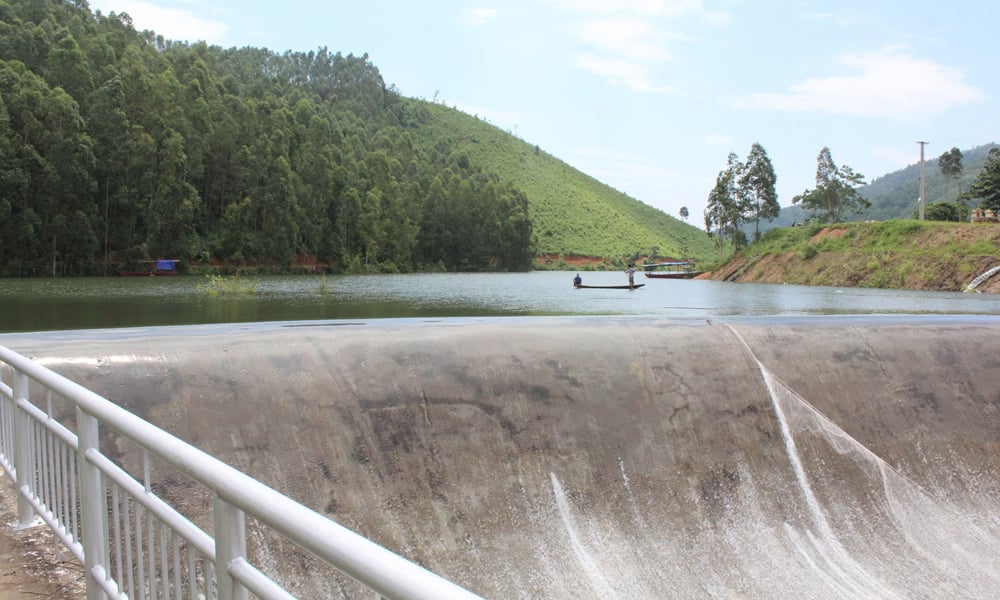 |
Cam Son Lake plays a role in regulating water levels, providing water for domestic use, and supporting tourism development. |
Similar to Cam Son Lake, other major irrigation projects such as Khuon Than Lake, Bau Lay Lake, Cay Da Lake, Va Khe Lake, etc., not only store water but also attract tourists with their majestic scenery and towering mountains. In recent years, the transportation system has been improved and upgraded, making it convenient for vehicles to travel to villages and hamlets in the lake area. Taking advantage of this, many cooperatives have developed experiential tourism with activities such as boating, fishing, enjoying local cuisine , and learning about the culture and customs of the local ethnic minorities.
The province currently has over 584 km of dikes (levels I-V), 1,400 pumping stations, 274 reservoirs, 203 diversion dams, and 12,000 km of canals and ditches; some large reservoirs include: Cay Da, Khoanh Song, Cau Cai, Cua Coc, Va Khe; and key dike routes such as the right bank of Thai Binh River, left bank of Cau River, right bank of Cau River, left bank of Thuong River, and right bank of Thuong River. The irrigation system plays a crucial role in disaster prevention and control, protecting infrastructure, industrial zones, agricultural production, and people's lives. Thanks to investment from the central and local governments, many projects have been upgraded to multi-purpose needs, basically meeting the needs for irrigation, drainage, and domestic water supply. 100% of the dikes have been asphalted or concreted, ensuring flood control and serving as vital transportation routes in rural areas.
Mr. Ngo Xuan Hiep, Chairman of the People's Committee of Trung Kenh commune, said: "The right bank dike of the Thai Binh River, which runs through the commune, is over 7 km long and 7-13 m wide, and has been 100% reinforced. 'Proximity to the road and proximity to the river' – convenient transportation is the driving force for the local area to develop livestock farming with over 202 hectares of aquaculture in earthen ponds, 657 fish cages on the Thai Binh River; waterway transport services; rice and crop cultivation, creating jobs and income for rural people."
Multi-purpose investment
Despite investment and attention, limited resources have resulted in inadequate irrigation infrastructure in the province. Many pumping stations, reservoirs, and dams built in the 1970s and 1980s have deteriorated and have not been repaired in a timely manner. Every year, localized water shortages occur in some areas due to the limited capacity of irrigation systems to draw and store water. In the mountainous Son Dong commune (formerly Vinh An commune and An Chau town), the location of irrigation facilities is not in line with the local development plan, resulting in localized water shortages for residents for 2-3 months each year.
| The province currently has over 584 km of dikes (levels I-V), 1,400 pumping stations, 274 reservoirs, 203 diversion dams, and 12,000 km of irrigation and drainage canals. Some large reservoirs include: Cay Da, Khoanh Song, Cau Cai, Cua Coc, Va Khe; and key dike routes such as the right bank of Thai Binh River, left bank of Cau River, right bank of Cau River, left bank of Thuong River, and right bank of Thuong River. |
In July 2023, the Prime Minister issued Decision No. 847/QD-TTg approving the Master Plan for Disaster Prevention and Irrigation for the period 2021-2030, with a vision to 2050. This is a comprehensive plan aimed at protecting people, property, and production from the impacts of natural disasters, ensuring efficient water supply and drainage for daily life, agricultural production, industry, services, tourism, combined with aquaculture, and environmental protection. Following the central government's directives, the Irrigation Sub-Department (under the Department of Agriculture and Environment) annually inspects, reviews, and assesses the current status and operational capacity of irrigation works. The unit compiles a list of degraded and damaged works and recommends that the province and relevant agencies prioritize their renovation, repair, and upgrading.
Comrade Dang Cong Huong, Deputy Director of the Department of Agriculture and Environment, emphasized: The department will continue to advise the province on investing in and renovating irrigation works in a multi-purpose direction, exploiting multiple values. This solution requires a very large amount of funding. Therefore, the unit proposes that the Provincial People's Committee mobilize all resources from the local budget, the central government, and social contributions from businesses, cooperatives, and individuals who directly benefit. Regarding the Cam Son reservoir project, the Bac Song Thuong Irrigation Works Exploitation One-Member Limited Liability Company is reinforcing the upstream slope of the dam, repairing the spillway body, and paving the upstream slope of spillway No. 1 with stone. When put into use (expected before December 15, 2025), it will provide strong support to the enterprise in the process of managing and regulating floods, and storing water for production and daily life.
With dilapidated dikes and pumping stations, the province has requested the central government to consider providing urgent funding for the upgrading of the entire left dike of Cau River and the pumping stations: Vong Nguyet 2, Cam Bao, Ngo Khong, Cong Bun, Thai Son 1, 2, 3, Quang Bieu... with a total budget of over 3.2 trillion VND.
Building and expanding multi-purpose irrigation systems helps Bac Ninh ensure safety in disaster prevention and control, and proactively secure water resources for production and daily life. This is also a new direction that opens up opportunities for green and sustainable economic development, in line with disaster prevention and control planning, contributing to protecting and improving the quality of life for the people.
Source: https://baobacninhtv.vn/bac-ninh-khai-thac-da-nganh-tu-thuy-loi-postid424578.bbg


![[Photo] Prime Minister Pham Minh Chinh holds a phone call with the CEO of Russia's Rosatom Corporation.](/_next/image?url=https%3A%2F%2Fvphoto.vietnam.vn%2Fthumb%2F1200x675%2Fvietnam%2Fresource%2FIMAGE%2F2025%2F12%2F11%2F1765464552365_dsc-5295-jpg.webp&w=3840&q=75)
































































Comment (0)