

To ensure food hygiene and safety, and protect consumer health, the Livestock, Veterinary and Fisheries Sub-Department (Bac Ninh Department of Agriculture and Environment) has recently intensified animal quarantine and slaughter control activities, focusing on inspecting illegal slaughterhouses, strictly handling violations of veterinary hygiene, closely quarantining meat products, and increasing inspections at markets and points of sale for animals, livestock, and poultry.
Root management
The Tien Thinh Livestock and Farming Production Cooperative (Dao Vien Ward), headed by Mr. Dao Viet Xue, regularly raises 1,500-2,000 pigs for meat. To enhance product value, in addition to safe farming practices, the cooperative has invested in a semi-industrial slaughtering line with a capacity of 40 pigs per day. With a relatively complete slaughtering line, the facility has been granted a slaughter control code by the Department of Livestock, Veterinary and Fisheries. According to Mr. Nguyen Van Hung, a veterinary officer overseeing the facility's operations, all pigs undergo quarantine before slaughter, and the slaughtering process complies with all legal regulations.
|
Workers at Sonchickens Food Processing Co., Ltd. in Viet Yen ward sort chicken meat products. |
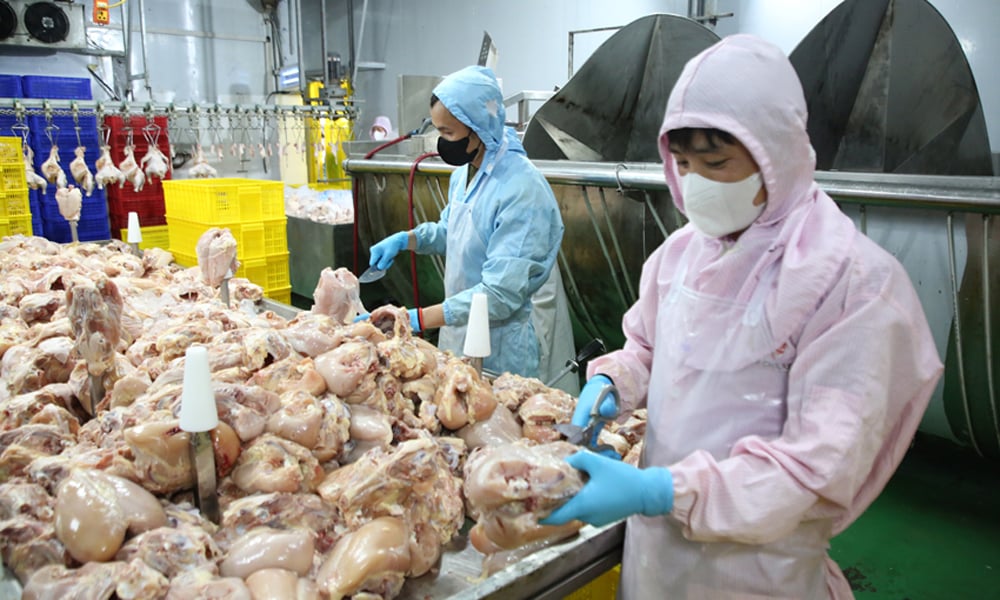
The CP pig sales center in Viet Yen ward handles the daily collection, transfer, and sale of 300-500 pigs from provinces such as Lang Son, Phu Tho, and Hung Yen , thus posing a high risk of disease outbreaks and transmission. To prevent disease, the import, export, and sale procedures are strictly implemented. According to Ms. Nguyen Thi Huong, an officer from the Quarantine Department of the Provincial Department of Animal Husbandry, Veterinary Medicine, and Fisheries, all incoming pigs, transport vehicles, and customers entering and leaving the center are thoroughly cleaned, disinfected, and strictly controlled.
The Phu Thanh DT Limited Company's food processing plant in Tam Tien commune specializes in slaughtering and supplying poultry products to businesses and schools inside and outside the province, with a capacity of 3,000 poultry per day. According to Mr. Do Danh Duy, the plant's director, the poultry brought in for slaughter is imported from affiliated farms with quarantine certificates, and has undergone checks for antibiotic residues and harmful microorganisms, minimizing the risk of food contamination. The plant is equipped with a semi-industrial slaughtering line currently with a capacity of 1,000 birds per day, and the processed products supplied to the market undergo quarantine and veterinary hygiene inspections.
Close monitoring
Bac Ninh has a large livestock and poultry population. In recent years, the province has actively promoted the application of high technology and linked production chains to ensure disease safety, food safety, improve capacity, quality, economic efficiency, and reduce environmental pollution. The province focuses on issuing policies to support the establishment of centralized slaughterhouses, supplying clean livestock products to factories and schools for meals for workers and students. According to statistics from the Department of Livestock, Veterinary and Fisheries, there are currently 1,989 livestock and poultry slaughterhouses in the province. Of these, 7 facilities have been granted slaughter control codes and have veterinary officers directly supervising them, while the rest are small, spontaneously operating facilities in local markets and residential areas.
In 2025, the entire province detected and handled 18 cases of violations in the slaughter and trading of animals (buying and selling dead pigs, transporting dead pigs, trading goods of unknown origin, slaughtering in unauthorized locations, slaughtering equipment and tools not meeting veterinary hygiene requirements, etc.), imposing administrative fines totaling over 160 million VND. |


![[Photo] General Secretary and President To Lam presides over a meeting on preparations for the review of one year of operation of the three-tiered government system.](https://vphoto.vietnam.vn/thumb/1200x675/vietnam/resource/IMAGE/2026/06/02/1780391821195_a1-bnd-4595-9717-jpg.webp)
















![[INFOGRAPHICS] Development goals for rural crafts and industries in the period 2026-2030](https://vphoto.vietnam.vn/thumb/402x226/vietnam/resource/IMAGE/2026/06/02/1780393054323_1780392879.webp)
























































Comment (0)